• Skip to primary navigation
  • Skip to main content
  • Skip to primary sidebar
  • Home
  • About Us
    • Privacy Policy
    • Comment Policy
    • Disclosures & Disclaimers
  • Resources
    • Links, Essays & Articles
    • Fandomology!
    • CLAMP Directory
    • BlogRoll
  • Features & Columns
    • 3 Things Thursday
    • Adventures in the Key of Shoujo
    • Bit & Blips (game reviews)
    • BL BOOKRACK
    • Bookshelf Briefs
    • Bringing the Drama
    • Comic Conversion
    • Fanservice Friday
    • Going Digital
    • It Came From the Sinosphere
    • License This!
    • Magazine no Mori
    • My Week in Manga
    • OFF THE SHELF
    • Not By Manga Alone
    • PICK OF THE WEEK
    • Subtitles & Sensibility
    • Weekly Shonen Jump Recaps
  • Manga Moveable Feast
    • MMF Full Archive
    • Yun Kouga
    • CLAMP
    • Shojo Beat
    • Osamu Tezuka
    • Sailor Moon
    • Fruits Basket
    • Takehiko Inoue
    • Wild Adapter
    • One Piece
    • After School Nightmare
    • Karakuri Odette
    • Paradise Kiss
    • The Color Trilogy
    • To Terra…
    • Sexy Voice & Robo
  • Browse by Author
    • Sean Gaffney
    • Anna Neatrour
    • Michelle Smith
    • Katherine Dacey
    • MJ
    • Brigid Alverson
    • Travis Anderson
    • Phillip Anthony
    • Derek Bown
    • Jaci Dahlvang
    • Angela Eastman
    • Erica Friedman
    • Sara K.
    • Megan Purdy
    • Emily Snodgrass
    • Nancy Thistlethwaite
    • Eva Volin
    • David Welsh
  • MB Blogs
    • A Case Suitable For Treatment
    • Experiments in Manga
    • MangaBlog
    • The Manga Critic
    • Manga Report
    • Soliloquy in Blue
    • Manga Curmudgeon (archive)

Manga Bookshelf

Discussion, Resources, Roundtables, & Reviews

Unshelved

Inside the DMG: Week 5

March 1, 2011 by MJ 9 Comments

In an otherwise quiet period at the Digital Manga Guild, the past week’s highlight for participants was a set of teleconferences with Digital Manga President and CEO Hikaru Sasahara. Guild members were invited to submit one question each for either of the two scheduled teleconferences (Friday, 2/25 at 3pm PST or Saturday, 2/26 at 11am PST), with the understanding that not all could be selected to attend.

As the teleconference dates approached, participants experienced some of the same kinds of glitches we’ve become accustomed to during this process, and which have certainly been a factor in the overall sense that DMP does not have their act together regarding the Guild. Notifications came a day later than promised, at which point some members received duplicate or conflicting information (my e-mail, for example, invited me to attend on Friday the 26th) or, in some reported cases, no notification at all.

Despite these glitches, however, the teleconferences were, in my view, the best idea Digital Manga has had to date in terms of nurturing member interest in the project, thanks largely to the obvious passion and dedication of Mr. Sasahara.

I entered Saturday’s teleconference a few minutes late (thanks to some technical difficulties of my own), missing most introductions of other attending members as well as attending staff, but Digital Manga employees who spoke up during the conference included VP of Production Fred Lui and Lanny Liu (aka starlightmuse on the DMG boards). Though we’ve heard Mr. Sasahara talk before about his plans for the Guild in the video posted on the main DMG page, the teleconference offered him a unique opportunity to convey his deep feelings for the project directly to its participants–an opportunity he leapt at with vigor.

With introductions completed, Mr. Sasahara took the floor to tell us about himself, the dreams he inherited from his father, his journey to the US forty years ago, and “the biggest and most serious project” of his career–the Digital Manga Guild. Another participant has posted a rough transcript of Saturday’s conference, but words alone can’t do justice to the passion and seriousness of Mr. Sasahara’s tone, which I found personally inspiring. Whether the manga industry as a whole will benefit from Mr. Sasahara’s intent to revolutionize the system remains to be seen, but it’s difficult to imagine that anyone attending the teleconference could have remained unmoved by his sincerity. I suspect no small number of us might have marched into the streets with promotional pamphlets and DMG flags, had we been asked to do so at the time, his fervor was that stirring.

Powerful rhetoric aside, between Mr. Sasahara’s opening remarks and the questions asked later by participants, quite a bit of good information came out of the conference. Here are a few particularly enlightening points:

  • Digital Manga has 100 titles already offered up by one of their participating publishers, some of which may be available for groups to work on as early as the end of March.
  • Though distribution of profit among the three participating entities (Japanese publishers, DMP, & localizers) is yet to be finalized, Sasahara is pushing for something in the neighborhood of 12% for localizing groups.
  • Some initial goals in terms of timeline: contracts signed by end of March; production starting in April; first titles to launch by early summer.
  • Packages for groups will be mixed (yaoi, adult titles, classic titles, etc.) with a view towards giving them equal value in terms of potential sales. Distribution of packages will be determined by DMP.
  • Accounting will be completely transparent. Groups will receive regular statements listing how many times each of their titles has been read on each applicable platform (eManga, Kindle, etc.), and what the group’s percentage is from each sale.
  • Though there will be some general guidelines offered up by DMP, localizers will be able to make most decisions in terms of things like honorifics and translation notes based on their own experiences as manga fans, and at their own discretion.
  • Localizers will decide how they wish to be credited on each of the titles they work on.

Mr. Sasahara emphasized over and over throughout the teleconference that the localizers are an incredibly important part of the process, and that he wants us to make money.

DMP representatives have indicated that a recording and/or transcript of the teleconferences will be made available to all, and I recommend that everyone take advantage of that when the time comes. Meanwhile, check out this thread at the DMG boards for detailed notes from those who attended!

ETA: These recordings are now available!


Anyone else who attended have thoughts to share? Any questions I may not have answered completely? Let me know in comments!

Filed Under: UNSHELVED Tagged With: digital manga guild, Inside the DMG

Upcoming 3/2/2011

March 1, 2011 by David Welsh

This week’s ComicList isn’t as loaded as the Midtown Comics version, the source of my current Pick of the Week. Thankfully, Vertical finds a way to make the trip to the comic shop worthwhile.

Redemption comes in the form of the fifth volume of Konami Kanata’s excellent Chi’s Sweet Home (Vertical). In this volume, Chi discovers that she doesn’t need to leave the house to have an adventure. Along the way, she also grasps the importance of being able to feign innocence. Anyone who’s ever lived with a cat will nod in rueful recognition at this development.

Of course, Chi also manages to spend some time in the great, suburban outdoors, making a new friend and relying on some old ones when she wanders well beyond her familiar boundaries. Fun as Chi’s adventures are, and lovely as it is to think about a protective community keeping her safe, I’m very much a partisan of the indoor-only feline experience. It makes me reflexively uncomfortable to see a kitten given that much liberty, no matter how charming the fictional results. Of course, this is why I would be a terrible parent to a human child; they’d never know a moment’s unsupervised peace.

As is usual, Kanata sneaks in some extremely moving moments where hints of Chi’s past life intrude on the way she lives now. These interludes really balance out the sweet charm of the more antic, observational sequences, and they make the book work better than it might have without them. In slice-of-life storytelling like this, a variety of experiences and emotions are always welcome, even for a kitten.

(Remarks are based on a review copy provided by the publisher.)

What looks good to you?


Filed Under: DAILY CHATTER, Link Blogging

Random weekend question: flicks

February 27, 2011 by David Welsh

It’s Oscar night! Can you feel the excitement? I can’t, but I’m kind of a bad gay in that respect. Still, I’ll take the occasion of the movie industry’s biggest night of self-adulation to ask the following: what comic would you like to see adapted into a film that could claim Oscar gold? Put aside your memories of Astro Boy and your fears about Akira and emphasize the positive, if you can.

I think Fumi Yoshinaga’s Ichigenme: The First Class Is Civil Law (DMP) could be made into one of those independent sleeper films that draw unexpected commercial and critical acclaim. And it has hot, smart gays getting it on and none of that maudlin, problem-movie nonsense of Brokeback Mountain. Of course, I can also imagine Makoto Yukimura’s Planetes (Tokyopop) getting turned into some overblown James Cameron thing that doesn’t really resemble the source material but still makes a ton of money.


Filed Under: DAILY CHATTER

Behold the power of emotional peril

February 26, 2011 by MJ Leave a Comment

Once again, it’s time for Let’s Get Visual, a monthly column in which Michelle Smith and I take a stab at analyzing manga art.

This month, we look at two scenes with heavy emotional impact, one from Ai Yazawa’s rock n’ roll soap opera, NANA, and another from Eiichiro Oda’s shounen epic, One Piece.

What both of us found extraordinary is just how powerful subtle details like body language can be in conveying the emotional resonance of a scene, even with the author’s dialogue completely stripped away.

“And while one might think that it’s the dialogue that makes it romantic (Nobu does say “I love you” right at the end, of course), I think the real testament to Yazawa’s skill here is that, even if you take all the dialogue away, the scene reads the same.”

Check out this month’s column to see what we have to say, and please let us know how you think we’ve done!

Filed Under: UNSHELVED Tagged With: let's get visual, nana, One Piece

The business end

February 26, 2011 by David Welsh

Here are some of the week’s links that focus on the business end of manga:

At Robot 6, Brigid (MangaBlog) Alverson speaks to Vertical‘s Ed Chavez about their new investors, Kodansha and Dai Nippon, and Ed reassures Vertical fans that the publisher will be better able to do the things it loves to do:

If there will be any changes, I think it’s that Vertical will hopefully eventually be the Vertical that everybody is familiar with. It wasn’t until last year that Vertical started producing more manga than anything else, and I’d like to bring us back to being the source of Japanese content in English, because as much as you know I obsess over manga, maybe too much sometimes, I enjoy their novels, I enjoy their nonfiction, I’m a huge fan of Kentaro’s cookbooks. I love the versatility, I love being able to present and be a curator to a catalog like that, and I want to get back to that.

At its blog, Tokyopop talks about some of the realities of the market, particularly as they relate to unfinished titles:

This probably comes as a surprise to a lot of manga fans, since you tend to be a very ’net-friendly bunch, but the percentage of our sales that come through Amazon.com and other online retailers is a fraction of that of the brick-and-mortar stores. There are some notable exceptions (BLU titles, mature titles, and some of our back list), but the vast majority of sales come through physical retail stores, and if something disappears from the shelves, it becomes exponentially more difficult to hit our sales targets.

One of those brick-an-mortar retailers, Christopher (Comics212) Butcher, appreciated Tokyopop’s frankness but questioned the tone:

Some of the finer points are disagreeable to me personally (particularly the enthusiasm for print-on-demand, though that at least is somewhat tempered by describing it as an ‘emerging’ technology) but at the core of the article is a very real problem; the combatative attitude between this Tokyopop employee–and really Tokyopop in general–and their fans. You don’t start off an answer to a frequently asked question on your website by complaining about your customers.

Speaking of publisher-consumer interaction, Fantagraphics shared the cover design of the first volume of Shimura Takako’s eagerly anticipated Wandering Son via their Twitter feed and said that their planned release schedule for the series was two volumes a year. This led to some discussion of the format (hardcover) and price ($19.99), which may be a barrier to entry for people used to paying around $10 for an individual volume. I’m irresistibly reminded of the time that Fantagraphics decided to package Love and Rockets reprints like manga (inexpensively and in paperback) to attract its audience to… you know… good comics.


Filed Under: DAILY CHATTER, Link Blogging

License request day: Rough

February 25, 2011 by David Welsh

Greg (Read About Comics) McElhatton has joined the knot of fervent admirers of Mitsuru Adachi’s Cross Game (Viz). It’s a title that inspires a bit of evangelical fervor among its admirers, or at least I feel like it is, and that enthusiasm must certainly extend to Adachi himself. Whenever the subject of out-of-print manga comes up, his Short Program (Viz) is always among the bemoaned.

There are plenty more volumes of Cross Game still to come (five of the twelve seventeen have been published in Viz’s two volumes so far), but Adachi is so amazing that it’s impossible to resist wondering which treasure from his catalog might be next in line. Many people might vote for Touch, a 26-volume series from Shogakukan’s Shônen Sunday. I would have no objection to this, but it’s another baseball series, and perhaps some variety might be key in building Adachi’s reputation among English-language readers. So, for a change of pace, why not see what he can do with high-school swimmers?

Yes, I’m talking about Rough, a 12-volume series that also ran in Sunday. It’s about a boy who swims and a girl who dives from feuding families that fell out over owl-shaped cookies. Will Yamato and Ninomiya’s shared love of pool-based athletics help them overcome this great cookie schism? I have no idea, and please don’t spoil it for me. I do know that Adachi has demonstrated a real knack for portraying contentious relationships between sporty teens of the opposite sex, and he can draw anything, so I’m not seeing a down side to Rough. It’s even a reasonable length.

Did you even need to ask if Rough is available in French? Of course it is, courtesy of Glénat, who have also published Touch and Niji-Iro Togarashi. (an 11-volume fantasy series that ran in… wait for it… Sunday). The French are basically all over Adachi, and I dream of a day when the audience for manga in English catches up.

But I’m not so selfish that I’ll only accept Rough. I would love to know what tops your Adachi wish list, assuming you have one. And if you haven’t joined the forces of Adachi advancement, well… there’s this little book called Cross Game…

Filed Under: LICENSE REQUESTS, Link Blogging

X-Men: Misfits

February 24, 2011 by Anna N

X-Men: Misfits Volume One by Raina Telgemeier, Dave Roman, and Anzu

Of all the American manga-style productions, I think X-Men: Misfits must be one of the oddest ones. Why did Marvel lend out one of their franchises for manga treatment? Who had the idea to write a reverse harem shoujo version of the X-Men? What audience was this supposed to appeal to? I think most X-Men fans wouldn’t be fans of the loose way general X-Men continuity was handled in this book, and would manga fans care about the opportunity to look at Quicksilver’s tanned abs? I’ve read plenty of X-Men comics and I’m a big fan of reverse harem shoujo so I found this title incredibly entertaining, if a little flawed.

Kitty Pryde is having a rough year. She keeps accidentally falling through things. Silver Fox Magneto shows up at her house to announce that she has a scholarship to the Xavier Academy. When she gets there, she finds out that she’s the only female teen student in a school full of boy mutants and she’s the object of everyone’s attention. When I realized that this X-Men adaptation was going to be a blatant reverse harem scenario, I thought it was a stroke of genius. The original X-Men comics were essentially reverse harem anyway, with Jean Grey being the only female mutant surrounded by boys. Kitty is torn between FIRE! (Pyro) and ICE! (Iceman). Bobby acts incredibly cold towards her, because he is AS COLD AS ICE! Pyro ensures that Kitty is invited to the Hellfire Club, which turns out to be a separate student faction headed by Angel and including Forge, Havok, Quicksilver, and Longshot.

Anzu’s art is a little overly pretty and occasionally features some stiff poses. I wish she’d spent more time on character design, because there are a few glimmers of enjoyable insanity in the way she depicted some of the older characters. The Beast is a puffy, Totoro-like cat. Colossus switches to his metal form and looks like a cross between one of the Mario Brothers and Tik-Tok of Oz. Sabertooth hangs around the Hellfire club wearing a choker collar and a chain, serving fondue. I think that reverse harem series are generally more effective if there are a manageable number of handsome male characters. X-Men: Misfits has far too many attractive men hanging around Kitty, to the point where they become indistinguishable from each other. I kept getting confused about who Havok and Longshot were, despite the fact that Havok always appears to wear sunglasses pushed back on his head. Gambit is introduced without wearing his customary trench coat, so I didn’t even recognize him. There are amusing cameos from some of the established X-Men characters. Cyclops is a cranky vegan, and Storm appears in her mohawk mode.

Despite some flaws, X-Men: Misfits has a certain loopy charm. I was amused by the endless parade of hot mutant guys and Kitty’s awkward reactions to dealing with her new social environment and her mutant powers. She spends the early portion of the manga wearing a bicycle helmet and skating pads because she can’t really handle her abilities. Kitty does well filling the traditional role of slightly clumsy shoujo heroine, and she discovers that her friends in the Hellfire Club aren’t as benign as they might appear. I’m honestly disappointed that there won’t be a second volume of this series published. As it is, X-Men: Misfits will remain a hilarious artifact of some of the inexplicable aspects of the manga publishing boom.

Filed Under: UNSHELVED

From the stack: Bakuman vol. 3

February 24, 2011 by David Welsh

I probably wouldn’t have picked up Bakuman (Viz) on my own. I can’t remember the exact reasons for that decision, but I’m sure they had something to do with the notion of people who make comics making a comic about people who make comics. It’s not a favorite subject unless the people who make those comics happen to be French.  But Viz sent me a review copy of the third volume, so I figured, “Why not?” Now, in spite of the fact that Bakuman has few of the elements I usually look for in a comic I’m likely to enjoy, I have to go find the first two volumes.

So what are those things that I usually like that are absent here? For one, I like engaging protagonists. Writer Tsugumi Ohba and illustrated Takeshi Obata (you may recall them from Death Note, also from Viz) tell the tale of would-be mangaka, writer Akito Takagi and illustrator Moritaka Mashiro as they try and build their careers. They’re in high school, but that’s not improbable on its face, and they seem to be making some traction. Unfortunately, they’re boring people. Neither displays the quirky passion that makes for a great shônen hero with a dream.

For another, I like a story with stakes. While the stakes are enormous for Takagi and Mashiro, I didn’t share their urgency at all. Maybe I’ll be better able to invest in their dreams after reading the first two volumes, but that still leaves the fact that these boys don’t have much going for them. On the subplot front, each has a girlfriend of sorts. Mashiro’s wants to be a voice actress in anime, and Takagi’s is the sporty, outgoing type. If either girl ever went an inch beyond type, I can’t remember it. And I also like interesting female characters, so there’s another strike.

And while I generally have no problem with dialogue-driven storytelling (hi, Fumi Yoshinaga!), Bakuman indulges in this approach to a ridiculous extreme. I remember thinking that the final volume of Death Note was just one big word bubble, and Bakuman shares that tendency to natter. It’s all tell, and virtually no show.

So why do I feel compelled to pick up the previous and future volumes? It’s because I suspect that Bakuman’s failings as shônen are entirely the point. Why else would Ohba and Obata go to such lengths to have their characters articulate what makes great shônen manga, to fully explore its key elements, only to willfully avoid incorporating them into their own actual manga? I’m casting my vote with “intentionally postmodern.”

Ohba an Obata talk a lot about manga, not simply as a creative process but as a profession. They talk about the vagaries of popularity, the self-perpetuating structure of magazines like Shônen Jump, the tyranny of reader polls, the weird formula of creative inspiration and commercial instinct, and so on. It’s not quite cynical, but it’s certainly frank, especially when you consider the fact that it actually runs in Shônen Jump, the very magazine it routinely criticizes. Of course, the criticism is generally reasoned and sounds fair, but still.

Without the almost clinical self-examination of the manga industry, there really wouldn’t be anything to take away from Bakuman. But the examination is there, and it’s undeniably compelling. I don’t really care if Takagi and Mashiro become big successes or fail miserably, but I don’t think I’m supposed to care. I think I’m supposed to enjoy the fact that Ohba and Obata are peeling back the curtain and showing that the creation of thrilling fantasy can be very dull indeed.

Update: Deb (About.Com) Aoki spreads the word about Viz’s Bakuman Fan Art Contest.

Filed Under: Link Blogging

Welcome, Cathy!

February 23, 2011 by MJ 10 Comments

Not long ago, we asked readers what they’d like to see from the new, multi-site Manga Bookshelf. One of the requests made of us at the time was for some kind of “anime vs. manga” feature, in which anime adaptations would be compared against their manga source material. We all thought it was a great idea! Trouble is… none of us watch much anime.

Today, please welcome Cathy Yan, the newest contributor to Manga Bookshelf, who will be sharing her thoughts on anime with us monthly via her new column, “Don’t Fear the Adaptation.” The first of Cathy’s articles has been posted this morning, featuring Rumiko Takahashi’s classic seinen romantic comedy, Maison Ikkoku.

So check out Cathy’s post, and let her know what you think! Then don’t forget to add her on Twitter!

Filed Under: UNSHELVED Tagged With: cathy yan

Upcoming 2/23/2011

February 22, 2011 by David Welsh

We’re back to a more substantial ComicList this week. You can click here for my Pick of the Week.

As for this week’s arrivals, there’s the third volume of 7 Billion Needles (Vertical), Nobuaki Tadano’s manga homage to Hal Clement’s novel, Needle. I’ve been enjoying the series for its balance of character development and monster mayhem, but the proportions seem a bit off in this installment.

Our sulky heroine Hikaru now finds herself host to not one but two powerful entities. Seeing as those beings have been acting in opposition forever, I was hoping for some focus on the new arrangement. Unfortunately, the triad is forced to adapt almost instantaneously, as outside forces demand their attention. Benevolent Horizon and malignant Maelstrom seem to have spun off and are causing evolutionary mayhem. This invites the intervention of a third powerful entity and drives our heroine and her tagalongs to try and set things right before the world is changed forever.

In short, there’s too much mayhem and not enough moping. I was enjoying Hikaru’s emotional progress, and it felt like that was shoved into the background in favor of incursions of instant monsters. It’s not devoid of emotional moments, but they tend to be drowned out in favor of the more visceral events. I’m hoping the fourth and final volume strikes a better balance, but, even if it doesn’t, this will have amounted to a very appealing series overall. And, if your reaction to either of the earlier volumes was that there wasn’t enough mayhem, this is a good opportunity to reintroduce yourself to the series.

(Comments are based on a review copy provided by the publisher.)

Other highlights for the week include:

  • Secret Avengers #10 (Marvel): I was a huge Marvel fanboy back in the day, so it’s nice to have a comic I really enjoy from one of my favorite franchises. This one features a stealthy group of super-heroes actually behaving in functionally proactive ways. It’s only failing is that it needs more scenes with Valkyrie.
  • 20th Century Boys volume 13 (Viz): This was Kate Dacey’s Pick of (last) Week, and I can’t endorse it any better than she did.
  • Goldilocks and the Seven Squat Bears (Yen Press): I’m recommending this one based entirely on the fact that it’s by Émile Bravo, who provided the art for the beautiful and moving My Mommy Is in America and She Met Buffalo Bill (Fanfare/Ponent Mon). This is reason enough.

What looks good to you?

Filed Under: DAILY CHATTER

Interlude: Blogging

February 21, 2011 by MJ 34 Comments

I rarely go off-topic here at Manga Bookshelf, but I read a blog post earlier today that irresistibly compelled me to do so. Furthermore, I’m going to claim that I’m on topic after all, since Manga Bookshelf is, first and foremost, a blog.

What so enraged inspired me is this: Teach, or Your Blog Will Die, a “Miscellaneous Blog Tip” at ProBlogger, from Two Hour Blogger‘s Martyn Chamberlin.

In his post, Mr. Chamberlin urges aspiring bloggers to recognize the importance of teaching through their blogs. He (quite rightly) explains that “personality” is not enough to draw or maintain readership, and offers up some sage advice for ensuring consistent, professional content. Though I think his hardline “teaching” mandate is more useful in some fields than in others, I thought his approach was pretty reasonable until I hit this particular bullet point:

  • Write thorough, two-hour posts that explore these topics, one at a time.
  • Two hours is overkill for some posts (though not nearly enough for others), which gave me a moment of pause. Thankfully, the next point began on a reassuringly sane note.

  • Publish consistently.
  • Great advice here, no? Consistent content is absolutely the key to building and maintaining readership. All worries quickly placated, I dove optimistically into the next sentence.

    Don’t publish something unless it’s the best thing you’ve ever written. This means you’ll either be deleting a lot of drafts, or you’ll be spending entire days revising your content.

    Wait, what?

    I realize that there is no one method of writing in the world that can work for every person, but my first thought upon reading that next sentence was that it was the single most destructive piece of advice for new bloggers that I had ever heard. “Don’t publish something unless it’s the best thing you’ve ever written?” That sentiment could be more succinctly conveyed by saying, “Don’t publish,” since, for most writers, that would be the result.

    Telling a blogger that every piece must be his or her newest masterpiece is the best recipe for writer’s block I’ve ever seen, leading inevitably to the real killer of most blogs: lack of regular content. Yes, building readership requires that your content be smart and compelling, but most importantly it must be new, daily or as close to it as possible. Otherwise, by the time you’ve managed to complete your next masterpiece, the only person still reading will be your mom.

    The internet is a vast and disorganized place, with more new content being generated in a second than most of us could possibly comprehend. That any one of us manages to reach even one other person via the tiny speck of a single blog is kind of a miracle, really. And while Chamberlin’s advice is about as sound as it gets in terms of trying to bring that miracle forth, keeping that one reader around after he/she’s read just one post is approximately a million times harder. Fortunately, though online readership can be fickle, most people are creatures of habit, and the best way to draw them back, time and again, is to become a part of their daily routine.

    With that in mind, here’s my advice for building and maintaining readership as a new blogger:

    1. Check out Chamberlin’s first two bullet points. I suspect they apply to nearly any kind of blogging, and hey, why recreate the wheel? I’ll add that you should write about something you love. That’ll help bring out the passion Chamberlin so rightly asks for.

    2. Publish something new every day, at least five days a week if possible. Give real time and attention to your masterpieces when they come, but let them be just part of a solid schedule of concise, entertaining, on-topic writing that may run the gamut from Serious Business to light-hearted linkblogging. Don’t go crazy to the point of spamming your readers, but a well-constructed, on-topic daily post (or two!) isn’t going to piss off anyone.

    3. Write your schedule down. This doesn’t have to be public (though it certainly can be) but it should be something you can stick to, week after week. If you discover that your schedule is too ambitious, change it, until you’ve got something you know you can maintain. A missed feature here or there isn’t going to do much damage, but it takes very little to fade from someone else’s habit, so try to build expectations you know you can follow through on.

    4. Engage your readers by encouraging them to interact, both with you and with each other. End posts with a question whenever appropriate, especially when blogging in first person. Though you may feel the invitation to comment is implied, you’ll be surprised to find how much more often it happens when you ask a question directly.

    5. Write, write, and write some more, and when the post is due, publish, even if it’s not a masterpiece. The truth is, as diligently as you may toil to create brilliant, beautiful prose, pondering thoughtfully on the Great Works Of Our Time, sometimes what people really want to do is dish about their crushes on fictional characters. Like it or not, your hard-won masterpiece may not be what’s bringing in the traffic. Deal with this. Learn to embrace it.

    6. Read and comment on other people’s blogs. You may think you don’t have time, what with all those posts to write, but the best way to establish yourself in any community is to actually be part of that community. Talk to other fans in comments. Get yourself on Twitter. Include a link to your blog when you sign your name, but talk to people about what they’ve said, and not just about yourself.

    I’ll be the first to admit that daily posting is hard. It’s the single biggest reason I begged Kate and David to join me. On any given day, I know someone‘s going to post, and their brilliant reviews and think-pieces allow me to spend my time on fewer “masterpieces” and more quick-n-easy bits of fluff. This is a great argument for being part of a group blog. Even in our tiny niche of a topic, in this nerdy corner of the blogosphere, daily content is the key to our continued existence.

    So don’t paralyze yourself with ridiculous expectations. Write good content, and let your best come when it can.

    What do you think, readers? Any advice from you for would-be manga bloggers?

    Filed Under: UNSHELVED Tagged With: rants, unsolicited advice

    Skyblue Shore Volumes 1 and 2

    February 21, 2011 by Anna N

    Are hot janitors a Thing? After reading Dengeki Daisy and Skyblue Shore, which both feature handsome yet tortured twentysomething janitors, I am now convinced that anyone who wants to find cute men in Japan needs to start staking out custodial closets in local high schools. Skyblue Shore is a fun shoujo manga, with some hints of darkness that keep it from being overly sweet.


    Skyblue Shore Volume 1 by Nanpei Yamada

    Tomo used to visit the beach daily as a little girl. One day she met a boy who gave her an agate that he found while beach combing. While she went back to the beach daily, she never saw him again. Years later, Tomo’s grown older and she’s left her love of the beach behind. She’s on her way to school when someone starts feeling her up on the bus. A tall, dark and handsome man notices what’s going on and throws the groper off the bus, yelling that no one is going to touch one of his students. He leaves behind a keychain that has the same type of agate that Tomo keeps as a souvenir. This is a fairly formulaic beginning to a manga. Stories about children who reconnect as teenagers are common but even while Skyblue Shore evokes plenty of shoujo cliches, it does so in a refreshing way. The teenage Tomo is a fairly typical shoujo heroine. She’s pretty, popular, and enthusiastic but considers herself average. What makes her stand out a bit from her character type is her tendency to exhibit a strong nurturing streak due to the fact that she’s had to take care of her flighty mother. Tomo stumbles across a sullen boy who has a hairtie that exhibits the same construction techniques as the mysterious stranger’s broken keychain. Ten offers to fix her keychain and she trails him back to a shack on the roof of the school. She barges in and finds an apartment furnished with things from the beach, with elaborate driftwood assemblages. Ten, is of course, the boy who gave Tomo the agate when they were children. While he figures out who she is fairly quickly, she doesn’t connect Ten with her long-lost friend. His older brother Riku is the junior janitor at the school who has a habit of defending high school girls from perverts.

    The pairing of an enthusiastic girl and sullen boy can be found plenty of times in shoujo manga. But I enjoyed seeing the relationship between this particular couple in Skyblue Shore. Ten starts taking Tomo beachcombing, and she’s delighted to rediscover one of her favorite childhood pastimes. She exhibits the same degree of excitement about being on the beach that she had as a little girl, but what happened to change Ten from being a happy little boy to a prickly teenager who hides behind his hair? Tomo spends more time with Riku, and promptly develops a hopeless crush on him despite his tendency to treat her like a little sister. Ten clearly cares about Tomo too, so the classic love triangle is all set up. Tomo starts appearing by Ten’s side after school, asking if he’s found any treasures at the beach. When Ten tells Riku that he’s taken on Tomo as his apprentice beachcomber, he says “I think…she’s been waiting a long time for me.”

    I enjoyed all the details about the sea that Yamada included. Ten shows Tomo how to bleach sand dollars, and you can practically smell the salty air when the characters go down to the beach. Yamada’s character designs are clean and attractive, and I like the way she varied the body types of the brothers. Riku is clearly more mature, with more of a weighty, adult look while it is clear that Ten and Tomo haven’t finished growing yet.

    Skyblue Shore Volume 2 by Nanpei Yamada

    Skyblue Shore might initially seem like a charming, slice of life shoujo series that is only differentiated from other similar manga by the beach setting. Where it starts to stand out is the theme of past psychological trauma and potential insanity that is interwoven with all of the nice scenes of Tomo and Ten hunting for agates. A dark female character with unhealthy ties to Riku is introduced in the person of Michiru, who only sporadically attends school. When she comes back she definitely doesn’t approve of Tomo and Riku’s friendship. Tomo observes some close encounters between Riku and Michiru, and is dismayed. While Riku doesn’t cross any lines, it is obvious that they have a shared history and Michiru seems very emotionally damaged. Ten can see straight through Michiru and warns Tomo to be careful of who she makes friends with. Riku shares the fact that he and Ten lost their sister to the sea when Tomo almost drowns. She comforts him, and he asks her to be a good friend to Ten and Michiru. She starts to treat Michiru like a bit of a project, trying to bring her out of her shell and getting her to socialize with some of the other students. When Michiru stops coming to school, Tomo gets her to come by using the only threat she can. She says “Unless you drag your lazy carcass to school, I’m going to claim Riku for myself!”

    Riku and Ten are clearly emotionally damaged by their loss, even though Riku might seem to do a better job of appearing normal. It doesn’t seem quite fair for Tomo to be put in the position of emotional caretaker for her group of friends. The blend of slice-of-life stories inter cut with past revelations of tragedy reminded me a little bit of Oyayubihime Infinity without the fantasy elements. Skyblue Shore is only six volumes long, and I’m curious to see if the characters actually manage to work through their various emotional issues and achieve some form of happiness.

    Review copies provided by the publisher.

    Filed Under: UNSHELVED

    Any excuse

    February 20, 2011 by David Welsh

    … to use this panel to illustrate a post. Any excuse at all.

    In this case, it’s because MJ, Kate Dacey and I have formed our manga blogging battle robot to talk over the 12th and 13th volumes of Osamu Tezuka’s Black Jack (Vertical) over at Manga Bookshelf.

    Filed Under: Link Blogging

    Harlequin Manga – Pregnant Women and Showbiz Babies

    February 19, 2011 by Anna N

    It has been far too long since I’ve read some harlequin manga! Much like the romance novels themselves, these manga are perfect to read when you want to switch your brain off for a little while. I’m coming down with a cold, so I relished the opportunity to read about pregnant women who somehow manage to attract the attention of millionaires. I think millionaires must really like motherly types, I have no other logical explanation. All of these books are available for rental at emanga.com.

    Claiming his Pregnant Wife – Sometimes it can be tricky to adapt books, even formulaic ones like Harlequin novels. This is a middling example of Harlequin manga, just because there were so few transitions between scenes it felt more like an outline of a story than the story itself. Erin is a tourist in Italy when she becomes stranded and happens to meet a beautiful Italian man named Francesco. They start to date during her vacation and she discovers that he’s been hiding the fact that he’s an incredibly wealthy businessman. They quickly marry, but their new marriage starts to disintegrate when Erin suspects him of being a womanizer like her father. Some of the character motivations seemed to come out of left field – all of a sudden Erin starts not trusting Francesco due to her psychological issues with her parents’ marriage, but this isn’t really hinted at earlier in the manga. It generally had a very choppy feel, with characters suddenly introduced, and various reasons for the couple to be apart worked through. The art was a little static, and looked rushed, with the characters sometimes displaying awkward poses. Not the best example of a Harlequin manga.

    The Millionaire’s Pregnant Mistress – This title had more of the loopy plot developments that I expect and enjoy in a good Harlequin manga. Tess is a hard-working chambermaid at a resort hotel who had a one night stand with a rich guest. He turns out to be Benjamin Adams, a millionaire movie producer who is haunted by the death of his wife and unborn son. He wasn’t haunted enough to stop himself from having a one-night stand with a maid though! He makes sure to tell Tess just how emotionally damaged he is after she tells him that she’s pregnant by saying “”Your existence itself will dig deeper into my wounds!” Benjamin decides that he doesn’t want a repeat of his past tragedy and will move her into his mansion to make sure she and the baby are safe during the pregnancy. While he’s planning on taking responsibility for the baby, he doesn’t plan to give Tess anything other than support payments after the baby is born. Tess has a hard time adjusting to the millionaire lifestyle and keeps trying to work at the hotel while she’s living at the mansion. Benjamin and Tess bond over their shared love for the movie Psycho (!) and begin to strike up a friendship. While the art in this title showed most people having problems with triangle-shaped chins, overall the art was a little more fluid and Tess’s glossy hair, limpid eyes, and devotion to her beater of a car made her an appealing heroine.

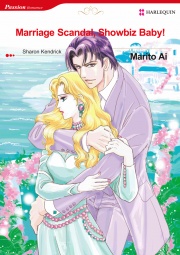
    Marriage Scandal, Showbiz Baby!

    I was happy when I started reading this volume and saw that instead of the rushed, less detailed art provided for many of these harlequin titles, it opened with a detailed scene of married but estranged actors confronting each other on the red carpet, complete with glossy hair and borders of floating flowers. If there aren’t flowers used as backgrounds in every few pages of a Harlequin manga I feel cheated. Jennifer is an actor and married to Italian superstar Matteo. They’re in the process of divorcing because Matteo romanced the actress that played the evil temptress in their most recent movie. Apparently she is also a temptress in real life. Temptress! There’s a series of flashbacks that show how they first fall in love, when Jennifer was appearing in a play and lured Matteo in because she didn’t care about his fame and wealth. Matteo liked a challenge! Now, as they split up Jennifer’s harpy of a mother keeps lecturing her about the evils of men, and Matteo’s trusty staff don’t put her phone calls through to him. Harpy! Betrayal! Jennifer gets cornered at a party by another womanizing actor named Jack, whose hairstyle, plucked eyebrows, and eyeliner somehow reminded me of John Taylor circa 1983. Duran Duran! Actually many of the fashions in this series ranging from Jennifer’s side-ponytail to the harpy mother’s blouse with attached bow evoked a certain over the top 1980s glamour, which I found amusing because this manga was produced in 2008. Matteo saves her, they get trapped in an elevator, and they make love. Love in an elevator! Jennifer finds herself pregnant, and she and Matteo begin to rebuild their relationship. Because if you need to trap a man, get pregnant! This was highly entertaining, and the lush art did a great job of evoking the fabulous lifestyles of the protagonists.

    Filed Under: UNSHELVED

    Random weekend question: comebacks

    February 19, 2011 by David Welsh

    I’m seriously considering selling my copy of Osamu Tezuka’s Swallowing the Earth (DMP). Copies are going for a small fortune on Amazon, and opportunism may overcome my tendency to hoard. This leads me to ask which books you’d like to see back in print from the sad limbo of licensed titles that have faded from active publication.

    I’d have to go with Viz’s Four Shôjo Stories, a collection featuring the work of Moto Hagio, Keiko Nishi, and Shio Satô. Copies are expensive, and it seems like something that should be more readily available. In fact, there are a fair number of really interesting, old Viz books that I’d like to see make a comeback, but this one tops my list.

    What’s your choice?

    Filed Under: DAILY CHATTER

    • « Go to Previous Page
    • Page 1
    • Interim pages omitted …
    • Page 40
    • Page 41
    • Page 42
    • Page 43
    • Page 44
    • Interim pages omitted …
    • Page 62
    • Go to Next Page »
     | Log in
    Copyright © 2010 Manga Bookshelf | Powered by WordPress & the Genesis Framework