• Skip to primary navigation
  • Skip to main content
  • Skip to primary sidebar
  • Home
  • About Us
    • Privacy Policy
    • Comment Policy
    • Disclosures & Disclaimers
  • Resources
    • Links, Essays & Articles
    • Fandomology!
    • CLAMP Directory
    • BlogRoll
  • Features & Columns
    • 3 Things Thursday
    • Adventures in the Key of Shoujo
    • Bit & Blips (game reviews)
    • BL BOOKRACK
    • Bookshelf Briefs
    • Bringing the Drama
    • Comic Conversion
    • Fanservice Friday
    • Going Digital
    • It Came From the Sinosphere
    • License This!
    • Magazine no Mori
    • My Week in Manga
    • OFF THE SHELF
    • Not By Manga Alone
    • PICK OF THE WEEK
    • Subtitles & Sensibility
    • Weekly Shonen Jump Recaps
  • Manga Moveable Feast
    • MMF Full Archive
    • Yun Kouga
    • CLAMP
    • Shojo Beat
    • Osamu Tezuka
    • Sailor Moon
    • Fruits Basket
    • Takehiko Inoue
    • Wild Adapter
    • One Piece
    • After School Nightmare
    • Karakuri Odette
    • Paradise Kiss
    • The Color Trilogy
    • To Terra…
    • Sexy Voice & Robo
  • Browse by Author
    • Sean Gaffney
    • Anna Neatrour
    • Michelle Smith
    • Katherine Dacey
    • MJ
    • Brigid Alverson
    • Travis Anderson
    • Phillip Anthony
    • Derek Bown
    • Jaci Dahlvang
    • Angela Eastman
    • Erica Friedman
    • Sara K.
    • Megan Purdy
    • Emily Snodgrass
    • Nancy Thistlethwaite
    • Eva Volin
    • David Welsh
  • MB Blogs
    • A Case Suitable For Treatment
    • Experiments in Manga
    • MangaBlog
    • The Manga Critic
    • Manga Report
    • Soliloquy in Blue
    • Manga Curmudgeon (archive)

Manga Bookshelf

Discussion, Resources, Roundtables, & Reviews

too many losing heroines!

Too Many Losing Heroines!, Vol. 6

December 4, 2025 by Sean Gaffney

By Takibi Amamori and Imigimuru. Released in Japan as “Make Heroine ga Ōsugiru!” by Gagaga Bunko. Released in North America by Airship. Translated by Matthew Jackson. Adapted by Hayame.

I think these volumes have started to hit their stride, in that I’m no longer incredibly annoyed with the main characters quite as much anymore. It helps that, for the most part, when I want to roll my eyes at Nukumizu, someone is there to do it for me. The conceit of this series is that its male lead is very familiar with the concept of light novel harem romcoms, but he’s also a normal teenage boy, and so, like all normal teenage boys, too dim to understand flirting and attraction towards him (a healthy dose of self-loathing helps too). The girls, meanwhile, are all very aware that they’re in a harem romcom, and are trying their best, but… (waves vaguely at Nukumizu). There’s a running gag which comes up a few times here where the girls try to have a romantic, sweet moment, and Nukumizu just watches as it goes right over his head, and they say “that right there…” to him. He never gets it. That right there is why this series is ongoing.

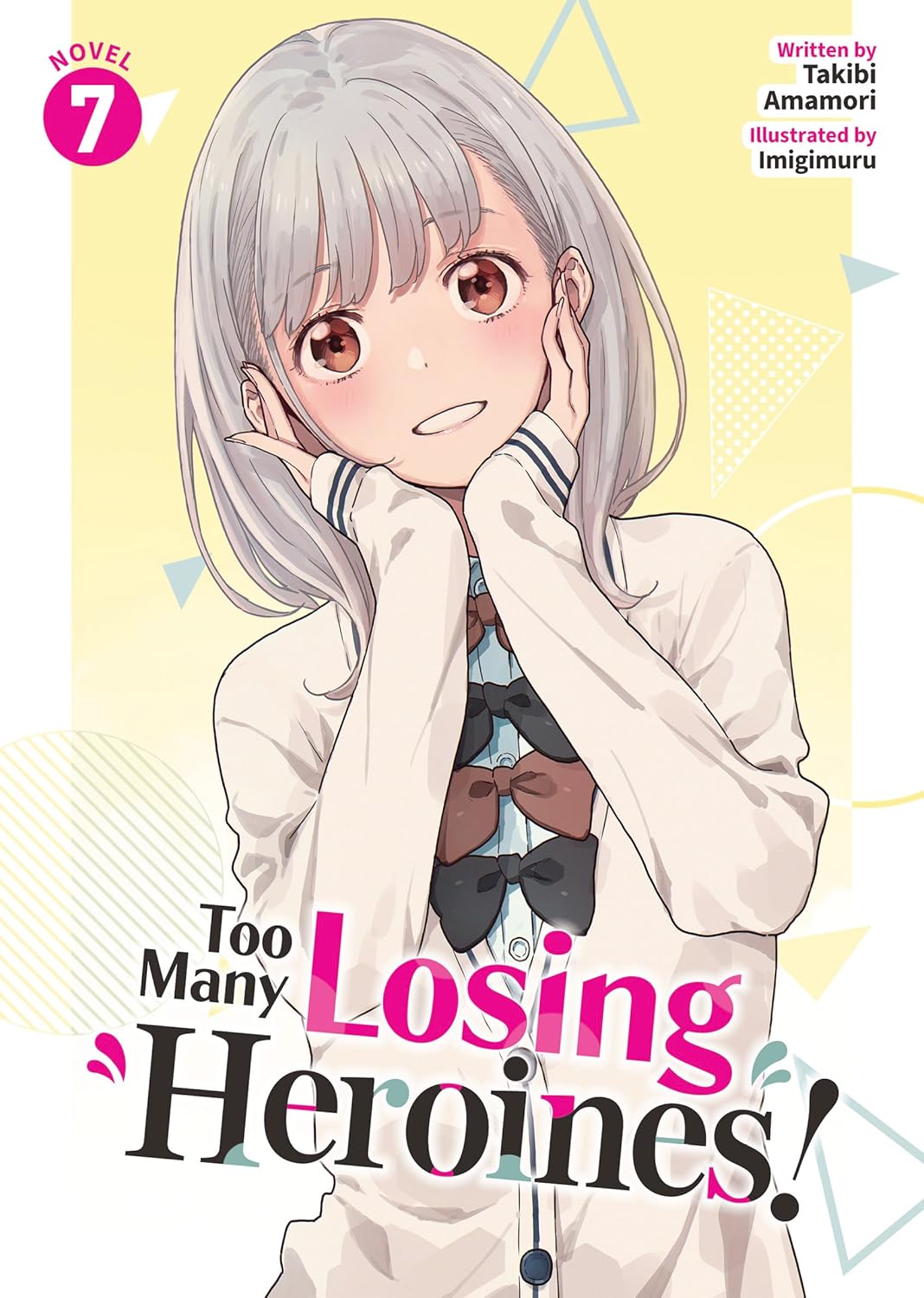
Yes, that’s Tsukinoki on the cover art, which means that for the first time we’re not seeing a Losing Heroine. That said, it’s the last time we’ll be able to see her, as graduation is here, and she and Tamaki are worrying about getting into university more than the current romcom plot. The current romcom plot is that Lemon has asked Nuzumiku out on a date, and after taking him to the aquarium and watching him be completely confused about why she would be doing this, she confesses she wants to quit her clubs. Plural. Both track and the lit club, which would be bad news for him and Komari. They end up making a bet – if he can beat her in a race, she’ll stay with both clubs. Of course, she’s an outstanding athlete who could compete in Nationals, and he’s a skinny, out-of-shape nerd. So she gives him a handicap… which likely still won’t be enough.

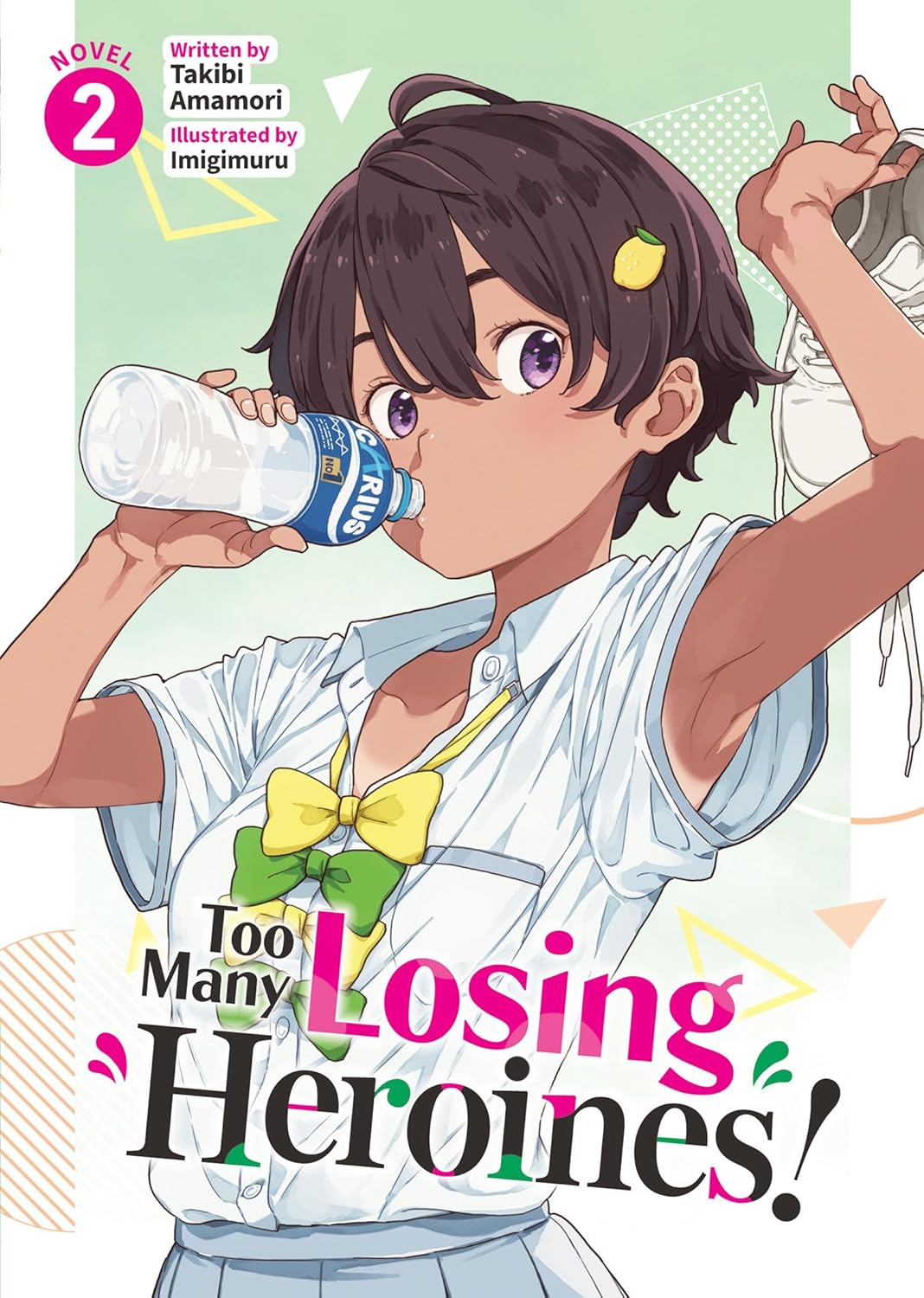
As noted above, this is not Tsukinoki’s book but Lemon’s, though the other girls all get a good scene or two. My favorite was Shikiya, who realizes that, like Araragi, Nukumizu is a guy who would “save anyone”, and she likes that a lot less than Senjougahara did. Lemon, meanwhile, is dealing with an issue she’s had before – she’s simply too good at track, and the coaches are understandably concentrating on her to get the school some notice and to get her into Nationals. She, however, is worried about all the other track girls, who are not as good as her and therefore not getting the attention. Of course, as it turns out none of the girls feel resentment towards her at all, mostly as Lemon is a sweetie pie who has not a single selfish bone in her body. Once he wins (sorry to spoil, but come on, this IS still a light novel), he solves the problem by telling her to be more selfish. The girls not being as good as she is is not her problem. Go for the gold. Too bad love isn’t like a track meet, no matter how much she tried to make it so.

So now our leads head into second year, and I bet that means a new character being introduced who’s a giant flaming loser of a girl. We wouldn’t have it any other way.

Filed Under: REVIEWS, too many losing heroines!

Too Many Losing Heroines!, Vol. 5

August 7, 2025 by Sean Gaffney

By Takibi Amamori and Imigimuru. Released in Japan as “Make Heroine ga Ōsugiru!” by Gagaga Bunko. Released in North America by Airship. Translated by Matthew Jackson. Adapted by Hayame.

Given that this is a series that, about half the time, frames itself as a parody of the standard light novel high school harem genre, I should not have been surprised with the outcome of this volume. And yet. I was surprised. I had certainly seen the previous four volumes, showing Nukumizu’s sister Kaju as, shall we say, dangerously obsessed with her brother, but other series have also done that (looking at you, Goodbye Overtime), and have known that it’s OK to show them as being far too close for a brother and a sister without saying straight out “there is sexual desire here, this is meant to be incestuous for real”. Losing Heroines goes there, and so this comes as a content warning for those who might be put off. That said, I think most who would be put off wouldn’t have gotten this far into the series anyway, and it’s not as if Nukumizu has the ability to understand anyone’s attraction to him, much less his sister.

It’s time for the middle school students to visit prospective high schools, and that means our protagonists have to show off what makes their school great. For some this is easy due to talent (Lemon, who may be held back a grade but boy can she run). For some it’s easy due to personality (Anna, despite her foibles, can be outgoing and personable). The literature club is in trouble, though, with its two introverts who hate dealing with others. Nukumizu, however, has other problems. It’s Valentine’s Day soon. He heard his sister recently on the phone talking about… a guy! And she’s got plans in the calendar the siblings share that imply dates! She’s 14, that’s far too young to date, surely! Everyone else tells him he’s overthinking this, but they’re not getting through to him, as he’s in full big-brother mode. Hijincks, of course, ensue.

As always this is a well-written book, with a lot of laugh out loud gags. Anna is funny whenever she opens her mouth, and her chocolate cannonball was deserving of the interstitial art it got. Nukumizu, as always, is so good at reading the hidden subtext of most of the relationships of others around him that he fails to see the actual TEXT of girls throwing themselves at him. He is told by his friend Ayano that he needs to realize how he looks to everyone around him who doesn’t have the full story, and Nukumizu… brushes him off. And let’s talk about the elephant in the room. Not only does Kaju provide a story for the literature club about a brother who has knocked up his little sister, but she’s also really desperate to help her friend Gondou with her own doomed relationship, despite the fact that Gondou knows that Kaju is really thinking about herself. She knows she can’t have sex with her brother. She knows he just sees her as family. And, as this volume makes explicit, she HATES that.

Now that we’ve unlocked the barn door and let the horses out, I assume that she’s going to get more blatant in future volumes, which does not thrill me. But she also won’t be the focus, so I’ll bear with it for now. For romcom diehards and people who don’t understand why I don’t like that sweet, sweet incest.

Filed Under: REVIEWS, too many losing heroines!

Too Many Losing Heroines!, Vol. 4

April 25, 2025 by Sean Gaffney

By Takibi Amamori and Imigimuru. Released in Japan as “Make Heroine ga Ōsugiru!” by Gagaga Bunko. Released in North America by Airship. Translated by Matthew Jackson. Adapted by Acro.

I feel that as this series has gone on it has very much decided to be a normal romcom with an oblivious protagonist rather than a satire/deconstruction of same, and I like it better this way. Sure, I still want to strangle Nukumizu, but that’s the point, and everyone else in the story agrees with me. Unfortunately, because this is a romcom, all the women in the series who are not otherwise seeing someone seem to be falling in love with him. Including new candidates this volume, because unlike previous ones, the plot forces him to stay involved the entire time and not try to blow everyone off. What it shows is that when he tries, he can be observant, caring, and genuinely nice… provided he’s not thinking about it. Once he does, and he gets into that “no, I’m overthinking this, there’s no way she could be interested in me that way” mode, that’s when he makes girls want to punch him.

This is one of those series where each volume has the heroine of that particular book, so as you may have guessed, this volume focuses on Shikiya, student council secretary and vaguely emotionless weirdo. That said, the book starts with Tiara Basori, the uptight vice-president of the student council, confiscating Tsukinoki’s later BL novel, which features… erm… a genderswapped student council president and Nukumizu in RPF. Naturally, she threatens to submit it to the faculty, which will definitely lead to Tsukinoki getting suspended at least, the dissolution of the literature club, and possibly Nukumizu, who’s in the book, also getting suspended. As such, there’s a new goal for Nukumizu to achieve… find a way to blackmail Tiara and get that book back! Of course, this is not an issue, because, as Shikiya says, “Tiara is easy.”

Note that easy means a romantic pushover, and not easy in the western way. She falls for Nukumizu almost immediately, it’s honestly one of the better jokes in the book at how comically fast it is. That said, she’s also the duller, more standard part of the book. The more interesting bit is with Shikiya and Tsukinoki’s fractured relationship, and how no one really wants to talk about it. Shikiya has been amusing but an enigma in the first three books, and in this one we see that her emotional difficulties are actually a major issue for her, and that she regards other people smiling – even if it turns out to be just a faked smile – as something that she can’t really do. As with every other girl in this series, if she and Nukumizu became a couple, they’d be a good one. Also like every other girl in this series, that would require Nukumizu to be self-aware, which he painfully isn’t. Right now he has a better chance of scoring with his “still walking the incest line but not going over it” younger sister.

Still, if you like romcoms with a greater emphasis on “com”, and don’t mind the fact that everyone in the cast is a failure pile in a sadness bowl, this is perfect for you.

Filed Under: REVIEWS, too many losing heroines!

Too Many Losing Heroines!, Vol. 3

February 7, 2025 by Sean Gaffney

By Takibi Amamori and Imigimuru. Released in Japan as “Make Heroine ga Ōsugiru!” by Gagaga Bunko. Released in North America by Airship. Translated by Matthew Jackson. Adapted by Acro.

Finally, with its third volume, I think this series is winning me over. Oh, I will admit, Nukumizu can still be irritating as hell, but it’s by design, and everyone (including himself!) calls him out on this. I did worry when we saw the appearance of the first winning girlfriend, Karen, but she’s kept to a minimum, so I can merely try to forget she exists. (Their subplot was, I think, meant to reference Nisekoi, but Karen is exactly the sort of heroine who usually wouldn’t win a manga like that, so I’ve no idea.) Mostly, though, this volume works because a) Komari’s subplot is interesting, works very well with her character growth, and tugs at the heartstrings, and b) Anna is finally becoming the sort of annoying character I can enjoy, rather than merely one I tolerate. I am now prepared to like her. Honestly, she’s almost becoming the voice of reason in this series, because Nukumizu is too caught up in his usual stuff.

Nukumizu thankfully tells us that this series can’t afford both a sports festival AND a culture festival, and besides, Lemon got focus last book, so no wants a track meet. So it’s just Culture Festival time, with the Literature Club being half-heartedly threatened by the Student Council, only one of whom really seems to have it in for them. More to the point, Tamaki and Tsukinoki are retiring from the club, and have chosen Komari to be the new president, with Nukumizu as a very reluctant vice. This is a good aesthetic choice, but will require her to – shock, horror! – speak in a group and deliver the literature club’s minutes at a meeting, something this introvert is seemingly incapable of. Given she’s already running herself ragged trying to do everything for the festival, can Nukumizu figure out what’s wrong *and* communicate properly with Komari about it? Spoiler: he manages neither of these.

There’s a bit near the end of this volume where Nukumizu is trying to figure out where he went wrong, and he realizes that while he and Komari are both introverts who say they want to be left alone, he really does, whereas she’s actually lonely and genuinely wants to be around other people. Leaving aside his stunning misreading of his own personality, Komari’s arc here reminded me that a lot of times in light novels and manga that feature the shy, introverted character, the goal is always to drag them out of their shells and make it so they can open up to everyone and communicate better. There’s a “we can fix you” aspect to them. And since Nukumizu thinks in light novel cliches, he assumes that’s what this is. But of course he forgets what Komari was dealing with when he met her – being in love with the president who helped her find a place in the club. She’s had that pillar taken away, and wants Nukumizu to understand that she would like him to be her new pillar. Sadly, as with Anna and Lemon, that would require Nukumizu to have more self-awareness than a bug.

Since I ended up enjoying this a lot more than the first two, I will forgive yet another oddly bordering on creepy younger sister who adores her big brother, mostly as it rests on the correct side of “incest is weird, don’t”. Anyway, we’ve run through our core heroine team, so who’s the next loser? Judging by the cover, it’ll be Shikiya, assuming she can wake up for it. For fans of this sort of series, “deconstruction” or no.

Filed Under: REVIEWS, too many losing heroines!

Too Many Losing Heroines!, Vol. 2

October 24, 2024 by Sean Gaffney

By Takibi Amamori and Imigimuru. Released in Japan as “Make Heroine ga Ōsugiru!” by Gagaga Bunko. Released in North America by Airship. Translated by Matthew Jackson. Adapted by Acro.

I had better get used to these books being backloaded in the second half, because I had the exact same experience with this volume that I had with the first. The start of this volume is packed with scenes designed to make the main characters annoying in a funny way, but I mostly found them annoying in an annoying way, particularly our narrator, who may be trying to contrast with the usual light novel romance narrators, but not by much, because like all of them he’s emotionally sensitive to everything but his own mind. As the book goes on, and it delves into the ongoing issues of Losing Heroine #2, and the way that sometimes even after you’ve been rejected you still have to see the guy you like every day, it gets a lot better. When he’s dealing with other people’s love lives, Nukumizu excels. When he’s dealing with his own inability to know what love feels like, you find yourself rooting for Anna. And I hate rooting for Anna.

As mentioned, our three losing heroines have all been rejected, but life still goes on. Anna attends a reunion and is horrified to discover her childhood friend and his new girlfriend acting like they’re already married. Chika is still in the same literature club with the girl who is now dating her crush, and is still being very smug about it. And then there’s Lemon, who seems to be… walking around town with Ayano? What? Is he cheating on his new girlfriend? Is Lemon trying to horn in on a brand new relationship? Nukumizu absolutely does not want to get involved, but he and Anna are forced to when they run into Ayano’s actual girlfriend, Chihaya, who also worries that something is going on between them, and decides to solve the problem by planting tracking devices on her boyfriend and following him around. This is a bad idea, FYI for new couples.

Lemon, frankly, has always given off the impression that she’s supposed to be the dumb one in our cast, but that’s mostly because the characters are all varieties of trope because this book is trying to be a deconstruction (which it succeeds at roughly 1/3 of the time). In reality, she studied hard with her childhood friend and crush so they could go to school together, and concentrates so hard at track because her family are all known for their brains and she doesn’t want to disappoint them, so plays to her strengths. She’s pretty emotionally mature here once she stops literally running away from her problem. As for Anna, who is clearly the secondary protagonist in these books, she kinda likes Nukumizu, and would be amenable to dating him, but she’s still too hurt by her previous relationship. so she needs him to do the job of asking her – and he’s NOT emotionally mature, so that’s not happening. I expect it won’t be happening anytime soon.

All this plus a very funny parody of Villainess isekai which, frankly, could easily be one – Chika should take that to a publisher ASAP. A combination of really irritating and quite heartwarming. In that order.

Filed Under: REVIEWS, too many losing heroines!

Too Many Losing Heroines!, Vol. 1

July 11, 2024 by Sean Gaffney

By Takibi Amamori and Imigimuru. Released in Japan as “Make Heroine ga Ōsugiru!” by Gagaga Bunko. Released in North America by Airship. Translated by Matthew Jackson.

Hoo boy. This is one of those books where I have to issue a warning to the newbie reader who knows nothing about it: keep at it, plow through the first half. I get it. The second half has a good payoff. But oh, that first half. When I started to read it, I felt like I was reading an author who had gotten really mad about Nisekoi and The Quintessential Quintuplets and decided to write the romcom equivalent of “guy gets revenge on his high school bullies”. But no, with only one exception, the actual “winning” couples barely get any focus in this series. It’s all about the girls who, while seemingly popular and/or cute, end up on the wrong end of a love triangle. Fortunately, they all have our protagonist, a friendless guy who likes to read bad light novels and snark at his little sister. Surely he can be there to heal their wounded hearts. … Or not, because this whole book is here to get really mad at him too.

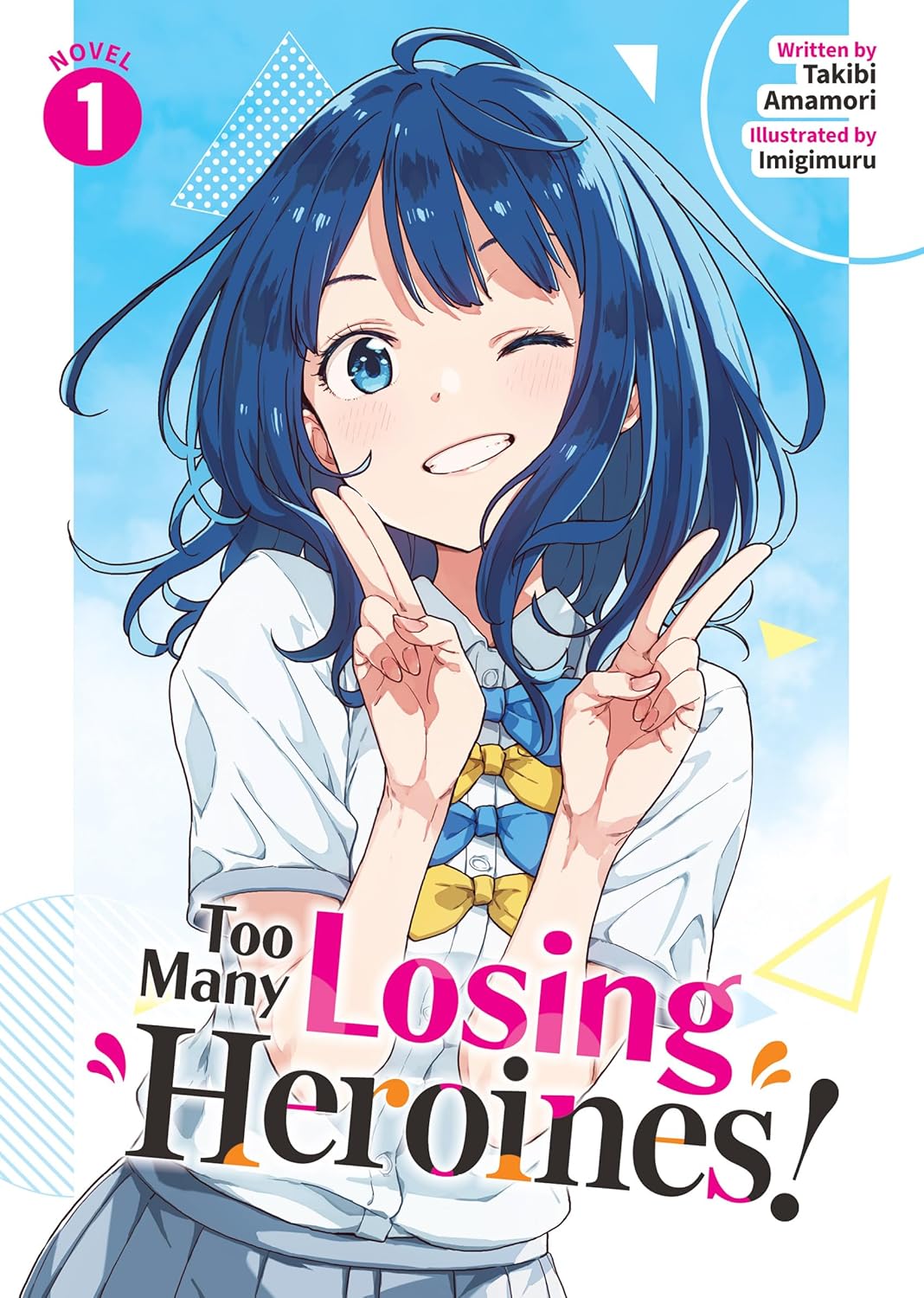
Nukumizu is the aforementioned protagonist. One day, while at a family restaurant, he overhears two classmates. The cute, popular girl Anna is telling her friend Sousuke to go chase after the new transfer student, Karen, who he has feelings for. Except, of course, Anna clearly also likes him. And once he takes off, she goes into an anger (and junk food) filled binge… then sees that Nukumizu overheard everything. About a week later, another of his classmates, the dumb-but-athletic and popular Lemon, confesses to the smart, studious guy she likes… but he just got together with his cram school partner. Then Nukumizu is reminded that he needs to actually attend the literature club that he joined… and finds a love triangle there as well, with the small, squirrel-like Chika clearly crushing on the club president, who also clearly is… in love with someone else. Why is he surrounded by losers?

Sometimes I go looking at the novel-updates site to see what comments are on a new license, and I saw a lot of “beta male” chatter from the usual sort who use that term like they would a comma. They’re full of it, of course, but it really is remarkable how much our hero kneecaps himself in this book. He’s terrible, being filled with snark and a grotesque determination to not get involved, despite clearly being the shoulder to cry on that some of these girls need. The “surprise” in the book is that, so far, it’s not actually a romcom – none of the so-called losing heroines have gotten over their first love, and they’re not looking for a rebound but just simple empathy. This comes out much better in the second half, in which the literature club goes on a field trip that turns into another romantic mess, and Nukumizu can’t even realize when someone is asking for a sympathetic hug.

The payoff comes in the last fifth of the book, when everyone makes their own decisions about what is best for the others, and Nukumizu snaps and actually has empathy for another person. Even if it’s accidental. But yeah, this is a guy with an idea of himself that’s so set in stone he has to be told that he’s already friends with someone. Who thinks in light novel cliches, but, unlike, say, Hachiman (and boy, I bet the author loved that series too), does not throw himself at problems like a bomb to sort them out, but actively runs away from them. As for the three “losing heroines”, the book makes it very clear why they got rejected. Each one has a bundle of eccentricities and neuroses, which would make for a terrible girlfriend but which make for good comedy. The main reason you can get through the first half of the book is that they’re goofy and silly, and yet still MUCH better at life than the “losing hero”.

This is currently 6 volumes and counting, so probably will eventually get some rom in its com. For the moment, though, the girls need to have time to recover from their heartbreak, and the guy needs to understand how to interact with others without it being a trope. I was going to recommend this reluctantly, but by the end it had won me over. Provided we keep up the character development. Also, totally abstaining from the “Makeine vs. Roshidere” social media wars, thanks.

Filed Under: REVIEWS, too many losing heroines!

 | Log in
Copyright © 2010 Manga Bookshelf | Powered by WordPress & the Genesis Framework