• Skip to primary navigation
  • Skip to main content
  • Skip to primary sidebar
  • Home
  • About Us
    • Privacy Policy
    • Comment Policy
    • Disclosures & Disclaimers
  • Resources
    • Links, Essays & Articles
    • Fandomology!
    • CLAMP Directory
    • BlogRoll
  • Features & Columns
    • 3 Things Thursday
    • Adventures in the Key of Shoujo
    • Bit & Blips (game reviews)
    • BL BOOKRACK
    • Bookshelf Briefs
    • Bringing the Drama
    • Comic Conversion
    • Fanservice Friday
    • Going Digital
    • It Came From the Sinosphere
    • License This!
    • Magazine no Mori
    • My Week in Manga
    • OFF THE SHELF
    • Not By Manga Alone
    • PICK OF THE WEEK
    • Subtitles & Sensibility
    • Weekly Shonen Jump Recaps
  • Manga Moveable Feast
    • MMF Full Archive
    • Yun Kouga
    • CLAMP
    • Shojo Beat
    • Osamu Tezuka
    • Sailor Moon
    • Fruits Basket
    • Takehiko Inoue
    • Wild Adapter
    • One Piece
    • After School Nightmare
    • Karakuri Odette
    • Paradise Kiss
    • The Color Trilogy
    • To Terra…
    • Sexy Voice & Robo
  • Browse by Author
    • Sean Gaffney
    • Anna Neatrour
    • Michelle Smith
    • Katherine Dacey
    • MJ
    • Brigid Alverson
    • Travis Anderson
    • Phillip Anthony
    • Derek Bown
    • Jaci Dahlvang
    • Angela Eastman
    • Erica Friedman
    • Sara K.
    • Megan Purdy
    • Emily Snodgrass
    • Nancy Thistlethwaite
    • Eva Volin
    • David Welsh
  • MB Blogs
    • A Case Suitable For Treatment
    • Experiments in Manga
    • MangaBlog
    • The Manga Critic
    • Manga Report
    • Soliloquy in Blue
    • Manga Curmudgeon (archive)

Manga Bookshelf

Discussion, Resources, Roundtables, & Reviews

Reviews

Danganronpa 2: Ultimate Luck and Hope and Despair, Vol. 1

December 20, 2018 by Sean Gaffney

By Spike Chunsoft and Kyousuke Suga. Released in Japan by Mag Garden, serialized in the magazine Beat’s. Released in North America by Dark Horse. Translated by Jackie McClure.

I tried to play the first DR game, but never got far due to frustration over a “gatcha” system giving you random pointless things. In other words, a typical game experience. I do know enough about the franchise, though, to know that the second in the series was more popular than the first, at least over here. As such, licensing the manga seems like a lock. That said, I think that once again this is a manga to read if you’ve already played the games – there’s very little help given to the newbie reader, and the character introductions come fast and furious. Given the large cast, and the complete lack of holdovers from the last game/manga (mostly), it’d normally be hard to get a handle on who we should be following. The player character is clearly Hajime Hinata, a weird fusion of Naegi and Kirigiri from the first series, but being a player character he’s pretty blank and dull. So the manga focuses instead on Nagito Komaeda, who… isn’t.

Danganronpa 2 takes place on an uncharted desert island, where the cast wake up after being in school previkously. They’re supposedly led by a rabbit bascot named Usami, but Monokuma quickly takes over by force and decides to restart the usual killing games. Quite how Monokuma’s mastermind is alive after the last game is not clear, but oh well. Everyone tries to make the best of it with a party, but midway through the power cuts out, and when the lights come back on, oh look, somebody’s stabbed. It’s Byakuya Togami who… seems different from the last time we saw him, and also a lot heavier. OK, frankly, the discerning reader knows it’s NOT Byakuya Togami, but as to why someone is impersonating him… we don’t really find that out either. There are very few answers in this book, but a lot of setup, and a lot of Komaeda. The conceit of this manga is that it’s from Komaeda’s “POV”.

Komaeda is a piece of work, and reminds me quite a bit off Izaya Orihara from the DRRR!! series. He says that he’s trying to prove that hope exists in a world of despair, but seems to want to accomplish this by getting everyone around him to despair and see if someone manages to beat him. He has a lot of “laughing crazy” faces too, as well as a heap of bromantic tension with Hajime. As for the rest of the class, so far there aren’t many standouts. One tanned athletic girl gives me memories of Aoi Asahina. There’s a nurse whose personality and looks are reminiscent of Hinata from Naruto, though Hinata never quite fell and exposed herself quite the way Mikan does constantly. (This seems to be a fanservicey running gag, and it’s awful, frankly. DR is still written for teenage boys in Japan, no matter how much ho yay may be in it.) And there’s a gamer girl who may be the Kirigiri to Hajime’s Naegi. But yeah, mostly still a faceless mass.

I believe this series is only three volumes in Japan, so I’m not expecting much in terms of coherence. That said, if you like Komaeda, it’s an easy purchase. He is all over this manga, and he is dramatic as fuck. Which is all the player wants, really.

Filed Under: danganronpa, REVIEWS

Der Werwolf: the Annals of Veight, Vol. 2

December 19, 2018 by Sean Gaffney

By Hyougetsu and Nishi(E)da. Released in Japan by Earth Star Entertainment. Released in North America by J-Novel Club. Translated by Ningen.

I’m always pleased when a second book in the series proves to be even better than the first, and that’s definitely the case with Der Werwolf. I enjoyed the first book quite a bit, but the second volume steps up its game, showing off Veight’s political and diplomatic skills in the first half, then pulling the rug out from under the reader with a plot twist I wasn’t expecting for a few more books yet. Perhaps best of all, there’s virtually none of the typical isekai cliches in this book – probably as the “I’m from Japan” part is still mostly irrelevant. There’s no gamer terminology, dungeon levels, and the romance is kept very much on the back burner – i.e. there isn’t any yet, though there’s clearly a few women who like Veight. Instead, we are simply reading a fantasy book. It reminds me a lot of The Faraway Paladin, and fans of one should enjoy the other.

At the start of this book, Veight is interested in expanding his allies on the Southern half of the continent, so reaches out to a pseudo-Arabian city along the coast. As with the first book, we occasionally get the viewpoints of other characters (though I wish they were marked off in the text a bit better – it can be tough to tell when we’ve left Veight’s viewpoint and when we return), and that helps here to show off the rock and the hard place that the other city is caught between, and also how Veight thinking that he’s being calm and reasonable is seen by other people as Veight being threatening and terrifying. In fact, there’s a running gag here, even more than the first book, of Veight saying he’s “just a vice-commander” and denying that he’s anything special, despite constant evidence to the contrary. It would be annoying if he were doing it deliberately, but he means it, so it’s just funny.

The second part of the book is much darker. We’d been introduced to the concept of a Hero arriving and challenging the Demon Lord at the start, but this proved to be a false lead (though it did get us another cute girl character, the stressed-out mage who can do illusion magic). Then a real hero does show up, and things go badly very quickly. It’s great to see how the concept of a hero here, in a book essentially narrated by “bad guys”, is that of a fiercely destructive force that none can stand against except the Demon Lord himself. Even more intriguing, there’s clear backstory between the hero and the Demon Lord, apparently involving a woman… but we never really get to find out what it is, except it’s made the hero hell bent on revenge. Actually, I’ll be honest here, I was expecting things to get even MORE dark, but thankfully things got a little better at the end, and Veight gets to go on being the most humble yet awesome vice-commander ever.

This is a pretty long-running series in Japan, so we have a ways to go. This pleases me, as reading these volumes is a treat. I highly recommend Der Werwolf to anyone who enjoys good light novel fantasy without the “light novel” cliches.

Filed Under: der werwolf, REVIEWS

Pop Team Epic: Second Season

December 18, 2018 by Sean Gaffney

By Bkub Okawa. Released in Japan by Takeshobo, serialized in the magazine Manga Life Win. Released in North America by Vertical Comics. Translated by Yota Okutani and Maya Rosewood.

It’s hard to get all the humor at the start of the second volume of Pop Team Epic without all the buildup that came with it. Pop Team Epic, the manga, was pretend cancelled, and the author was going to start a new work in the magazine called Hoshiiro Girldrop. There were even some promos for it. Then we get the chapter you see in this volume, and, well, surprise! (It wasn’t much of a surprise – everyone expected something fishy.) Now, of course, we not only have the anime using the series for its previews, but there’s also doujinshi anthology books with other artists writing genuine Girldrop stories. Honestly, I wouldn’t be surprised if there was an OAV at some point (well, yes I would, no one does OAVs anymore). With all that said, Girldrop is just the opening gag here, and the rest of the volume gives the reader what they want – more of Popuko and Pipimi.

Fans of the anime will be pleased to know that they will still recognize quite a few gags, although a lot less than the first volume. The Undertale stretching head gag is here (in fact, a lot of the video game stuff is seen here) as well as Popuko ordering latte art. For the most part, though, these gags were left out, and so the reader can enjoy them in their original environment. There aren’t a lot of gut-busters, but Pop Team Epic doesn’t really go for gut-busting humor. It’s a nerd manga that revels in its nerdness even as it tears down nerds gleefully, knowing that having its cake and eating it too is part of the reader appeal. And for those who look for that sort of thing, there are again one or two strips that imply that Popuko and Pipimi really like each other, though this is never going to be a comic that will commit to yuri in any way that isn’t present for a gag. I am also very fond of the “Holy shit, you’ve ruined it, like everything you do” strip, which definitely falls in the category of “too real”.

Towards the end of the volume, it’s become clear that the anime had been greenlit, and so we get a number of strips making fun of that fact. There is another “fake cancellation”, which also didn’t stick (I suspect Vol. 3, when it comes out, will be called “third season”. There’s also some mocking of the fact that Popuko and Pipimi aren’t cute or moe enough for the anime market, and are being replaced with more “natural” moeblobs – the anime did actually mock this, with the hegemony scenes at the end, showing off the yuri schoolgirl series that PTE is never going to be. And so Popuko and Pipimi, shunned by their own production companies and publisher, end the manga in a literal cage, making one last joke about bad ratings before the end. I have no idea how good the ratings were in Japan, but PTE definitely became a bigger phenomenon, both in Japan and the West. How will a third volume deal with the fame? God knows, but for now please enjoy more of this shitty manga.

Filed Under: pop team epic, REVIEWS

Defeating the Demon Lord’s a Cinch (If You’ve Got a Ringer), Vol. 2

December 17, 2018 by Sean Gaffney

By Tsukikage and bob. Released in Japan as “Darenidemo Dekiru Kage kara Tasukeru Maou Toubatsu” by Famitsu Bunko. Released in North America by Yen On. Translated by Caleb DeMarais.

The good news here is that everything is just a bit more toned down than the first volume. Sure, Ares spends much of the book frustrated and gritting his teeth, insulting the hero and companions at every turn, but he never runs into them, so it’s more tolerable. Toudou and company likewise are a lot more likeable than the first book (knowing Toudou’s secret helps), and I like their resolve even in the case of crippling fear and dealing with insane priests. And no, I don’t mean Ares, though he’s clearly not all there either – in fact, given Amelia also seems to exhibit some eccentricities this volume, I’m wondering if being in the Church means that sanity is an optional extra. But no, instead the second volume is spiced up by the arrival of Gregorio, a smiling nightmare of a crusader who seems ready to restart the inquisition. For once Ares seems to genuinely have something to be frustrated about.

We start where we left off, with our heroes trying to level up in an area known for tombs and undead. Sadly, two of the three in the hero’s party are terrified of the undead – including the hero. Area and Amelia try to help them out by finding an apprentice priest to join their ranks. Sadly, there isn’t one available, so Amelia grabs the cutest orphan she can find at the church and Ares forcibly has her killing (restrained) undead till she’s at least Level 10. That said, mostly what Spica does in this book is sit back and marvel at what is going on around her. Particularly once Gregorio arrives. He’s very devout, to a manic extent, very sure of his faith, and very ready to kill anyone who is not faithful enough. Which, given “faith” to him means “strength”, is not good news for Toudou, who’s still dealing with being rather low-level. Can Ares manage to intervene before Gregorio decides to purge them all?

The high point of the book is Spica, who is a fascinating study in what happens when you take an orphan girl with little to no power and then put her in situations where power is needed and she constantly feels useless and pathetic. You expect her to break, and arguably she does a bit, but once again Demon Lord Ringer has a last-minute reveal that’s so good I don’t want to spoil it. It absolutely makes sense for the character, though. As for everyone else, the hero’s team is a lot more likeable this time around, and we get a lot more from their perspective. This allows the narrative to not hammer on Ares’ asshole qualities quite as much, to an extent that I can almost start to feel sympathy for him. Almost. Also, Amelia, I think you’re going to have to throw him onto a bed and straddle him in order for him to get a clue about your feelings.

It’s a good second volume, and I’m liking this series a little more now. It keeps surprising me. If you can tolerate Ares, as well as endless discussion of levels and buffs, it’s a good read.

Filed Under: defeating the demon lord's a cinch, REVIEWS

Ao Haru Ride, Vol. 2

December 16, 2018 by Anna N

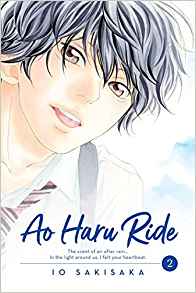
Ao Haru Ride Volume 2 by Io Sakisaka

When reading the second volume of this series, I found myself thinking about how the characters in Ao Haru Ride are different from some of the unusually self-aware protagonists that occasionally appear in shoujo manga. Teens with involved thoughts about the condition of being teenagers are fairly common, but Ao Haru Ride is concerned with issues of time and memory, and how memory can be a constructed choice in a way that feels refreshing to me as a reader.

As Futuba enters her second year of high school, she still struggling to find her niche. Her attempt to ingratiate herself with a small gang of judgemental girls didn’t work out well for her, and she wants to develop real friendships. She makes a point of being friendly to Makita in an attempt to head off a resurgence of rumors and finds herself a topic of gossip. Joining her and Makita in the new class are the enigmatic girl Murao, the boisterous Aya, and Kou. Futuba decided to throw herself into class leadership after hearing about a school-sponsored leadership retreat, and she’s joined by her new classmates.

Ao Haru Ride

Kou isn’t too happy when he realizes that he’s signed up for a trip that his older brother Tanaka is overseeing as a teacher, but he and Futuba reach a sort of understanding about their previous middle school crushes, as he warns her that he’s different now, and she starts appreciating Kou in the present without expecting him to match up with her memories. Futuba is also extremely conscious of making new memories on the trip, as the not-quite-friends-yet group goes through the typical outdoor activities to encourage class bonding. She makes sure that everyone gets together to watch the sunrise, knowing it is the type of memory they will treasure later.Ao Haru Ride’s are unusually insightful and self-reflective, which makes this a shoujo romance manga with so much emotional depth. Kou points out to Futuba that things come easier for him because he just doesn’t care about anything, and the fact that she’s struggling to make things better means that she’s a better person than he is. Futuba in turn notices all the times that Kou’s innate kindness shows through his acerbic exterior.

This series is inching up the list of my all time shoujo favorites after the fourth volume. There’s the potential for more drama to develop as the new group of friends starts to come together, but with Kou and Futaba being such uniquely thoughtful protagonists, I’m looking forward to seeing how they deal with all the issues of high school life. Ao Haru Ride is such a special series, I’m glad to have the chance to read it.

Filed Under: Manga Reviews, REVIEWS Tagged With: Ao Haru Ride

So I’m a Spider, So What?, Vol. 4

December 15, 2018 by Sean Gaffney

By Okina Baba and Tsukasa Kiryu. Released in Japan as “Kumo Desu ga, Nani ka?” by Fujimi Shobo. Released in North America by Yen On. Translated by Jenny McKeon.

I’m still not quite sure about where out spider girl stands in terms of the current timeline (my current guess is that she’s the “white” girl rather than the demon lord, despite personality differences), but the two timelines are definitely starting to converge a bit. Or at least the spider is out of her dungeon… mostly… and starting to see the world. More to the point, much as I like seeing the spider’s adventures fighting things, I’ve become far more interested in the rest of the reincarnated kids, who are (mostly) all reunited at the Elf Village this volume. It’s a shame that the Demon Lord is about to annihilate all the elves. And also that the kids at the elf village feel rather strongly that they’re being used by their teacher. Which… may be true? Certainly Ms. Oka is not the pillar of goodness and light that, say, the teacher from Arifureta is.

On the spider side of things, she gets to the top of the dungeon, but the battle between both her mother and a higher spider that her mother calls in to help means that most of the time she’s shuffling back and forth between the dungeon and outside, fighting a mostly losing battle against various enemies. With a character as overpowered as our spider girl, there has to be a balance to show that she has it tough as well, and we certainly see it here – she’s decapitated twice, and is constantly at death’s door… and this is AFTER gaining the power of immortality, which she rightly assumes is not quite as great as it sounds. We also see one of her rare overconfident decisions, as she goes to fight the final battle against her mother with just better stats, not realizing that her mother is even craftier at traps.

Still, spider battles are not as interesting to me as the adventures of Shun, Katia and company, still trying to deal with the fact that Hugo has mind controlled the kingdom into making them public enemies. They go to the elf village to regroup, but that requires going through the dungeon to get there, which means running into some of our spider girl’s leftover selves. It’s not really clear how she pulls this off, but given it’s about 18 years later it wouldn’t surprise me if she’s just that powerful. In any case, there’s no battle with the heroes, but her mere presence – and announcement that she’s a reincarnation – is enough to stun everyone. Things don’t get better when Ms. Oka explains the mechanics behind this world and what the elves are doing to ensure that the gods/administrators don’t win. Honestly, their plans just sound mean. You can see why the other kids are sort of angry about being told to farm and never get strong. I don’t blame them.

We end with a bit of a cliffhanger, and I have a sneaking suspicion that I won’t have to worry about remembering most of these kids for much longer. Meanwhile, our spider has finally met another reincarnation… and she’s a vampire! Will the two plots finally converge? Well, now that we’re out of the dungeon, we can hope things move a bit faster. And hey, not NEARLY as many stats in this book! Excellent news!

Filed Under: REVIEWS, so i'm a spider so what?

Ne Ne Ne

December 14, 2018 by Sean Gaffney

By Shizuku Totono and Daisuke Hagiwara. Released in Japan by Square Enix, serialized in the magazine Shonen Gangan. Released in North America by Yen Press. Translated by Taylor Engel.

The artist here may be familiar – the same one also draws Horimiya. The author is relatively unknown, however, and this did not take off the way Horimiya did – it’s just one volume total. But to be honest, that seems about right. Not that I didn’t enjoy this series, it was very cute and had some great humor. But you get the sense when reading it that future volumes would have been much the same – it’s the sort of series that only resolves when the main couple gets together, and has no plot except “will they finally get together”, so ongoing volumes would have felt a bit like it’s dragging it out. Of course, Ne Ne Ne has a bit of a head start on those other cute romantic comedies, in that our heroine starts the book off married to the hero. Why aren’t they involved physically? Well, it’s an arranged marriage, and she’s a bit too young. He’s also awkward, and inexperienced himself. Basically, they’re both naive blushing cuties.

There’s a supernatural element to the series as well, but it feels very tacked on. I’ve talked before with some isekai series how the “brought to another world” aspect feels halfhearted and tacked on, and to be honest the yokai stuff in Ne Ne Ne feels much the same. It seems to be an excuse to have Shin, the male lead, wear a mask all the time to make him a bit less nebbish. We never really get a good explanation as to why – he says it’s to make him less easy to possess, and you get the sense that if the series had gone on this is the direction the authors may have taken it in. As it is, though, the supernatural is not the reason to read the book. They treat a wounded fairy, he points out dragons flying in the sky that normal people can’t see, etc. The real meat of the story is in the embarrassed romantic flirting.

Shin is told by Koyuki’s overprotective father that he’s not to try anything with his wife till she’s twenty, but we’re never quite sure how much younger than that she is. At least a few years, I’d expect – she seems pretty young, and has a bit of a complex about getting older as quickly as possible. Like many newlyweds in Japanese ‘arranged marriage’ stories, there’s also a frisson of ‘Do you even like me at all?’ to the proceedings, though that’s entirely on the part of the characters – the reader knows immediately that they’re perfect for each other, though I agree with the dad that they should wait for now. There’s humor in seeing the local villagers mistake Koyuki for Shin’s maid (and then, when he corrects them, becoming the big gossip of the day) and Koyuki pouting when Shin says something unthinkingly. But they actually communicate pretty well, and there are no difficult problems to get past.

Ne Ne Ne may be only one volume because of that. This is a story of two people who are married and really like each other. And they all lived happily ever after.

Filed Under: ne ne ne, REVIEWS

Durarara!!, Vol. 11

December 13, 2018 by Sean Gaffney

By Ryohgo Narita and Suzuhito Yasuda. Released in Japan by ASCII Mediaworks. Released in North America by Yen On. Translated by Stephen Paul.

If you enjoy scenes where one character tears down the motivations of another character, you’ll love this volume of DRRR!!, because that’s almost all it is. Yes, by the end of the book the plot guns are finally going off (or in some cases blowing up – nice cameo, Vorona), but most of this book is still buildup and dialogue. Izaya confronts Anri about her own nature, how she “uses” Saika, and her aggressive passiveness (yes, Anri can be very aggressive about not doing anything), to the point where she almost has a nervous breakdown. Izaya also confronts Mikado about what he’s trying to do with the Dollars – turns out Mikado is not ready for life entirely on the dark side either, and in order to maintain the excitement he craves, he needs to remain balanced on the edge between safety and danger. And Masaomi is forced, once again, to confront his past and the past of his gang, which looks to resolve itself in a series of beatings.

The cover implies hot Saika-on-Saika-on-Saika action, and to be fair, that is what we get, though the action is somewhat limited. Having been released from her “guard Celty’s head” duty, Haruna is free to try to find her true love, the creepy high school teacher, and also confront Anri, who dared to be loved and rejected by him. Midway through this battle, Kujiragi shows up, seemingly to try to get Anri to “sell” her Saika to her, but in reality we know why she’s really there – she’s angry they scared off the cats. Kujiragi’s stoic love of cat stuff (and later, as we discover, cosplay) is a charm point, but like so many, many others in Narita’s universes, she’s a villain who knows it and is content to be villainous even as she tries to escape. Anri, to be honest, spends most of this confrontation staring in confusion – she’s already mentally exhausted from Izaya tearing her apart, and how she has Kujiragi saying she’s far too nice to be wielding someone like Saika – which is true, but just taking Saika and leaving Anri normal won’t solve her issues. Anri doesn’t even get to go home and have a nice sleep, as Masaomi’s girlfriend is lying in wait outside her apartment.

Anri is the “main character” of this volume, but there’s other things going on, not least of which is Celty’s head being used to set everything in motion. Izaya is delighted and somewhat appalled by this turn of events. Meanwhile, Shizuo is out of prison, but after seeing Vorona stealing the head, he thinks she’s working for Izaya, and finally seems to be snapping. Unlike the anime, Shizuo and Izaya have rarely personally confronted each other in the novels – they just want to never see each other. I suspect, though, that the climax of these books will finally feature what fans want to see. No, not that. What non-BL fans want to see – Izaya getting the shit beaten out of him. As for Celty, she, like Anri, is having trouble coping with everything around her at the moment, and the cliffhanger ending (there’s about four cliffhangers at the end of the book) shows her about to snap as well. Is everyone going to get angry and snap at the start of the next book? And will Erika get Kujiragi to cosplay for her?

Fans may be familiar with these events from the anime, but I still urge them to get the books as well, as the examination of everyone’s psyches works better in prose format than spoken aloud.

Filed Under: durarara!!, REVIEWS

The Promised Neverland, Vol. 7

December 12, 2018 by Sean Gaffney

By Kaiu Shirai and Posuka Demizu. Released in Japan as “Yakusoku no Neverland” by Shueisha, serialization ongoing in the magazine Weekly Shonen Jump. Released in North America by Viz Media. Translated by Satsuki Yamashita.

A lot of this volume has our heroes dealing with a grumpy adult guy who’s hiding out in the shelter they’ve come to, and is trying to kick them out. He is, of course, the last remains of a different group that tried to escape years ago. I like this, as it reminds readers that Ray and Emma aren’t trying to reinvent the wheel here. Kids have escaped from the field houses before, and likely will again. That said, things are still exactly the same. How will Emma and Ray genuinely change things? They’ll need help. Moreover, they’ll need help from this grumpy guy, still nameless, who has essentially given up on the world. Fortunately, the kids are all smart bordering on geniuses, which gives them advantages others might not have. They can make bargains, use threats. And when all else fails, and Emma is about to be killed, there’s always a punch to the nads. Works every time.

The cover reminds us that the cast of important kids is expanding, even if it’s still the Emma and Ray show much of the time. That said, aside from Don and Gilda, I still have trouble remembering their names. Indeed, so does grumpy guy, who resorts to giving them all nicknames rather than bother to learn actual names. (And Emma’s ahoge, the traditional Japanese sign for someone with ‘airhead’ qualities to some degree, is of course what her nickname revolves around. I also feel bad for Anna, who is nicknamed ‘nanny’ just because she happens to look like the standard kind anime mom type despite being all of nine years old.) Grumpy guy mentions they’re a good family, and he’s right. They work well together, they trust each other. They can quickly incapacitate an enemy if need be. And they have Ray and Emma, who ARE the leaders. Emma in particular once again belies the “she’s the idiot shonen hero” argument, cheerfully telling grumpy guy that if he doesn’t help him they’ll blow up the shelter.

The volume ends with grumpy guy leading Ray and Emma to the next map point left for them by the mysterious William Minerva, though he’s also supposedly looking for a way to get rid of them. I say supposedly because, as Emma spots immediately, he doesn’t actually have the nerve to directly kill them. You get the sense that grumpy guy is a broken former protagonist rather than a villain, and I suspect he will eventually give in, learn to trust the kids, and probably be killed off in a few books’ time for drama. He also has good analysis of Ray and Emma themselves and their leadership qualities, which reminded me a bit of Kirk and Spock in Star Trek (though arguably Norman was the Kirk and Emma the McCoy before Norman left to go get his brain eaten). That said, they’re still kids. When Emma is faced with a slavering monster trying to eat her head, she freezes. Which is a shame, as there’s a lot more coming, and grumpy guy seems to be perfectly fine with indirectly killing them.

This was a volume for plot and character development, which is good as I suspect the next book will feature lots of action. The Promised Neverland still names compulsive reading.

Filed Under: promised neverland, REVIEWS

Outbreak Company, Vol. 6

December 11, 2018 by Sean Gaffney

By Ichiro Sakaki and Yuugen. Released in Japan by Kodansha. Released in North America by J-Novel Club. Translated by Kevin Steinbach.

It can sometimes be a bit striking how blase this series is about the government of Japan wanting Shinichi to be murdered because he ruined their grand plans. The Japanese side of things are simply one of the villainous factions in the books, and this time around they put into place a new plan: give Shinichi an assistant who turns out to be better than him at everything and watch him slowly lose confidence and break. Or at least, that would be an excellent plan if that was their actual intent. Because in that respect it works out quite well, and it’s only the heartfelt feelings of Myucel that manage to win him back from depressed land. No, instead Japan and the new character seem to be dedicated to destroying the country through commerce one way or another, and while they don’t succeed, things do get a bit dicey. Fortunately, as always, Shinichi is here to win the day with a really irritating otaku speech that grates on my nerves.

On the cover is Hikaru, who is the new Japanese “assistant” to Shinichi who is there to shake things up. Honestly, she should share the cover with Shinichi, but I know a lot of light novels refuse to have the main character on the covers, possibly as they still tend to think in terms of “faceless unseen protagonist” from ero games. Speaking of ero games, Hikaru is willing to do anything to get profits for the Japanese side, even if that means importing trading cards (the rare ones immediately get traded for massive amounts of money) and, yes, erotic games, which is causing the kids of Shinichi’s school to turn into, well, puberty-infested boys who refuse to leave their game. (The fact that the ultimate solution for this issue is to give them body pillows instead of games shows us where the issue ultimately lies.) Unfortunately, turning a bunch of the nobles’ kids into addicts is not what Shinichi had in mind. What’s worse, in the games you can create your own girl to moon over… and some are creating girls that look a lot like the Queen.

There’s a lot of discussion in this volume about the ‘otaku’, and how they’re viewed in Japan. Hikaru seemingly hates them with a passion, and regards them as the root of all evil. Some of this is related to Hikaru’s past, but there is a certain amount of truth to the idea of “let’s find a game/anime we can blame this tragedy on” to both Japan and North America. That said, ‘gaming addiction’ is clearly the motif here, and I really liked the fact that Shinichi accepted that it was ultimately his responsibility for what happened, and he thus sets out to correct things. A kidnapping helps to add a bit of excitement to things (the kidnapping, it turns out, is unrelated to the game issue), but for the most part this volume turns on Shinichi vs. Hikaru, and how they both view this world and the people in it. Shinichi is an empathic guy, as we’ve seen time and time again, and this is why he’s trusted by the Eldian people, despite his goody @D speeches.

Next volume we take a break for short stories, but I’m sure that there’s more political machinations to come. In the meantime, this was a pretty good volume of Outbreak Company. Plus this is past where the anime ended, I believe.

Filed Under: outbreak company, REVIEWS

Yona of the Dawn, Vol. 15

December 10, 2018 by Sean Gaffney

By Mizuho Kusanagi. Released in Japan as “Akatsuki no Yona” by Hakusensha, serialization ongoing in the magazine Hana to Yume. Released in North America by Viz. Translated by JN Productions, Adapted by Ysabet Reinhardt MacFarlane.

So much of this volume is magical that it’s a bit difficult to know where to begin. There are at least five or six moments that feel like they’d be voted in a “top 10 Yona of the Dawn moments” list. Even leaving Yona herself aside (and trust me, I’ll get to her in a bit), there’s so much going on here involving Riri, as we see her becoming politically active and arguing with her father that politics are all very well and good but not when it means letting your people die and kill each other just to avoid political turmoil. And she’s joined by Su-Won, undercover and wandering the world again, to the exasperation of his bodyguards, who decides to help out this righteous and well-meaning but very naive girl. Especially since everyone in the city keeps questioning every woman they find, looking for the one with the red hair.

Riri is at the beginning of a journey down a path that Yona has long trod, and she knows it too – their parting is very emotional, and there’s a reason that they’re the couple on the cover. (I’ll leave the yuri reading to others, but I will note that Ayura and Tetra are absolutely a couple.) Yona is a leader, and her resolve is what drives everyone around her. A lot of shoujo series make you wonder sometimes why there are five to six guys all in love with the heroine. Yona does not have this problem. Everyone reading it is in love with the heroine. The first thirty pages alone are stunning – Yona attempting to recover from her wounds, her desire to question the villain suddenly overcome by her desire to CUT HIM IN THE FACE when he tries to draw a blade, and her attempts at getting Hak (who is feeling upset, of course) to stop brooding by talking about how it was her choices that led to this. “These are MY injuries” is one of the most powerful lines in the volume.

Aside from the plot and characters, I’ve also grown very fond of the way that Kusanagi crafts the manga itself. Once Su-Won arrives on the scene we know that he and Yona are going to run into each other again, but the moment is put off a number of times as they keep missing each other, or Su-Won runs into Jaeha (who doesn’t know who he is), etc. This lends the moment when they finally do meet extra emphasis. And, much as this is a serious-minded volume for the most part, there is some wonderful art-derived humor involving Riri’s father, who is a parody of the “always remain calm and drink tea” sort of character, not getting upset at all when Riri is screaming out about drugs destroying their country, but when she steals his golden seal (the symbol of the clan’s authority)… well, his face is worth the price of the book in itself.

Every volume of Yona of the Dawn makes me think I’ve reached the high water mark of the series, and then it tops itself. A must read. Again.

Filed Under: REVIEWS, yona of the dawn

Ran and the Gray World, Vol. 1

December 9, 2018 by Anna N

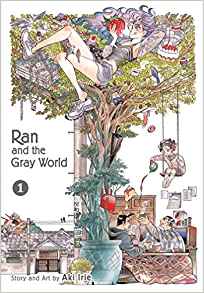
Ran and the Gray World Volume 1 by Aki Irie

Ran and the Gray World blends slice of live pacing with beautiful illustrations in this story about a girl with magical tennis shoes that transform her into a grown-up. Ran is being forced to do her chores in her cluttered home, and her older brother Rin strategically hides her shoes in a light fixture in order to get her to clean up. Ran’s homelife is just as haphazard as her room, since her mother is a powerful sorceress who has to live away from her family to deal with magical business.

Shizuka appears accompanied by a flock of birds and a profusion of flower petals, conjuring up sweets that threaten to engulf the whole neighborhood. Irie’s illustrations are wonderful at showing how things get off-kilter and out of control with such a powerful sorceress paying a visit, as Shizuka and her daughter lean up against a giant strawberry while eggs hatch into giant chickens and doughnuts threaten the roofing of the family’s near neighbors. Shizuka seems utterly unaware of the effect of her sudden appearance and disappearance on her family, and doesn’t seem to care that she’s annoying her son as she dazzles her daughter with magic.

Ran and the Gray World

Ran continues to throw on her tennis shoes and run away, with her most extended adventure involving dropping out of the sky onto the penthouse garden of playboy, who is intrigued by Ran. They remodel her guest room and have an additional random encounter at a local festival.

One aspect of the book that made me uneasy was seeing how Ran was getting placed in situations with adult men who are reacting to her as a young woman. While nothing much happens due to her magical powers, naiveté, and the vigilant actions of her older brother Jin, this is certainly something that I’d like to see minimized in further volumes. The first volume did such a great job setting up a unique magical world, though, I’m hoping that the series doesn’t turn into another Bunny Drop. Uneasiness aside, Ran and the Gray World seems like a must for low key fantasy fans. The magical world Irie creates with her illustrations is lovely, and it is shown off well by the larger volume size and deluxe treatment of the Viz Signature Edition.

Filed Under: Manga Reviews, REVIEWS

ECHO

December 9, 2018 by Sean Gaffney

By Akira and Oguchi, based on the Vocaloid song by Crusher-P. Released in Japan by PHP Institute. Released in North America by J-Novel Club. Translated by Kevin Chen.

There is a certain subgenre of novels that are based on Vocaloid songs. We’ve seen a few of them over here, Kagerou Daze being the most obvious. But Kagerou Daze has sort of morphed into a franchise of which the original songs are but a part. ECHO, on the other hand, is a stand-alone novel based on the video of the same name, and after reading it it really doesn’t feel like you can separate the two works. In fact, I’d recommend tracking down the video on Youtube and watching it before reading this book – it doesn’t really spoil much beyond the girl who’s already on the cover, and it helps to make sense of some of the surreal events happening in the middle and end of the book, which quote most of the song outright. As for the book itself, in addition to fans of the original work, I’d recommend it to fans of dark horror with a mystery tinge. As for me, it was well-written, but it didn’t grab me as much as I’d have liked.

Our heroine, much as she spends much of the book denying it, is Hitomi, a teenage girl who helps her family run an electronics store. (Her last name is an aggravation to her but also a character point, so I’ll avoid it for now.) While watching the store one afternoon, she suddenly finds herself flipping through various places as if she were a TV program, finally ending up falling from quite a height into a bizarre amusement park. Fortunately, she doesn’t go splat, and runs into a few other people in the park – her childhood friend, who she’s somewhat estranged from now; the daughter of the richest family in their (very rural) town; a tall introverted girl who seems to be connected to the rich girl in some way; and an adult actor who says he was just passing through town and somehow wound up here, and seems suspicious right from the get-go. Where are they? Why can’t they remember how they got there? And what’s with the girl with six arms and a TV for a head?

The novel is written by a seasoned pro at the genre, and it shows, there’s no awkward “webnovel” prose that you’d see in some works these days. There is some striking imagery, starting with the prologue, which features a horrific sight sure to get rid of any readers who don’t like horror at all. That said, I wish I’d had more time to get to know the characters before events caught up with them. There’s also the presence of Hitomi, which doesn’t really match any of the others, and whose explanation is far from satisfying – clearly she was there because the narrator needed to be an “everygirl” and audience surrogate. She insists she’s not the sort of person to be a protagonist, which may be true of shoujo manga, but if you turn towards Japanese novels for young adults, she absolutely is. The most interesting part of the book to me was probably the real world perspective of the mother of one of the characters, who ends up being tied into the plot far more than expected.

In the end, this is a good book that does what it set out to do – craft a novel around a piece of music. Fans of the song will enjoy it. (Also, wow, what a depressing “this is what happens after you die” this novel has. Pass on that.)

Filed Under: ECHO, REVIEWS

We Never Learn, Vol. 1

December 8, 2018 by Sean Gaffney

By Taishi Tsutsui. Released in Japan as “Bokutachi wa Benkyou ga Dekinai” by Shueisha, serialization ongoing in the magazine Weekly Shonen Jump. Released in North America by Viz Media. Translated by Camellia Nieh.

It always feels reassuring to have a romantic comedy coming out in Shonen Jump in amongst all the friendship, training and victory. Especially coming out in North America, where Jump romantic comedies have not always had the best track record. Nisekoi was a recent hit, but it’s an outlier – To-Love-Ru and its sequel were farmed out to a different company, and does anyone remember Strawberry 100%? That said, like Nisekoi, We Never Learn seems to be falling more on the side of “romantic comedy with strong character development” rather than “romantic comedy with lots of panty shots and sexual suggestiveness”. Like, well, those other two series. As a result, it’s far more my type of series. The main characters are all types, but they’re enjoyably written and aren’t aggravating. Nisekoi fans may find Fumino a bit familiar to Onodera, but that’s no surprise, given the author wrote Nisekoi’s magical girl spinoff.

Nariyuki is a serious young man from a poor family who needs a recommendation to get into a good school. He’s an excellent student, not through innate ability but hard study. He is, sadly, not the best in his class in science and literature, thanks to two geniuses who effortlessly get the best grades. Now he is being told to tutor these two, as they each have goals that clash with their specialty – literature genius Fumino wants to study astronomy but is wretched at science, and Rizu wants to go into the arts despite being seemingly awful at understanding feelings and emotions. Things get off to a rocky start, but Nariyuki is not one to give up easily, To make matters more chaotic, Naruyuki’s friend Uruka needs to study in order to stay on the swimming team, but she’s bad at EVERYTHING. Can he get these girls to bone up on the right things and achieve their dreams? And, more importantly, fall in love with one of them?

Well, I say that, but at this point in the series love is not all that high on the agenda, which is content to introduce the main cast and have them bond as friends. The plot is very sedate with few surprises – the girls meet Naruyuki’s family, the girls each reveals secret asides to themselves, etc. One of the interesting things about the title I noticed is that there’s no “first girl” here – both main female protagonists are introduced at once, so you don’t get a sense of who the author favors. (Sorry, Uruka, you arrive three chapters late.) I suspect that Western readers will gravitate to Rizu – let’s face it, Fumino is the classic “nice girl who always comes in second” sort (see also Nisekoi) – but it’s going to be more of a surprise than these titles usually pull off. The author also has a good flair for art and facial expressions – there’s just a lot of amusing faces here, and I found myself laughing at them as much as the characters and situation.

So overall a pretty strong debut, and I can see why it was licensed. I look forward to seeing these girls make painfully slow progress in their efforts to learn outside their specialties.

Filed Under: REVIEWS, we never learn

Toradora!, Vol. 3

December 7, 2018 by Sean Gaffney

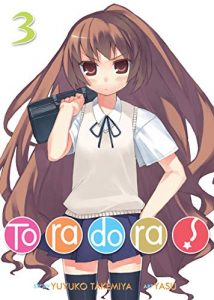
By Yuyuko Takemiya and Yasu. Released in Japan by Dengeki Bunko. Released in North America by Seven Seas. Translated by Jan Cash & Vincent Castaneda. Adapted by Lora Gray.

In many ways this feels like a filler volume in the series, but I think it’s actually focusing more on the main cast and how Ryuuji is able to understand them – or not, as the case may be. Ryuuji is a nice, kind person but he’s not all that good at getting “what women want”, so to speak. That applies to Taiga, who spends much of this book intensely frustrated and upset – even for her. It also applies to Ami, who has been given her depth in the last book and so is free to backslide and be the ‘evil transfer student’ everyone was fearing – or is she merely trying to aggressively flirt? And then there’s Minori, who is theoretically Ryuuji’s crush, but who he seems to try to understand the least, letting her walk through the novel being Taiga’s goofy best friend without pondering why she acts the way she does. It’s not just “I am weird”, Ryuuji. By the end of the book he hasn’t figured much out either, but the stage is at least set for the next part of the series.

The book takes place immediately after the previous one, where Ami put Ryuuji in a compromising position and is now gleefully watching the fireworks. Taiga, of course, insists she is not angry, and we know what that means. Worse, swimming classes are up next, and Taiga has to wear a swimsuit (thus showing off her childlike figure) and also swim (which she can’t). Things come to a head when Ami invites Ryuuji to her summer home over the break, so they could get to know each other better. Taiga snaps, and we’re set up for a swimming challenge – the winner essentially gets Ryuuji. You could argue Ryuuji’s biggest mistake in this book is not shutting this down before it starts, but instead, he does his best to teach Taiga to swim and try to figure out why she’s so upset – which isn’t quite the reason he thinks.

This book came out about twelve years ago in Japan, and so a lot of the things that might feel obvious to the reader were a lot fresher then. If the big drawback in this volume is that there’s very little forward movement, the plus is this allows us to see a lot of silly and/or heartwarming scenes that we might not otherwise have gotten. The cold opening at the hospital, where we worry that Ryuuji’s mother may have died but then realize the far more amusing truth, is an absolutely perfect scene. Ami too is a horrible delight, and the humiliation she goes through near the end once again feels especially deserved. But as always the main reason to love this is Taiga, who is a bundle of issues and all the more readable because of them. Her “solution” to the challenge was fantastic, if also appalling.

If I recall correctly from the manga, the next volume should be especially strong. This one isn’t a world beater, but it’s fun, especially if you like seeing Taiga blow up.

Filed Under: REVIEWS, toradora!

  • « Go to Previous Page
  • Page 1
  • Interim pages omitted …
  • Page 156
  • Page 157
  • Page 158
  • Page 159
  • Page 160
  • Interim pages omitted …
  • Page 346
  • Go to Next Page »
 | Log in
Copyright © 2010 Manga Bookshelf | Powered by WordPress & the Genesis Framework