• Skip to primary navigation
  • Skip to main content
  • Skip to primary sidebar
  • Home
  • About Us
    • Privacy Policy
    • Comment Policy
    • Disclosures & Disclaimers
  • Resources
    • Links, Essays & Articles
    • Fandomology!
    • CLAMP Directory
    • BlogRoll
  • Features & Columns
    • 3 Things Thursday
    • Adventures in the Key of Shoujo
    • Bit & Blips (game reviews)
    • BL BOOKRACK
    • Bookshelf Briefs
    • Bringing the Drama
    • Comic Conversion
    • Fanservice Friday
    • Going Digital
    • It Came From the Sinosphere
    • License This!
    • Magazine no Mori
    • My Week in Manga
    • OFF THE SHELF
    • Not By Manga Alone
    • PICK OF THE WEEK
    • Subtitles & Sensibility
    • Weekly Shonen Jump Recaps
  • Manga Moveable Feast
    • MMF Full Archive
    • Yun Kouga
    • CLAMP
    • Shojo Beat
    • Osamu Tezuka
    • Sailor Moon
    • Fruits Basket
    • Takehiko Inoue
    • Wild Adapter
    • One Piece
    • After School Nightmare
    • Karakuri Odette
    • Paradise Kiss
    • The Color Trilogy
    • To Terra…
    • Sexy Voice & Robo
  • Browse by Author
    • Sean Gaffney
    • Anna Neatrour
    • Michelle Smith
    • Katherine Dacey
    • MJ
    • Brigid Alverson
    • Travis Anderson
    • Phillip Anthony
    • Derek Bown
    • Jaci Dahlvang
    • Angela Eastman
    • Erica Friedman
    • Sara K.
    • Megan Purdy
    • Emily Snodgrass
    • Nancy Thistlethwaite
    • Eva Volin
    • David Welsh
  • MB Blogs
    • A Case Suitable For Treatment
    • Experiments in Manga
    • MangaBlog
    • The Manga Critic
    • Manga Report
    • Soliloquy in Blue
    • Manga Curmudgeon (archive)

Manga Bookshelf

Discussion, Resources, Roundtables, & Reviews

restaurant to another world

Restaurant to Another World, Vol. 6

November 18, 2025 by Sean Gaffney

By Junpei Inuzuka and Katsumi Enami. Released in Japan as “Isekai Shokudou” by Hero Bunko. Released in North America by Airship. Translated by Elliot Ryouga. Adapted by Rebecca Schneidereit.

It has been over five years since the last time I reviewed this series, so pardon me for forgetting literally everything about it. Which is a shame, as this is a series that very much rewards the sort of reader who keeps a spreadsheet showing the main characters and when they first arrive and what their favorite meals are. There was a two and a half year gap between the 5th and 6th books in Japan, but the likely reason this one took so long is a) renegotiating the contract with a publisher that is famously cool towards translating its stuff, and b) the fact that we still don’t have a Book 7. Nothing since 2021. Well, the manga is still running. That is to say, the second manga, which is digital-only and chapter-only, apparently. Basically, this is a somewhat cursed series, but at least there’s delicious food throughout. It still makes you hungry as you read it.

As with previous volumes, this consists of 20 chapters, each titled with a food dish of some sort, and gives us a little story about who is ordering it. That said, there are a few other plot-related things going on here. There’s an infestation of moth monsters that’s going to go out of control unless something is done, and this will involve getting the hiding Princess Victoria involved – under her code name Pudding, which makes it especially amusing when she runs into fellow diner Heinrich, aka “Fried Shrimp”. We also meet a new waitress from our own world, who is the niece of the Master and is trying to learn so that she can be a chef and start a restaurant of her own. Fortunately, she has her uncle’s temperament as well, so takes the otherworld stuff in full stride. Though Aletta might be a bit jealous of Saki’s reading and writing skills…

The fact that this takes place across a long period of time, and you never know when each new chapter will be, keeps the mind alive in among the long, lingering descriptions of people eating food. One chapter shows us a woodcutter and his wife, along with their two kids, showing a noble who has gotten lost the restaurant. Two chapters later, we see a younger woodcutter proposing in the same restaurant. And in another we see the late owner of the restaurant running the show, with the current Master just a newbie who’s still learning the ropes. A large chunk of this seems to take place before Kuro arrives at the restaurant, as there’s very little of her here, but we do get a lot of Aletta, who constantly worries she’s not being useful enough (hence why Saki’s arrival sent her into a panic.) Unlike the anime, there’s little to no romance – while the restaurant is encroaching on the fantasy world more and more, it’s in terms of establishing bonds of friendship that will allow them to reach out in times of need.

This was really good. I hope it’s not the last one.

Filed Under: restaurant to another world, REVIEWS

Restaurant to Another World, Vol. 5

November 4, 2020 by Sean Gaffney

By Junpei Inuzuka and Katsumi Enami. Released in Japan as “Isekai Shokudou” by Shufunotomosha. Released in North America by Seven Seas. Translated by Elliot Ryouga. Adapted by Nino Cipri.

Last time I said that the book jumped around several time periods, and that goes double for this book, which shows us a few of the ongoing characters and their development but is also happy to show us how the fantasy world is coming from a period where there were battles to the death between humans and demons, between Empires and Kingdoms, and between vampires and “liliputians”. Indeed, it’s not really clear how time connects the world to the restaurant – there’s one story here which feels like it reads as a vampire from way in the past ends up at the restaurant of the “present”. That said, I honestly think that I’d need to go back and read the pr3evious books if I wanted to keep track of it all. This is a series about fantasy characters eating food, and while it’s doing its best to provide plot and characterization to go along with that, anything else is secondary. Which, as I’ve said before, makes it hard to review.

The “big” development at the start of the book is that the owner puts a sign on the fantasy world-side of the door that translates the restaurant’s name and purpose for the denizens of that world. Until now, the clientele it had attracted – at least in regards to first-timers – always tended to be either people in dire straits or people who naturally say “oh hey, what’s this door in the middle of nowhere?”. Now that it can say what it is, it’s attracting more newcomers who might have been wary were it just a door with Japanese written on it. Of course, even if they’re aloof elves that literally live in the clouds, they still end up enchanted by the clouds. I also liked that the customers are interacting with each other in ways other than talking about the food – one bard with a broken leg who found the door in the middle of nowhere gets healed by a priestess, meaning the restaurant is literally a life-saver.

The “main” cast still don’t do much but serve food. I had wondered if the series might be going for some sort of romance between the owner and Aletta, but there’s absolutely no sign of that here – I think it’s got nothing else on its mind but food. Aletta is still working on recovering from the abuse she received in the fantasy world – when she comes down with a bad cold (and gets some egg porridge), she fears that she’ll end up being fired for being unable to work. Kuro has a more difficult problem – she’s hideously overpowered, doesn’t speak (she communicates with customers telepathically, and none of them notice this at all), and is at heart a stoic sort of character. She seems to care for Aletta and the owner, but it’s hard to get a grasp on her. I’m not sure we ever will.

All this and food, food, food. There’s roast beef, Chinese congee, mille crepe cake, etc. The series continues to be a peaceful meal of a book.

Filed Under: restaurant to another world, REVIEWS

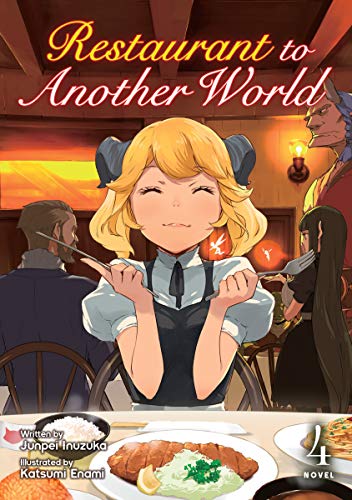
Restaurant to Another World, Vol. 4

June 20, 2020 by Sean Gaffney

By Junpei Inuzuka and Katsumi Enami. Released in Japan as “Isekai Shokudou” by Shufunotomosha. Released in North America by Seven Seas. Translated by Elliot Ryouga. Adapted by Nino Cipri.

This sat in my queue for a while, not because I don’t enjoy it, but because I know reviewing it will always be hard, as it’s 75% loving descriptions of food. We get rice burgers, French onion soup, Oyakodon, Peperoncino and potato chips, and trust me, they’re all described so that you immediately want to make the meal yourself. Sadly, there aren’t recipes included in these books the way you see with a lot of cooking manga (perhaps the manga version will add them?). In terms of the restaurant itself, the biggest development is that Aletta gets a raise, as she’s now been there for one year. That said, there’s a lot of development on the other side of the door in terms of worldbuilding. Indeed, we finally get the origin story for the doors, and it shows a tie between both worlds that is both surprising and obvious at the same time. Turns out it runs in the family.

This isn’t to say that we don’t get glimpses of the future as well. One of the book’;s more annoying but tolerable habits is to show a character won over by something the restaurant is serving and think about how to create it in their world, followed by a caption talking about how in a hundred years’ time, their names would be legendary in terms of achieving the objective. The fantasy world may lack preservatives, but it’s making do, and finding ways to at least come close to things that the restaurant can serve. There’s also more discussion of half-elf prejudice – we’ve seen this discussed before, but here we get it starkly laid out, as by chance one girl in a village born to two half-elfs is a “changeling” – essentially meaning she develops in elf terms. This leads to her being abandoned by the village for being “slow”, when in reality it’s more she’s still a baby. Fortunately, she gets rescued and apprenticed.

The book jumps around more than usual – there’s several chapters with the previous generation at the restaurant, and the prologue and final chapters deal with the generation before that. It turns out that Yomi, one of the saviors of the world from ancient times, was essentially blown up into our dimension, and ended up being found by the current manager’s grandfather. Them marrying is what led to the restaurant and the special relationship it has with her old world. Her husband has passed on, but she’s still around, and shows up at the final chapter to give her grandson the “master key” – in essence, showing she trusts that he can handle everything going forward. It’s not a “I’m about to die” sort of scene, but reads more as a passing of the torch – indeed, she reads like a tough old grandma, and even meets up with one of her old compatriots, now also an old man.

So another solid entry in the series, though as noted you’d better love descriptions of food. Fans should be quite hungry – I mean, happy.

Filed Under: restaurant to another world, REVIEWS

Restaurant to Another World, Vol. 3

September 23, 2019 by Sean Gaffney

By Junpei Inuzuka and Katsumi Enami. Released in Japan as “Isekai Shokudou” by Shufunotomosha. Released in North America by Seven Seas. Translated by Elliot Ryouga. Adapted by Jude Wetherell.

We’re introduced to the third main cast member from the anime here. Kuro (who calls herself Black in her inner monologue, but they mean the same thing anyway) is an ancient legend now living, literally, on the moon because in her true form she causes people to drop dead around her. Fortunately, she can suppress it when she turns into an elf girl and can enter the restaurant, where she falls in love with the chicken curry and stays to become the restaurant’s second waitress. That said, much like the first two books, the staff don’t get much focus at all. The emphasis is on the diners – some old friends, some new – and the food they’re eating. We jump around a lot more here, sometimes confusingly (one chapter ends with an ancient warrior going to see his late lover, who seems to have the same name as our sweets-loving princess), but if you love reading about food, this remains the light novel for you.

Indeed, sometimes the novel seems to actively avoid any conflict at all. The first and second volumes had a few arguments (usually about food), but there’s none of that here, as they’ve learned to simply avoid the people they know would cause friction. It’s especially obvious with Kuro, who once has an ancient Elven priestess come for food and completely not notice her, despite mentioning her fearsome and terrifying past earlier in the book. It was a bit frustrating to me till the end, when it became apparent that – much like her power of “death” – Kuro seems to be making it so that she’s unnoticed by all but the strongest folks – and they’re not saying anything. She was asked by “Red” – the dragon we’ve seen earlier – to essentially be security for the restaurant in case someone tries to kidnap the owner and take him back to the other world. So far she’s done her job very well, but it can lead to a certain… I want something exciting to happen, dammit!

Till then, there’s just getting excited about the food. We get a few interesting variants here. Birthday Cake comes up to celebrate a child’s not-quite-coming-of-age-but-close-enough, and we see the Master preparing BBQ for a Japanese festival he’s participating in (we do not actually see the festival). The sake-steamed clams sounded amazing. And oh yes, right near the end as the legendary warrior is experiencing the wonder of croquettes, we find that the Master and his father (who we also see, as several of these chapters take place “in the past”) may not be as completely unrelated to the fantasy world as previously expected. I liked the idea, very appropriate for a book like this, that since the master was not able to use, say, magic or swordfighting in modern-day Japan, that he was taught how to be a marvelous chef instead. You pass down what you can to teach your children.

We’ve seen a plethora of food-related manga and novels recently, but this one remains in the top tier for both descriptions of delicious food and also giving you enough characterization and plot to keep coming back for more even though it’s still a bit thin. A yummy read.

Filed Under: restaurant to another world, REVIEWS

 | Log in
Copyright © 2010 Manga Bookshelf | Powered by WordPress & the Genesis Framework