• Skip to primary navigation
  • Skip to main content
  • Skip to primary sidebar
  • Home
  • About Us
    • Privacy Policy
    • Comment Policy
    • Disclosures & Disclaimers
  • Resources
    • Links, Essays & Articles
    • Fandomology!
    • CLAMP Directory
    • BlogRoll
  • Features & Columns
    • 3 Things Thursday
    • Adventures in the Key of Shoujo
    • Bit & Blips (game reviews)
    • BL BOOKRACK
    • Bookshelf Briefs
    • Bringing the Drama
    • Comic Conversion
    • Fanservice Friday
    • Going Digital
    • It Came From the Sinosphere
    • License This!
    • Magazine no Mori
    • My Week in Manga
    • OFF THE SHELF
    • Not By Manga Alone
    • PICK OF THE WEEK
    • Subtitles & Sensibility
    • Weekly Shonen Jump Recaps
  • Manga Moveable Feast
    • MMF Full Archive
    • Yun Kouga
    • CLAMP
    • Shojo Beat
    • Osamu Tezuka
    • Sailor Moon
    • Fruits Basket
    • Takehiko Inoue
    • Wild Adapter
    • One Piece
    • After School Nightmare
    • Karakuri Odette
    • Paradise Kiss
    • The Color Trilogy
    • To Terra…
    • Sexy Voice & Robo
  • Browse by Author
    • Sean Gaffney
    • Anna Neatrour
    • Michelle Smith
    • Katherine Dacey
    • MJ
    • Brigid Alverson
    • Travis Anderson
    • Phillip Anthony
    • Derek Bown
    • Jaci Dahlvang
    • Angela Eastman
    • Erica Friedman
    • Sara K.
    • Megan Purdy
    • Emily Snodgrass
    • Nancy Thistlethwaite
    • Eva Volin
    • David Welsh
  • MB Blogs
    • A Case Suitable For Treatment
    • Experiments in Manga
    • MangaBlog
    • The Manga Critic
    • Manga Report
    • Soliloquy in Blue
    • Manga Curmudgeon (archive)

Manga Bookshelf

Discussion, Resources, Roundtables, & Reviews

i've been killing slimes for 300 years

I’ve Been Killing Slimes for 300 Years and Maxed Out My Level, Vol. 17

December 4, 2025 by Sean Gaffney

By Kisetsu Morita and Benio. Released in Japan as “Slime Taoshite 300 Nen, Shiranai Uchi ni Level MAX ni Nattemashita” by GA Novels. Released in North America by Yen On. Translated by Tristan Hill.

I will admit that I never thought that I would be comparing the meandering, Cute Girls Doing Cute Things, decidedly ambivalent to romance despite its yuri fanbase I’ve Been Killing Slimes for 3400 Years to the energetic, Anything Can Happen, very very bisexual and horny series The 100 Girlfriends Who Really, Really, Really, Really, REALLY Love You, but here we are, they both tend to handle their casts the same way. Both have a cast that is simply too large to juggle everyone all the time. So 100 Girlfriends will see Rentaro going out on a date with four of his girlfriends, and a footnote will say “the others were busy and couldn’t make it”. Likewise, Azusa will always be involved in the wacky antics of the short story, but the supporting cast and expand or contract depending on the needs of the author. Which is good, as I tend to have a lot of trouble remembering who is who in 300 Slimes beyond the ones who live in the house.

The stories: 1) Flatorte goes to visit her parents, and the rest of the house residents come with. They end up babysitting a neighbor’s blue dragon child, which causes havoc as they have no idea how to deal with baby blue dragons; 2) Sandra has a flower grow on top of her head, and attracts attention, both good and bad; 3) Pecora feels her idol singing career is in a rut, so goes on a training camp, and forces Azusa to come; 4) Vania needs to get her Leviathan Flying License renewed, and forces Azusa to come along; 5) A demigod escapes from the underground and starts creating magical girls… pardon me, magical gurus; 6) Pecora is horrified to find a demonic sweets company is making knockoffs of Azusa’s edible slimes, and forces her to fix the problem; and the after story, starring Wynona, she goes to learn magic from Wizly, but finds that she’s actually a genius.

As you can see by the short stories, a lot of these involve pushy characters forcing Azusa to do things to advance the plot. This is the danger of having a passive character as the lead. Azusa is immortal, can defeat almost everyone in the world, and is quite content to hang at her cottage on the hill with her family and have nothing happen to her. This is very undramatic. Fortunately, other characters do seem to be growing, if only a little, in this series where even the author admits they cannot actually have dramatic events. Flatorte is noticeably more mature in the stories that feature her doing more than eating, and if folks had listened to her a bit more, the first story would have gone much easier. Likewise, while Halkara has her drunkard moments, she’s allowed to also be very intelligent and innovative. It’s nice to see in a series where nothing usually happens.

Look at that, 500 words. I have defeated another volume. See you next time.

Filed Under: i've been killing slimes for 300 years, REVIEWS

I’ve Been Killing Slimes for 300 Years and Maxed Out My Level, Vol. 16

April 9, 2025 by Sean Gaffney

By Kisetsu Morita and Benio. Released in Japan as “Slime Taoshite 300 Nen, Shiranai Uchi ni Level MAX ni Nattemashita” by GA Novels. Released in North America by Yen On. Translated by Tristan Hill.

I was sort of dreading this volume, to be honest. This series never has anything happen to it other than adding new cast, and at the moment the 28th volume is coming out in Japan, meaning we get further and further behind every time we see it. I’m sure Yen Press is trying to renegotiate its light novel contracts to say “surely we can cancel SOME titles, right?”. But if ever there was time for a really good volume, this is the time, as the second season of the anime debuted last week, and is promising more of the same, only in animated form. Great news, though, this is actually quite a strong volume, when compared to other volumes in this series. It’s strong because a) it’s run out of CD dramas to add, so has to include another “Laika’s Schooldays” short, which are excellent. Second, there are fewer, longer short stories within, and that means they have room to breathe for once.

The stories: 1) Pecora is holding a comedy competition, and non-demons are also invited to join. Laika and Flatorte, Flafa and Shalsha, and Rosalie all compete from Azusa’s team, and her daughters ask her to write them a script, because she’s the best at comedy (note this is Japanese comedy, meaning they’re all boke/tsukkomi routines); 2) While visiting a museum, Azusa touches an artifact that turns her into an old lady for a week, and while dealing with this, she’s asked to go to a witch convention; 3) Halkara suggests taking their pet mimic for a walk; 4) Goodly Godly Goddess has written an RPG, and the *entire* cast of the series is brought in to populate it; and in Laika’s side story series, her third year begins with dealing with some delinquents who are doing the dragon equivalent of joyriding.

There’s only one weak story here, with the mimic. The old lady one is also not great, but I was highly amused with its idea of a witch convention being much like a real work convention, with cute games and prizes for the winners. The comedy one I was expecting to be bad, but it really worked well – the routine Azusa wrote and Flafa and Shalsha refined was not only surreal and creepy but also funny, though I agree with the judges that Laika and Flatorte deserved to win, as they’re both naturals. Best of all is the final main story, a giant parody of RPGs like Dragon Quest III. This is the second time that Azusa has essentially tested a game for god (something she points out), but this one is more involved and involves everyone pointing out all the cliches and poor writing that go into these RPGs where you frequently have to smile, nod, and go get the fruit so that the boy will give you a clue. I also had fun trying to figure out who would be cast as what (as does Azusa).

This is not a good book as a book, mind you. It’s a good volume of Killing Slimes for 300 Years. There’s a difference. But if you like the series, this is solid.

Filed Under: i've been killing slimes for 300 years, REVIEWS

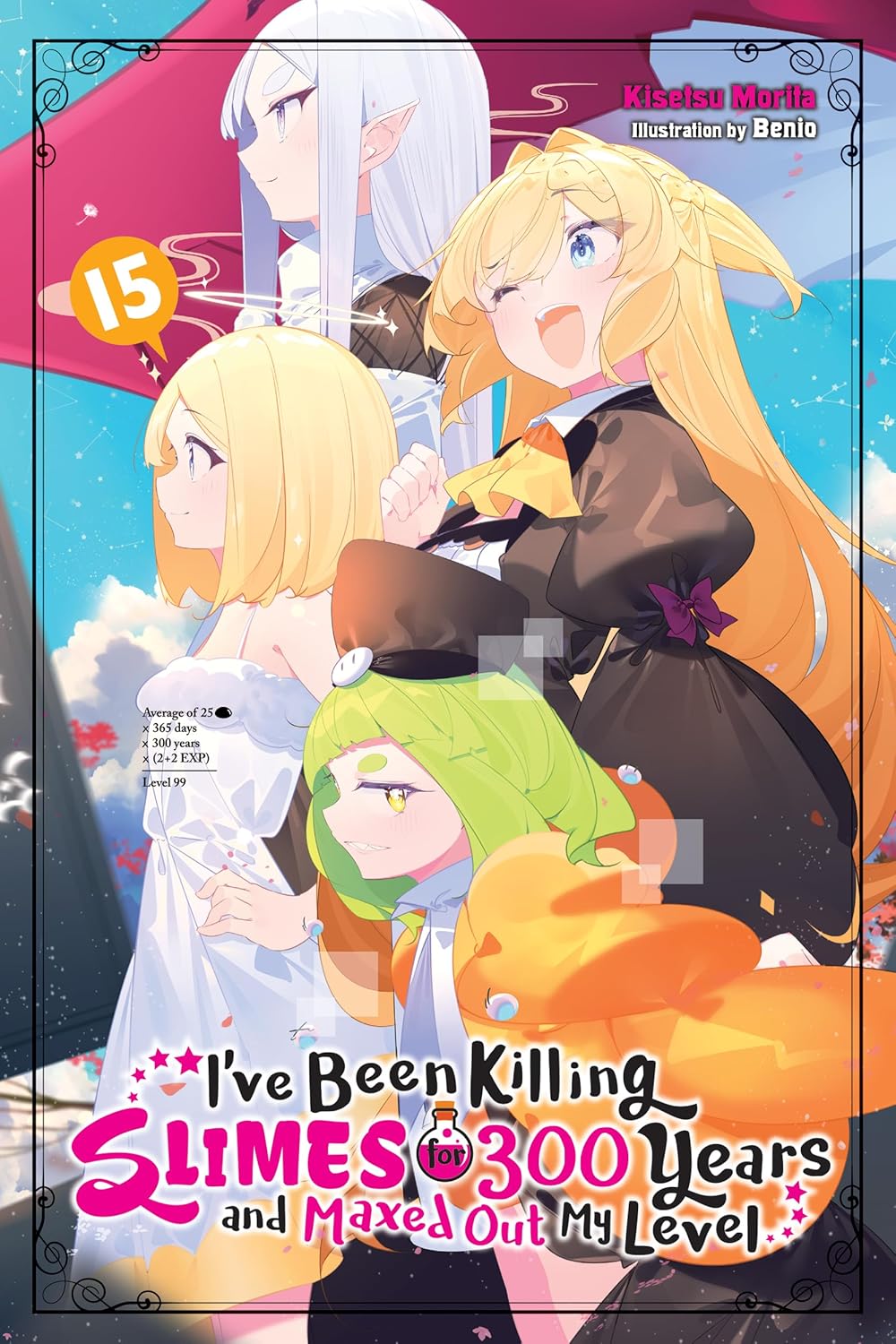
I’ve Been Killing Slimes for 300 Years and Maxed Out My Level, Vol. 15

November 22, 2024 by Sean Gaffney

By Kisetsu Morita and Benio. Released in Japan as “Slime Taoshite 300 Nen, Shiranai Uchi ni Level MAX ni Nattemashita” by GA Novels. Released in North America by Yen On. Translated by Tristan Hill.

This one was scheduled for the summer but got delayed several months, possibly duie to the change in translators we see with this book. Honestly, I’m not too sure it’s a bad thing. As a book series that is supposed to have plot and characterization and an endpoint in sight, this is a failure. This series would run away screaming from actual drama. But I think it’s best if I try to think of it as music. Let’s say you buy a 90s house compilation on CD. You want variations on a basic concept, that concept being 90s house. It should not stray far at all from that core concept, because that is why you bought the CD. Likewise, if people want more drama in their slow life, go read Kuma Bear, which is perhaps one step up from this. This is only the fluff, only the slice-of-life. As such, it’s perfectly fine. It gives you 6 main tracks on the CD, as well as 2 bonus CD remixes that you can skip.

The six main stories: 1) Beelzebub takes the cast to meet a group of living monoliths, as well as their Elder monolith, who houses… well, a big surprise; 2) After hearing that there’s an area of the desert where there are no slimes, curiosity has Azusa and company try to see why, and they find out that they really hate the heat; 3) After Halkara and Laika both discover that this year is unlucky for them, Azusa meets up with a new god, who explains how fate works in this world; 4) Falfa, Shalsha, and Sandra try to discover when Azusa’s birthday is, and then proceed to go on a journey to get her the perfect birthday present (Azusa secretly follows them); 5) The world’s worst thief returns, having been hired to go to a museum that has one of her targets and get rid of the mimics living there; 6) everyone goes to meet a famous hermit, and finds that trying to live up to expectations can be really embarrassing.

There’s also the 2 CD drama scripts. In the first, Falfa and Shalsha try to figure out who hit Halkara over the head with a massive metal jar (knowing Halkara’s proclivities might help get them the answer), allowing them to act like they’re in Case Closed, and in the other, Laika worries that she’s training the same way each time, and meets with each of the rest of the cast to try to figure out how to expand her boundaries. These both suffer greatly from being unable to hear them – they’re written for audio, and it shows. As for the rest of the book, well, it has what you’d expect. Lots of found family, lots of Azusa tsukkomi responses, lots of Laika having a massive crush on Azusa without any danger of it coming to anything. This is more than slow life, it’s almost no life. It does add a mimic to the cast… but we’ll need to wait till the 16th book to find out anything about her.

But it’s still relaxing, and still likeable, and yeah, I’ll likely grump about 16 as well.

Filed Under: i've been killing slimes for 300 years, REVIEWS

I’ve Been Killing Slimes for 300 Years and Maxed Out My Level, Vol. 14

February 28, 2024 by Sean Gaffney

By Kisetsu Morita and Benio. Released in Japan as “Slime Taoshite 300 Nen, Shiranai Uchi ni Level MAX ni Nattemashita” by GA Novels. Released in North America by Yen On. Translated by Jasmine Bernhardt.

I had been wondering what we’d see at the end of this new volume. For most of this series, the main storyline has taken up the first 2/3 of the book or so, and the last 1/3 was taken up by a side story about another character. First it was Beelzebub, and that ended up getting its own genuine spinoff. Then it was Halkara, which did not get a spinoff but at least allowed her to be something other than “the drunk with big boobs”. And then there was Laika, probably the best of the three spinoffs, and that also got a manga adaptation. That said, we are starting to run out of characters that can carry a side series. As such, it’s probably a good idea, given that the CD dramas themselves are long out of print in Japan, to add the original CD drama scripts. The unfortunate problem with this, of course, is that CD dramas, by their nature, cannot affect anything. Unlike the side stories, there’s no character development here.

As always, this is basically a short story volume, as there isn’t an ongoing plot. We start off by Azusa and company heading to an underground city as the demons have discovered that an elder god might be released if a seal comes undone… which of course it promptly does. They then attend a demon-run exhibition about apples, showing off varieties and different scientifically grown apple-related things. They go to a cat cafe run by the ghost city, and a ghost cat ends up possessing Azusa. And then it’s time for them to run their cafe again, but since the word about the cafe has gotten out so much, they worry that it’s gotten completely out of hand and will be too big. Fortunately, the pine spirit is able to step in and help them out, and we then see the cafe (now moved to a different location) doing well with its star waitress (Laika) there. And we then get the two CD drama stories, where Azusa discovers that this world has curry, and Azusa discovers this world has ramen.

There’s not really anything to really dig into here, and I don’t think readers really want there to be. A serious, life-threatening plotline would feel grotesquely out of place at this point in the series. It’s all fluff all the time, and this volume certainly provides it. It does perhaps pretend that there’s a major crisis with the first story, but the elder god turns out to be about as threatening as all the other gods we meet in this series, and by later in the book is wandering around the town like a tourist. As for the CD dramas, it’s nice to see the scripts, but god, they’re slight. There was a bit of yuri tease that the author has been pulling away from ever since they first wrote this and realized a yuri fandom they really did not want had glommed onto it. Other than that? It’s cute, it’s sweet, it’s funny.

The previous volume of this came out in 2022, and it’s been a long time ill we got this one. The next one should be much sooner. If you wanted more of it, this certainly is that.

Filed Under: i've been killing slimes for 300 years, REVIEWS

I’ve Been Killing Slimes for 300 Years and Maxed Out My Level, Vol. 13

November 14, 2022 by Sean Gaffney

By Kisetsu Morita and Benio. Released in Japan as “Slime Taoshite 300 Nen, Shiranai Uchi ni Level MAX ni Nattemashita” by GA Novels. Released in North America by Yen On. Translated by Jasmine Bernhardt.

Perhaps the author has been listening to me a little bit more, as this volume thankfully features no fake yuri tease followed by Azusa saying that she’s straight. Instead it leans entirely on the found family side of the equation, while doing what it does best: adding new characters and telling fun stories. There’s no plot to this story, no ongoing goal or character development, so as always there’s very little to grab on to for a review, but in terms of “cute girls doing cute things”, it serves well enough. The closest we get to depth in this one is when we’re introduced to the Grim Reaper by the two goddesses, and Azusa realizes that, having lived 300 years, she is definitely the baby in the room compared with the others, who casually discuss trying something as a hobby for fifty thousand years to see how it goes. Which of course makes it all the more impressive that she’s one of the biggest powerhouses in the world.

In this volume: everyone gathers at the city of the undead to celebrate Rosalie’s 200th Deathiversary; The group hikes up a mountain to see a historical citadel that fascinates Shalsha; Pecora forces Azusa and Beelzebub to join her in re-enacting a favorite book… by running across the countryside on giant robot Godzillas; Godly Goddess and Nintan invite Azusa to meet the world’s grim Reaper, who turns out to be a frustrates author (and is also entirely covered in hair, it’s implied because of introversion); Godly Goddess gets Azusa to try out her new “training program”, which ends up essentially being a Super Mario game, complete with Pecora as the final boss AND Pecora as the Princess in the castle; a phanton thief vows to steal one of the exhibits in Halkara’s museum, and Halkara is quick to capitalize on this; and in the side story, Laika fights her old master and her sister.

A lot of these feel more like they’re there to entertain the author rather than the reader. The citadel one in particular is very “let me show off all the research I couldn’t put into my Oda Nobunaga series”. Those who enjoy nerd references in their titles will be amused by the robot kaiju, as well as the long parody of platformer games. There’s also some actual fanservice, as Azusa gets stripped to her underwear by the game, but I think it’s meant to amuse rather than titillate. The author also apologizes to the artist for having to draw someone who isn’t a cute girl – I assume he means the reaper, who is indeed a ball of hair, but I have no doubt that a future book is going to take care of that. Basically, the series keeps chugging along, and that’s fine. The Laika stories seem to come to an end with this volume, and I wonder who will take their place now that we’ve had Beelzebub, Halkara, and Laika.

So yes, fluff, good fluff, but plotless fluff. The goal with these is always ‘is there enough here for a full review?” Just barely.

Filed Under: i've been killing slimes for 300 years, REVIEWS

I’ve Been Killing Slimes for 300 Years and Maxed Out My Level, Vol. 12

May 30, 2022 by Sean Gaffney

By Kisetsu Morita and Benio. Released in Japan as “Slime Taoshite 300 Nen, Shiranai Uchi ni Level MAX ni Nattemashita” by GA Novels. Released in North America by Yen On. Translated by Jasmine Bernhardt.

There has been some discussion over the last few years about “yuri tease” or “yuribait” series, i.e. series which promise yuri content but fail to deliver. (This is entirely separate from LGBT content, by the way.) Frankly, any series that was popular with yuri fans in 2004-2005 would likely be piled on by modern fans for this very reason. Gains in media have made people spoiled, especially when you hear things like “it’s a yuribait series because men exist in it” (heard that one recently about Birdie Wing). But sometimes I do have to admit that I feel like I’m being led on. I’m not even sure I *want* Killing Slimes to be yuri. I think it works much better as found family. But if I could pay the author to drop Azusa reminding us that she’s straight every single volume, I would. Especially when the side story is MariMite with dragons. In any case, this volume is pretty much the same as the previous ones.

(Cover art, you are REALLY not helping the author’s case.)

In this volume: Azusa finally decides to get some rice and make some Japanese dishes, but reckons without Laika and Flatorte’s appetites; a Tiger Festival in a nearby down proves to be an excuse for baseball jokes; the treasure dredged from the lake a book or two ago is appraised by “experts”; Azusa and the ghost characters investigate a haunted hotel; Kuku and Pondeli have invented the compact disc, but that also comes with the marketing for same; Falfa and Shalsha see what might (or might not) be a UFO and have a debate about it; and finally, Azusa, Beelzebub and a few others try to help the smart slime, one of the great sages of the world, meet up with another sage who lives on an inaccessible island. In the Laika side stories, Laika continues to mature and become a better fighter almost despite herself.

Again, there’s almost no depth to any of this. The closest we come is when Azusa, on board a ship with only Smarsly for company, actually tells them that she’s a reincarnation from Japan, and opens up about her regrets. Unfortunately, we only get her summarizing this, and it’s mostly done to make Azusa realize that she’s come to terms with and is happy with her new life, but it’s better than nothing. We’re introduced to a bunch of sages from an isolated island, who turn out to be dryads… who talk like Valley Girls. Fortunately, as we discover towards the end of the main story, they really are brilliant, and are happily discussing philosophy with Smarsly, so that’s good. It honestly astonishes me that these books tend to run 250-300 pages, as they feel light as air. Still, at the same time, aside from the walking back on the yuri tease, there’s nothing really wrong with them.

Another popcorn book down. It should please fans, provided they don’t ship Azusa with anyone.

Filed Under: i've been killing slimes for 300 years, REVIEWS

I’ve Been Killing Slimes for 300 Years and Maxed Out My Level, Vol. 11

January 31, 2022 by Sean Gaffney

By Kisetsu Morita and Benio. Released in Japan as “Slime Taoshite 300 Nen, Shiranai Uchi ni Level MAX ni Nattemashita” by GA Novels. Released in North America by Yen On. Translated by Jasmine Bernhardt.

I read this volume immediately after a volume of The Saga of Tanya the Evil, and I highly recommend it, because it probably made the book feel better than it actually is. That said, there are other reasons this is a very solid book in the series. First of all, the stories are slightly longer, which allows for a bit more depth to a series for which depth is eternally absent. Secondly, the side stories at the end move to focus on Laika, and I am far happier to read about Laika at Lillian Girls’ Academy (or whatever its name is here, MariMite is clearly what it’s supposed to be, though) than I ever was with Halkara. Seeing Laika wound up so tightly is both nostalgic and also a bit bittersweet – at least we know she has a peaceful future ahead of her. As for Azusa, well, she’s discovering that just because she’s resolved to take it easy and relax in her next life doesn’t mean she has to do that all the time.

Stories in this volume: our main cast has a moonlight picnic, which unfortunately leads to an existential crisis for the newest cast member Canimeow caused by our other newest cast member, Wynona; Azusa learns that, in fact, this world does have actual physical laws that she cannot break, so a trip to the moon is not happening soon; The cast take a day off by visiting the demon world’s main town, and help Fighsly raise a slime child… pet… whatever; after Azusa is paying too much attention to an injured Sandra, Falfa and Shalsha decide to run away from home; Halkara wondering what it would be like to eat a slime leads to a jellyfish that feeds off negative emotions; the aftermath of that, as Halkara, freed from her base desires, is super annoying; and the entire cast run a relay race.

The most interesting story was probably the relay race. Pecora has been reading yuri romances again, and declares that Azusa and Beelzebub have been “taking their friendship for granted” and not bonding the way that true friends do. Which Azusa is not going to be bonding with anyone anytime soon, she does come to a realization that she can occasionally try her hardest. Her past life doesn’t get a mention in this book specifically, but it’s clearly what has been driving her to sort of half-ass everything in this new life. She literally worked herself to death before. So of course she’s not going to want to do anything that goes near that. But at the end of the race, when she has to run faster and harder than she ever has before, she discovers that sometimes it’s OK. Sometimes you can try your hardest. Hopefully this is something that she can continue to teach her extended family in future volumes.

All this plus Laika at school, where we see her desperately trying to get out from under her sister’s shadow, and only partially succeeding. Despite the excitement of the race at the end, this is still a book for those who enjoy relaxed fare.

Filed Under: i've been killing slimes for 300 years, REVIEWS

I’ve Been Killing Slimes for 300 Years and Maxed Out My Level, Vol. 10

September 1, 2021 by Sean Gaffney

By Kisetsu Morita and Benio. Released in Japan as “Slime Taoshite 300 Nen, Shiranai Uchi ni Level MAX ni Nattemashita” by GA Novels. Released in North America by Yen On. Translated by Jasmine Bernhardt.

It’s the 10th volume of Killing Slimes for 300 Years, and that means that big, earth-shattering changes are in store. OK, no, that’s not what it means. This book is exactly the same as the previous nine. Anyone reading this to see characters change or grow is a glutton for punishment. Despite that, this is a very good volume, avoiding some of the series’ usual pitfalls. Azusa doesn’t even have to point out that she’s not gay! Instead, you get a lot of cute, fun stuff happening and the cast either causing it or reacting to it. Heck, even the Halkara side stories, which I have ragged on the last two books, are better than usual. The one thing that does happen in these books is the addition of new cast members, and we see that here, as we get a fortune-telling Moon Spirit. We also see Azusa’s estranged slime daughter Wynona, who pops up several times in this book and, despite her best efforts, ends up being part of the extended family.

Stories in this volume: they all go to a sweets fair, where Falfa and Shalsha try to sell the edible slimes as sweets; they see a fortune teller who is surprisingly blunt, and she reveals she’s yet another spirit, though she’s not really sure what she should be doing; Wynona asks Azusa and Laika to party with her for a competition in a dungeon, and shows off her seemingly aloof self (and her obsession with the color white); everyone goes to a peach festival, with Momotaro references galore, an 18+ exhibit Azusa has to stop everyone from going to, and so many peaches; Muu from the ancient civilization requests the help of Flatorte to help with an encroaching plant problem; after this, due to what happened, Flatorte is suddenly extremely calm and efficient; and Beelzubub shows off her new demonic credit card… though there’s still a few bugs in the system. Meanwhile, Halkara and Flatorte struggle with local cuisine, and Halkara gets sent by the goddess to Japan, where she runs into Azusa pre-death.

I mentioned that no one expects character development, though that isn’t strictly true here; by the end of her stories, Wynona is decidedly less tsun and more dere towards her “step” mother. That said, the highlight of the book is definitely Flatorte. She hasn’t been able to fight or blow off steam in a long time, and has been getting even more eccentric as a result. The solution to Muu’s problem, which involves using her freezing breath more than she ever has before, also leads to her suddenly being polite, calm, and competent; Azusa even compares her to a butler! That said, We Want Our Jerk Back, so it doesn’t stick. There is also an amusing Lovecraft pastiche towards the end, describing events we’ve already seen as if they were the most terrible things imaginable. Halkara’s stories aren’t great, and I wish she’d actually interacted with Japanese Azusa, but they didn’t bore or irritate me. Plus, they’re the last of that spinoff – next time Laika gets the side stories.

So yes, cute fluffy, relaxing, nothing earth-shaking happens. A good book to read after you’ve read something dark and brooding.

Filed Under: i've been killing slimes for 300 years, REVIEWS

I Was a Bottom-Tier Bureaucrat for 1,500 Years, and the Demon King Made Me a Minister

April 5, 2021 by Sean Gaffney

By Kisetsu Morita and Benio. Released in Japan as “Hira Yakunin Yatte 1500-nen, Maō no Chikara de Daijin ni Sarechaimashita” by GA Novels. Released in North America by Yen On. Translated by Jasmine Bernhardt and Sarah Neufeld.

Theoretically this is a Vol. 1, but I’ll be honest, I suspect this is a one-off. Those reading along with the parent series, I’ve Been Killing Slimes for 300 Years and Maxed Out My Level, will know of demon administrator Beelzebub and her assistants, as well as the Demon Lord Pecora. Three of the volumes featured side stories that talked about Beelzebub’s past and how she ended up where she is today. This volume collects those stories, as well as adding six others. So yes, you’ve read some of this before. That said, reading the stories in order does help to give Beelzebub’s transformation from office schlub to the grandiose demon we know a bit more impact. There are added cameos from most of the rest of the cast, though they have to be carefully done given most of the cast “meet” for the first time in the main series. It’s pretty much exactly what you’d expect in a spinoff.

In the six stories we’ve read previously, we see how Beelzebub got promoted about 11 steps up by a mischievous Pecora; how she copes with her aides, one of whom is less of an aide than she’s really like; how she gets to grips with audits and is here to show that the days of bribery and corruption are over; how she beats up her predecessor (who has tried to kill her multiple times), thus showing her strength; how she first meets Laika on a hot spring trip with her staff; and how Pecora leads her all around the area on a “date”, where she meets a certain witch, though neither will remember it. New stories have Beelzebub’s parents showing up; Pecora showing Beelzebub the wonder of travel the hard way; Vania shows that when it comes to food she becomes an entirely different character; Beelzebub meets Flatorte, who is exactly like you’d expect; Pecora stays over at Beelzebub’s place despite having a bad cold; and we learn the dangers of too many office plants.

Like its parent series, this is basically fun and fluffy. The only conflict in the entire book is when Beelzebub faces off against the now disgraced noble who was in line to be the next Minister, and there’s never any sense there’s danger to her or the others. The stories help to further develop Beelzebub’s character, with the most amusing ones being her amazingly embarrassing parents (where we essentially lean about Beelzebub’s redneck past) and the story about the ministry’s pathetic cafeteria, which upsets Vania so much that she goes on a veritable crusade to make it better in every possible way. The addition of Flatorte also helps to round out the “I actually met the entire cast years ago and have simply forgotten” gag we’ve seen in previous stories. And the relationship between Beelzebub and Pecora is amusing but also sweet.

In the end, this is pretty inessential, especially if you have Killing Smiles Vol. 5-7 already. But if you really love the universe, this is a decent volume to read more about it.

Filed Under: i've been killing slimes for 300 years, REVIEWS

I’ve Been Killing Slimes for 300 Years and Maxed Out My Level, Vol. 9

February 20, 2021 by Sean Gaffney

By Kisetsu Morita and Benio. Released in Japan as “Slime Taoshite 300 Nen, Shiranai Uchi ni Level MAX ni Nattemashita” by GA Novels. Released in North America by Yen On. Translated by Jasmine Bernhardt.

One of the main reasons to read this series, aside from the fact that it’s a relaxing read where you can be reasonably assured that nothing terrible will be happening to anyone ever, is the push-pull characterization of the lead character, Azusa was an OL in Japan, and she’s subsequently been living for… well, over 300 years by now… in a fantasy world. And yet, of course, for the most part she does not remotely act her age, because her mental state has remained in as much of an unchanging mode as her physical one. This allows for plots where she can be a bit doofy and cute, as well as the main role that she normally fills in the series, which is being a tsukkomi to everyone else. The best parts of this book are where we got to see an Azusa who’s not constantly making comebacks. That said, for those who love that, no fear, the book is still littered with examples.

Stories we see here: Azusa and company help Nintan to help get her followers back by figuring out what’s really driving the current mood; everyone goes to another world created by Godly Goddess and finds out what it’s like to be a slime in a world of slimes; Azusa gets a haircut that ends up being too short, and takes the opportunity to be “big sis” rather than “mom” with her daughters; she and the gang go to a “meat festival” which is basically a barbecue, then watch a bullfight with minotaurs which is EXACTLY like sumo; Azusa and her daughters visit the Great Slime and learn that a 3rd slime similar to them has been born… but she’s reluctant to make Azusa her new mom; and Sandra grows a mushroom hat after a big storm and learns the value of not getting too greedy. Meanwhile, Halkara’s spinoff exists.

The weak point of the book, as you may have guessed, is the Halkara spinoff chapters, which show no signs of getting a series like Beelzebub anytime soon. I like Halkara, but these prequel chapters simply aren’t very good. I’m also a little tired of Azusa having to say that she’s not gay at least once per volume – I get the sense the author knows there’s a large yuri fandom that follows this series and is unhappy about it. (Given the series has only women in it, I’m not sure what they expected.) Other than that, though, this is a pleasant enough book. Azusa’s reaction to her new “daughter” was quite amusing, and the constant comebacks in the bullfight were quite appropriate. The book does seem to really be leaning hard into Japanese culture once more – see the sumo, but also earlier, where a kanji pun has to be explained with the actual kanji for it to work. The translation is excellent, but the original makes for headaches, I expect.

It’s hard to write reviews for series like this, because there’s never going to be anything ever happening beyond the addition of new eccentric characters. But if you want something akin to Nisekoi or Laid-Back Camp, this fits the bill very well.

Filed Under: i've been killing slimes for 300 years, REVIEWS

I’ve Been Killing Slimes for 300 Years and Maxed Out My Level, Vol. 8

December 7, 2020 by Sean Gaffney

By Kisetsu Morita and Benio. Released in Japan as “Slime Taoshite 300 Nen, Shiranai Uchi ni Level MAX ni Nattemashita” by GA Novels. Released in North America by Yen On. Translated by Jasmine Bernhardt.

There are many times during my reading of the Killing Slimes for 300 Years series that I realize that not only are the characters treating this world as an excuse to relax and do inconsequential things, but so is the author. The author has many, many light novel series under their belt, some of them running simultaneously via different publishers, and you get the sense that this series is the one where the author can just kick back and not have to worry too hard about plot or characterization. It’s essentially a short story collection. The biggest thing that happens in this book is that Beelzebub has finally gotten the side stories that appeared in Books 5-7 farmed out to her own official spinoff (which has already been licensed over here for the spring) and so the last sixth of the book or so is devoted to Halkara, who gets a spinoff, seemingly set before the main series, where she… reviews restaurants. Don’t expect this to get spinoff novels anytime soon.

A breakdown of this book: Sandra goes through a Flowers for Algernon-style transformation after some super fertilizer turns her into a teenager with a high IQ (that said, there’s zero angst here); Pondeli invites the cast to the new Demon Arcade that she’s opening, whose games are hit-or-miss; the hippie pine spirit who does weddings finds that the flaky God who brought Azusa over is muscling in on her territory; that same God tries to reason with a fellow, more traditional God in order not to lose followers (and Azusa ends up leveling up EVEN MORE); they return to the ghost nation’s temple and tell ghost stories, most of which have a familiar bent; Azusa gets stranded on a desert island and meets what she thinks is a native tribe; a strange butterfly woman insists of staying with Azusa a week for no reason whatsoever and not because The Crane repays A Debt or anything; and Pecora starts a Youtube stream service from the demon world.

That last one may drive home the point that, aside from having elves, dragons, and slimes, this series is absolutely uninterested in building its own world, but would much rather leech off of Japan’s own past and present. The ghost stories Azusa tries to tell, common ones from Japan, are also very well known here. the cuisine Halkara samples is essentially variations on what you can get in any mid-sized town, complete with a conveyor belt sushi place. It’s… very low bar, to be honest, but it’s also relaxing for the reader, who might get a bit annoyed at streamers being a thing in this land of Gods and demons, but will likely quickly get over it. The stories are all basically about the same – cute – though I might have critiqued the desert island one more had it not ended how it did. (At least the natives did not go “unga bunga bunga’ a la Bugs Bunny.)

It’s cute, it’s fuzzy, and you will forget about it the moment that you finish it. And sorry, yuri fans, Azusa still insists that her house is home to family, and not, and I quote, “a special, gay dimension”.

Filed Under: i've been killing slimes for 300 years, REVIEWS

I’ve Been Killing Slimes for 300 Years and Maxed Out My Level, Vol. 7

July 26, 2020 by Sean Gaffney

By Kisetsu Morita and Benio. Released in Japan as “Slime Taoshite 300 Nen, Shiranai Uchi ni Level MAX ni Nattemashita” by GA Novels. Released in North America by Yen On. Translated by Jasmine Bernhardt.

I’ve gradually gotten used to this being the isekai version of K-On! (the illustrations helping along, as they get more and more ‘moe’ with every volume), and this volume in particular reminds me that Azusa’s laid-back style works so well here because the entire world is laid-back. The idea of someone being killed off or an evil villain trying to take over the world feels so foreign to everything we’ve read here to date, and the result is that you have a reader who is completely relaxed in reading this book. There’s never any serious conflict, and that’s good! The characters are all various varieties of “cute girls doing cute things’, and that’s good too! There are no stories in this series that run longer than about a quarter of the book, so you don’t have to pay too much attention, and if a character returns, you’re helpfully reminded where they showed up before. On the downside, reading this may make you fall asleep.

Things that happen in this book: At Pecora’s birthday party, she changes Azusa into a fox girl, which ends up backfiring when Azusa starts beating up everyone in the demon kingdom in an effort to eat abura-age, which reminds you how Japanese this series is and also likely makes you turn to Google. Azusa and company then go to see one of the goddesses in this world speaking at what amounts to a business convention, and she is startled to find this is the goddess who first sent her to this world… who has since been demoted, as she refused to deal with anything but cute girls. There’s a battle to see who the next Dragon Lord is, which turns out to be a typical beauty contest. We get Around the World in 80 Days, Killing Slimes style, which is to say it’s pretty boring. And in the longest story in the book, the cast discover an ancient civilization, now inhabited by stuffy ghosts and a very unstuffy ruler who is annoyed no tsukkomis exist here.

This is fun and insubstantial as always. The ancient ghost queen is amusing as she talks in a broad accent, and also seems content to treat her temple like it’s a dungeon raid. Azusa is less grumpy than usual here, having fully accepted everyone’s eccentricities. That may, in fact, be the biggest negative in the book – everyone’s gotten too used to each other. No one fights anymore, no one gets upset. Conflicts are resolved almost immediately. It’s definitely a series that you should read after you’ve read a volume of something serious, bulky and filled with plot – it acts as a dessert or a palette cleanser. That said, this is absolutely the worst kind of series to marathon. If you read all seven books at once, you’ll give up. One book every few months is just the right pace.

Filed Under: i've been killing slimes for 300 years, REVIEWS

I’ve Been Killing Slimes for 300 Years and Maxed Out My Level, Vol. 6

December 31, 2019 by Sean Gaffney

By Kisetsu Morita and Benio. Released in Japan as “Slime Taoshite 300 Nen, Shiranai Uchi ni Level MAX ni Nattemashita” by GA Novels. Released in North America by Yen On. Translated by Jasmine Bernhardt and Taylor Engel.

There is a literary device known as lampshade hanging, wherein the author, knowing that a plot point is ridiculous or obvious, points this out in the narrative, thus taking the curse off it a bit. A classic example is Bruce Willis in Die Hard 2 bemoaning that he’s having the same bad Christmas as Die Hard 1. Readers of Killing Slimes for 300 Years, therefore, should be ready for a number of instances in this book, even more than the usual, where our heroine just straight up says “wow, it’s just like we have in Japan”. The temple visits, the way that weddings happen, various types of spirits… boy, it seems really familiar somehow. This, of course, is because the author is Japanese and doesn’t want to spend too much of a slice-of-life book developing a world when she can have the cast go to the beach instead. Even the Beelzebub side story (which makes a welcome return) has as the central gag Japanese office politics, only with demons.

As with previous volumes, it’s a grab bag of what are basically short stories with Azusa and the gang. While visiting her “mother”, she eats something that turns her small, allowing her a few days to be treated like a real child. She goes to a “singles event” that turns out to be filled with much older men than expected, then meets the local spirit, who tries to officiate weddings but has had bad luck with no one coming by lately. No one in the cast is ready to get married, so they do a “sister’s wedding” between Falfa and Shalsha, inviting most of the regulars. After an injury causes her to revert to her slime form, Fighsly enters a fighting tournament anyway. The cast, as I said above, go to a jellyfish-filled beach, and then we see Halkara’s hometown, and find she’s the responsible one. Then we get more of Beelzebub’s origin story, as she has to deal with crooked administrators and murderous former colleagues.

There’s nothing really to analyze here – it’s not as if people have character development in a series like this – so the goal is to see how cute and fluffy everything is. The answer is very. The wedding may be between two sisters, but features all the things you’d expect, and will put a smile on your face. Halkara’s family were funny and also helped make a character who can grate on a reader fairly easily more sympathetic. There’s more wacky spirits – one talks like a dazed hippie a lot of the time, and another is interested in painting portraits… but the portraits may not come out the way others like. And the Beelzebub chapters are great, showing how even when she’s unsure of herself she still kicks eleven kinds of ass.

Anyone wanting depth and ongoing plot should run far away from this series. But if you like “cute girls doing cute things”, it’s right up your alley.

Filed Under: i've been killing slimes for 300 years, REVIEWS

I’ve Been Killing Slimes for 300 Years and Maxed Out My Level, Vol. 5

September 19, 2019 by Sean Gaffney

By Kisetsu Morita and Benio. Released in Japan as “Slime Taoshite 300 Nen, Shiranai Uchi ni Level MAX ni Nattemashita” by Softbank Creative. Released in North America by Yen On. Translated by Jasmine Bernhardt.

I tend to enjoy this series, and so I will try to be charitable about some of its… quirks. A lot of the series involves revisiting plots and characters that we’ve seen before, and this gets turned up to eleven in this book, which starts with a dungeon crawl that turns out to be a tourist trap… much like the tourist trap we saw in the previous book. There’s also another festival, which gives our heroes the opportunity to run another cafe, only this time they have more people on their side, which is good as the cafe has a LOT more visitors. The festival itself is a cavalcade of “oh, that’s where they got to” reunions. It might be annoying if it weren’t for the matter-of-fact, blase tone of our heroine, whose tendency towards lack of surprise helps ground the reader as well. Even when she does react, it sounds more like tsukkomi than anything else. This series “chugs along”, in the best and worst sense of the term.

There’s a new character introduced here, who ticks off a few more boxes. She’s an intelligent mandragora, one that’s been around for a century or two but still tends to act exactly like a child who’s intellectually mature but emotionally stunted. Sandra quickly moves in with the others and becomes the tsundere they never knew they needed, as well as giving Azusa a child who is not essentially perfect. In fact, her other two slime children may be a bit TOO perfect, as we find when they attempt to go to a local elementary school and blow away the competition… and the teacher. Speaking of imperfections, Sandra, being a walking plant, is quick to point out what a horrible garden Azusa has, and this may be why no one likes to eat their veggies in this hourse. With the addition of some really good soil, we briefly get a nice foodie manga scene.

The highlight of the book, though, is the spinoff at the end, giving an origin story for Beelzebub, who (no surprises here) turns out to have been a LOT like Azusa, to the point of being a low-level officer worker for 1500 years as she didn’t really want more responsibility or trouble. Unfortunately, the new Demon Lord takes notice of her and immediately appoints her Minister, thereby upending her entire life. There’s lots of fantastic scenes in these two chapter, including Beelzebub trying to perfect her new over the top haughty personality, and dealing for the first time with the Leviathan Sisters and their complete opposite personalities. It also makes you realize why she’s always dropping in on Azusa, and why she keeps asking the slime kids to come live with her: after 1500 years on her own, she’s discovered what friendship is, and wants more.

If you’re looking for surprises or emotional depth, these books must be like Kryptonite for you. If, on the other hand, you want a relaxing book that goes at its own pace and does what it likes (even if it’s the same things it’s done before), this is another good volume.

Filed Under: i've been killing slimes for 300 years, REVIEWS

I’ve Been Killing Slimes for 300 Years and Maxed Out My Level, Vol. 4

May 17, 2019 by Sean Gaffney

By Kisetsu Morita and Benio. Released in Japan as “Slime Taoshite 300 Nen, Shiranai Uchi ni Level MAX ni Nattemashita” by Softbank Creative. Released in North America by Yen On. Translated by Jasmine Bernhardt.

In general, when you have a series that runs on “slow life”, a light novel subgenre where the characters in another world decide that they’re going to take it easy and do things at their own pace (whether this succeeds or not is, of course, a question for the author to decide), the book rises and falls on the narrative voice of its main character. Slow Life protagonists tends to be relaxed and easygoing to begin with, but it’s dangerous to make them too bland, as you risk the reader wandering off. Fortunately, that’s not going to be a problem with Azusa, whose internal tsukkomi is stronger than ever in this volume. As her bond with her extended family grows stronger, she’s becoming more “mom-like”, but that doesn’t mean that she’s above screaming at people Osaka-style, and that happens a lot here. As for the plot itself, well, we spend most of the book outside the house, believe it or not.

As with previous volumes, we get a lot of interconnected short stories here. Azusa eats a mushroom that turns her into a child, and struggles against everyone wanting her to act like one as well. The solution to this involves climbing to the top of a 108-story tree, which ends up being a hilarious parody of tourist traps. Then they meet a death metal bunny-girl musician (not making this up) who is down on her luck, possibly as her death metal is terrible. Azusa and company convince her that changing her genre would not be the end of the world, and it turns out that when she calms down and gets more introspective, she’s actually really fantastic. Azusa then finds a rice field, which inspires her to make manju and mochi for the locals, something that might get her rebranded as a sweets maker rather than a witch. Finally, she and her slime daughters go to a convention and meet… Azusa’s mother?

For the most part this volume hit all the right buttons. There were a few things I didn’t care for (the mom chapter felt a bit odd to me, though it fits in with the “found family” concept of the series in general), but for the most part we get to see a) Azusa snarking at everyone and everything around her, and b) Azusa also helping everyone and everything around her. She’s still the strongest in the land (at one point she has to fight the entire Blue Dragon tribe, who she compares to a group of high school delinquents, and mops the floor with them), so growth has to come from other directions. I was particularly pleased with the translation this time around – it’s a new translator, but the narrative voice seems unchanged, and there was a joke involving a hashtag that made me grin from ear to ear.

Yen Press has recently licensed two other series by this author for the fall, and you can see why – Killing Slimes for 300 Years is a fun, breezy read, and makes trying to do nothing interesting.

Filed Under: i've been killing slimes for 300 years, REVIEWS

  • Page 1
  • Page 2
  • Go to Next Page »
 | Log in
Copyright © 2010 Manga Bookshelf | Powered by WordPress & the Genesis Framework