• Skip to primary navigation
  • Skip to main content
  • Skip to primary sidebar
  • Home
  • About Us
    • Privacy Policy
    • Comment Policy
    • Disclosures & Disclaimers
  • Resources
    • Links, Essays & Articles
    • Fandomology!
    • CLAMP Directory
    • BlogRoll
  • Features & Columns
    • 3 Things Thursday
    • Adventures in the Key of Shoujo
    • Bit & Blips (game reviews)
    • BL BOOKRACK
    • Bookshelf Briefs
    • Bringing the Drama
    • Comic Conversion
    • Fanservice Friday
    • Going Digital
    • It Came From the Sinosphere
    • License This!
    • Magazine no Mori
    • My Week in Manga
    • OFF THE SHELF
    • Not By Manga Alone
    • PICK OF THE WEEK
    • Subtitles & Sensibility
    • Weekly Shonen Jump Recaps
  • Manga Moveable Feast
    • MMF Full Archive
    • Yun Kouga
    • CLAMP
    • Shojo Beat
    • Osamu Tezuka
    • Sailor Moon
    • Fruits Basket
    • Takehiko Inoue
    • Wild Adapter
    • One Piece
    • After School Nightmare
    • Karakuri Odette
    • Paradise Kiss
    • The Color Trilogy
    • To Terra…
    • Sexy Voice & Robo
  • Browse by Author
    • Sean Gaffney
    • Anna Neatrour
    • Michelle Smith
    • Katherine Dacey
    • MJ
    • Brigid Alverson
    • Travis Anderson
    • Phillip Anthony
    • Derek Bown
    • Jaci Dahlvang
    • Angela Eastman
    • Erica Friedman
    • Sara K.
    • Megan Purdy
    • Emily Snodgrass
    • Nancy Thistlethwaite
    • Eva Volin
    • David Welsh
  • MB Blogs
    • A Case Suitable For Treatment
    • Experiments in Manga
    • MangaBlog
    • The Manga Critic
    • Manga Report
    • Soliloquy in Blue
    • Manga Curmudgeon (archive)

Manga Bookshelf

Discussion, Resources, Roundtables, & Reviews

girl i saved on the train

The Girl I Saved on the Train Turned Out to Be My Childhood Friend, Vol. 5

December 15, 2023 by Sean Gaffney

By Kennoji and Fly. Released in Japan as “Chikan Saresou ni Natteiru S-kyuu Bishoujo wo Tasuketara Tonari no Seki no Osananajimi datta” by GA Bunko. Released in North America by Yen On. Translated by Sergio Avila.

I am reading too many of these high school romcoms, to be honest. There’s been a big glut over here the last few years, spearheaded by Oregairu and Tomozaki, but the best of them all have some motivation to them beyond “which girl is he going to end up with after finally having a clue beaten into him?”. You can’t simply ride on that alone, or you run the risk of… well, of being this series, which is running on fumes in terms of “I am not getting that these women are all throwing themselves at me”. Theoretically there should also be the film/acting subplot, and that does vaguely rouse my interest a bit. Hina is getting it ground in her face that acting is a series of failed auditions forever till your break, and Ai has gotten that break on the back of her idol work, but is dealing with the cattiness and fending off date requests that that entails. It SHOULD be interesting.
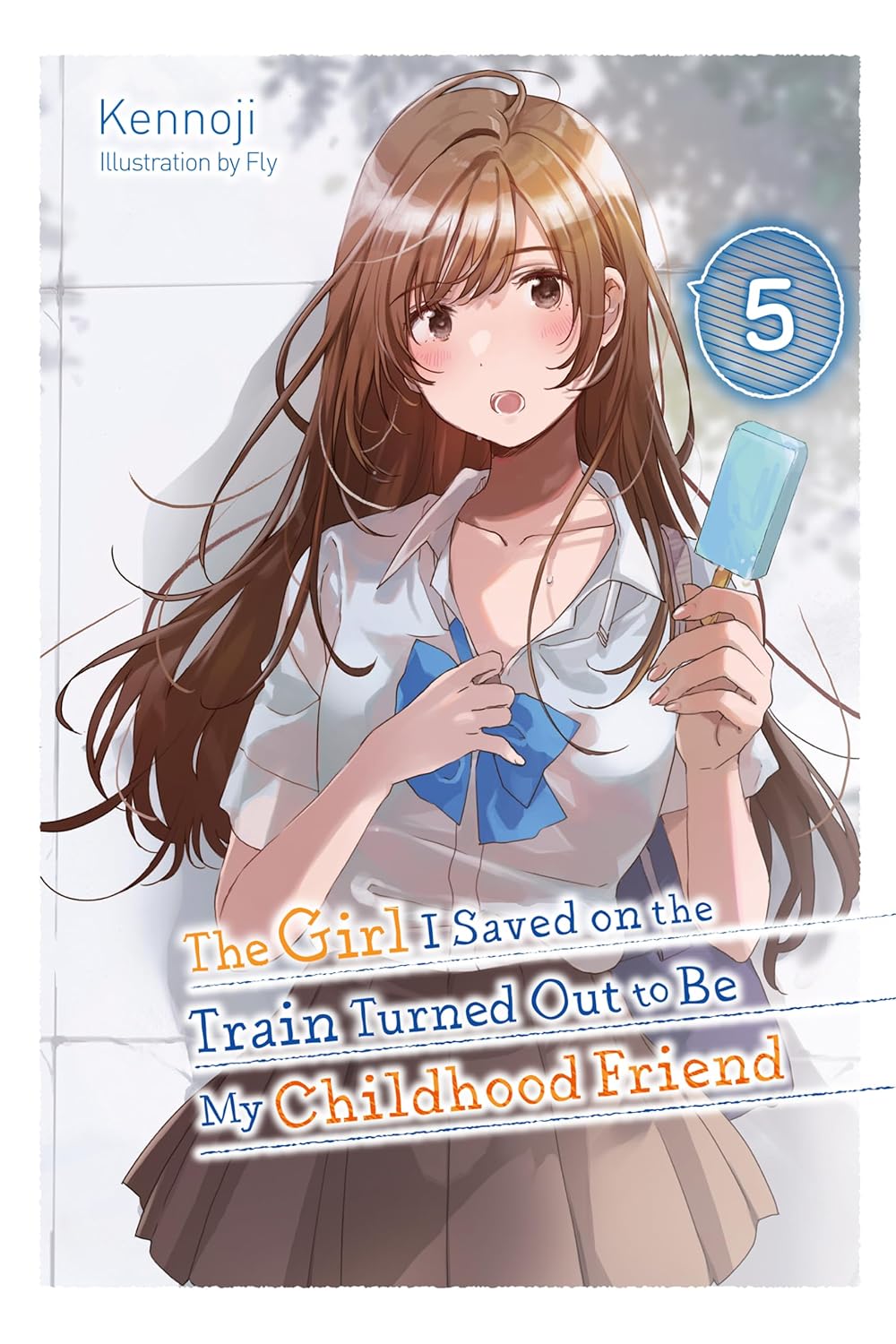
Ryou’s film is nearly finished, just requiring Ai to film some remaining scenes when she’s not doing her acting gig. He’s still trying to get Shizuka to star in his new film idea he’s had, but a) there’s no script yet, and b) she really doesn’t want to. It doesn’t help that her mother is overly worried about her, which is coming out as anger. It also doesn’t help that, as a result of that, Shizuku is lying to her. This leads to a run away from home plot!… that lasts about five pages. This series just can’t get that dramatic. As for Hina, since she’s still depressed about her failed audition, and lacking much else to do, she’s helping Ryou study for school… mostly by forcing him to do it. Ca they all get together in time for a summer festival? And will the girls manage to convince Ryou they like him?

This series is not much like Oregairu at all (Ryou wishes he had Hachiman’s narrative panache), but they do share one thing in common, which is that the relationship between the lead and his little sister is the best thing about the series. Mana remains the best character in this by a country mile, being cool, self=confident, chiding but also supporting her brother, and being friends with all his various girl friends. If she had a spinoff, I’d read it, mostly as it would not be this series. There’s nothing wrong with this except that it’s boring, and I keep waiting for a payoff that I know is a good 7-8 books away, if that. The reason that a lot of romcoms these days have the leads hook up early is that everyone got tired of series like these, where we know who will win (it’s Hina) but we have to watch Ryou being thick as a brick for ten more volumes before he gets it.

If you have to read every romcom out there, this is one. I think I’m going to drop it here.

Filed Under: girl i saved on the train, REVIEWS

The Girl I Saved on the Train Turned Out to Be My Childhood Friend, Vol. 4

October 5, 2023 by Sean Gaffney

By Kennoji and Fly. Released in Japan as “Chikan Saresou ni Natteiru S-kyuu Bishoujo wo Tasuketara Tonari no Seki no Osananajimi datta” by GA Bunko. Released in North America by Yen On. Translated by Sergio Avila.

This book tends to work against my fragmentary memory. It’s been almost a year since the last volume, which doesn’t help. Nor do Fly’s illustrations, which in this series tend to make everyone look very similar to each other. And, of course, everyone refers to each other by different names – be they polite “last name only” folks, childhood friend first names, cute nicknames, etc. What all this ends up meaning is that I find myself constantly trying to remember which girl is which and what their backstory is. But then that’s also what Ryou is doing here, of course. His entire childhood seems to be a blur, and even the promise with his childhood friend turns out to be something of a lie. He can remember things when literally confronted with them, as we see in a beach scene. But he’s too buried in his own self-loathing to really try experiencing anything else, such as, say, dating one of the girls in love with him.

The bulk of this volume is concerned with making the movie everyone has decided to do, with Ryou as the director, Shizuka as the writer, and Hina and Ai as the actresses, with the clever conceit that the guy they’re both in love with is never seen, but merely implied offscreen. Of course, there are a few hiccups to get through. Getting a camera requires getting a part-time job, but fortunately Ai’s agent can help Ryou out. A scene filmed on the beach turns into an entire vacation day at the beach, and Ryou and Hina almost, ALMOST moving forward in their relationship but still failing. The big subplot, though, is that Hina, the talented amateur, and Ai, the former-idol-turned-actress, are both up for the same role in a production. Only one can get the job, while the other is doomed to disappointment. What can Ryou’s role be in regards to both of them? And can he find a path of his own?

Probably the most gripping scene in the book is where Ryou, at the absolute limits of his utter loathing of himself, starts pouring words out into a notebook for the entire night, and they end up turning into another, different film that he wants to make – this one with Shizuka as the lead. We can probably guess why – given that it’s a product of his own frustration and despair, it makes sense that he’d turn to the girl in his life who’s also gloomy and self-hating to get the right vibe. But the frustration and despair stem from the two main girls in his love triangle (sorry, Shizuka), who are both gorgeous, talented, and know what they want to do with their life – or at least, that’s what he thinks. We know from the occasional non-POV narration we get from them that both are also feeling a bit lost and afraid, which is why Ai’s agent asks Ryou to step in and help in THAT way at the book’s conclusion.

There are better “summer of my youth” romances out there, but there’s nothing really wrong with this one.

Filed Under: girl i saved on the train, REVIEWS

The Girl I Saved on the Train Turned Out to Be My Childhood Friend, Vol. 3

October 30, 2022 by Sean Gaffney

By Kennoji and Fly. Released in Japan as “Chikan Saresou ni Natteiru S-kyuu Bishoujo wo Tasuketara Tonari no Seki no Osananajimi datta” by GA Bunko. Released in North America by Yen On. Translated by Sergio Avila.

There is a very famous meme in regards to the visual novel/anime franchise Fate/Stay Night regarding Shirou’s obliviousness towards any and all romantic affection from other girls, which has Rin showing him diagrams of sex ending with “Jam it in”, to which Shirou’s response is “..you lost me.” Of course, the real reason beyond Shirou’s lack of emotional sensitivity stems from his traumatic past. Ryou’s past is not quite as traumatic as Shirou’s… despite the cliffhanger to this book… but he is another character whose obliviousness has more depth to it than the standard anime harem lead. That said… it’s been three books, and the solution to all of this seems to have been “add more girl” each time. I’m hoping that Ai Himejima may be the final straw, mostly as she brings something to the table that the other non-Hina girls don’t have: she is also a childhood friend. And, apparently, was also in love with Ryou.

The book starts almost the same way the first one did, with Ryou rescuing a girl from a groper on the train, and almost getting in trouble for it himself. Said girl turns out to be Ai (aka Himeji), who is transferring to their school… in June, an odd time to transfer schools. It is, however, just in time to be part of the annual school trip, which involves lots of shrine visits and cultural education. Himeji is eager to reconnect with Ryou, and also reconnects with Hina, though she’s less thrilled about this. (Ryou finds himself thinking “they must be very good friends” in response to their constant arguing over him… again, this book requires a lot of patience.) Is Himeji going to steal Ryou away from Hina? Why did she transfer in the first place? And can Ryou please stop hating himself?

The main reason that Himeji is interesting is what she brings to the table: she was in elementary school with Ryou and Hina as well, and (as the cliffhanger points out) may have been far more involved with Ryou than he remembers. This series relies heavily on the transient quality of childhood memories, especially when you have a lot of upheaval in your life in between, and I wonder (but doubt, frankly) if this will cause Ryou to actually push back a bit. We also get a sense that Ryou and Hina need each other, if only as without him around she might end up in a lot of trouble. The scene where she tries to give directions to a “lost tourist” and is almost taken off to a dark alley somewhere is chilling, and fits oddly in the midst of this relatively fluffy book. Oh yes, and we get Ryou’s sister giving him condoms – again. She knows someone needs a constant ass-kicking if he’s going to get anywhere.

This is not really an essential high school romcom, but I’m curious as to how things will shake out. It’s not in the genre of “sugary sweet and conflictless” – the love quadrangle won’t let it be – but it’s the next level down.

Filed Under: girl i saved on the train, REVIEWS

The Girl I Saved on the Train Turned Out to Be My Childhood Friend, Vol. 2

June 2, 2022 by Sean Gaffney

By Kennoji and Fly. Released in Japan as “Chikan Saresou ni Natteiru S-kyuu Bishoujo wo Tasuketara Tonari no Seki no Osananajimi datta” by GA Bunko. Released in North America by Yen On. Translated by Sergio Avila.

This got off to a slow start but was definitely improving as it went along. Last time I said that this was what books like Bottom-Tier Character Tomozaki deconstructed, and that was certainly true of the first book, but here we see the author starting to really look at the situation. Ryou is the standard oblivious, self-hating potato protagonist, but here we see how that’s actually hurting everyone around him – and hurting himself as well. Ryou has, by the end of the book, four love interests, three of whom seem to be along the lines of “did a decent thing in front of her”, which is also standard high school romance LN but reminds you how goddamn low the bar really is. And he’s actually a little more serious than most high school boys – he doesn’t feel comfortable returning anyone’s feelings until he understands how love feels himself. Unfortunately for the rest of the cast, this may take a while.

Our cast is in that most popular of years, the 2nd year of high school, and as such they have to deal with present-day concerns like the school festival while also trying to think about the future. Ryou can’t really imagine what he’ll be doing in the future beyond vague “college, I guess”. Hina, on the other hand, has a secret… and a dream. She really is far more mature and put together than Ryou, something that he dwells on constantly. That said, he might not be dwelling on it enough, given that Hina said she’d happily give everything up to spend her days married to him… and he didn’t react at all. (She was expecting him to at least push back on that.) Even a surprise first kiss cannot get past Ryou’s wall of self-loathing that he’s put between the two of them. Will a film project help, or just make things even more complicated?

I remain pleased with the relationship between Ryou and his sister Mana. She clearly loves her brother, supports him, and is STILL buying him condoms he won’t use, but there is not one speck of subtext between them, which is an increasing rarity in books these days. This is meant to be a realistic sibling relationship. The other strong part of this book was Hina. She’s been hiding her dreams of being an actress from the others, but it turns out that she has some serious chops. This leads to good and bad things with Ryou. Good in that filming something she can use as a quick promo video shows off his film editing skills, leading to a possible future direction. Bad in that he clearly puts her on a massive pedestal, and clearly the main reason he is not going out with her is for that reason. She tears into him for it, and her frustration is palpable.

That said, we get yet another saved childhood friend at the end of the book, and this risks becoming Osamake if it’s not careful. It can be difficult at times to deal with Ryou’s moping, but the book eventually rewards you.

Filed Under: girl i saved on the train, REVIEWS

The Girl I Saved on the Train Turned Out to Be My Childhood Friend, Vol. 1

December 2, 2021 by Sean Gaffney

By Kennoji and Fly. Released in Japan as “Chikan Saresou ni Natteiru S-kyuu Bishoujo wo Tasuketara Tonari no Seki no Osananajimi datta” by GA Bunko. Released in North America by Yen On. Translated by Sergio Avila.

I have not read the two other series that this author has out in English. Hazure Skill and Drugstore in Another World are both in genres that I’m gradually trying to read less of. But ‘syrupy sweet high school romance’ is still a relatively new genre in English-translated light novels. Honestly, the marketplace changes a lot these days, and yesterday’s down and outs are today’s up and comers. Remember 15 years ago when we all said sports manga was impossible to license? Even just five years ago I was saying that you couldn’t get a LN title licensed unless it had some sort of fantasy or supernatural plotline in it. But now here we are. That said, to be honest I picked this up because of the artist. Fly is best known here for Bottom-Tier Character Tomozaki, and this is in the same basic genre. That said, the two books are doing different things. Tomozaki is a deconstruction. This book is what it deconstructs.

Ryou is a typical light novel romance protagonist: nondescript, doesn’t have many friends, school skipper, thinks of himself in terrible ways. One day on the train he sees a girl being groped by a salaryman, and decides to make a scene and get the guy caught. Later, in school, it turns out that he’s sitting next to said girl in class… and that it’s Hina, his childhood friend. They had been inseparable in grade school, but in middle school she got super gorgeous and popular, and he got more self-conscious and so they drifted apart. But while he may have mostly forgotten about her, she certainly hasn’t forgotten about him. As the book goes on, Ryou starts to notice that Hina is asking to walk home with him, and making him food, and asking him out on dates. Does this mean… she has feelings for him? Nah, let’s not overthink this.

As always with this genre, whether you can tolerate it or not depends how much you like ‘oblivious’ teenage boys. I’d say it was unrealistic except I was also a teenage boy, and no, it really is this bad. That said, at least the series gets a confession out of the way by the end of the first book, even if it leads to “I’m not sure how I feel about you”. Hina is cute, and the reader is meant to understand her frustration with Ryou and sympathize, and it works pretty well. I also loved Ryou’s younger sister Mana, who does not have a shred of the standard “younger sister of the protagonist” character to her and is quite happy wingmanning for her brother, though buying condoms for him turns out to be a mistake. (There’s no sex in this book, sorry to disappoint. Everyone’s very pure.) And the love rival role is handled pretty well, as she’s good at analyzing Ryou and Hina and knows that’s why she doesn’t really have a chance.

There’s nothing outstanding about this book, and it doesn’t have a good gimmick like Tomozaki. But it’s decently written, and there are no terrible people in it yet. If you like the genre of “pretty girl tries to get guy to admit that someone might actually like him and it’s her”, this is a good one to try.

Filed Under: girl i saved on the train, REVIEWS

 | Log in
Copyright © 2010 Manga Bookshelf | Powered by WordPress & the Genesis Framework