• Skip to primary navigation
  • Skip to main content
  • Skip to primary sidebar
  • Home
  • About Us
    • Privacy Policy
    • Comment Policy
    • Disclosures & Disclaimers
  • Resources
    • Links, Essays & Articles
    • Fandomology!
    • CLAMP Directory
    • BlogRoll
  • Features & Columns
    • 3 Things Thursday
    • Adventures in the Key of Shoujo
    • Bit & Blips (game reviews)
    • BL BOOKRACK
    • Bookshelf Briefs
    • Bringing the Drama
    • Comic Conversion
    • Fanservice Friday
    • Going Digital
    • It Came From the Sinosphere
    • License This!
    • Magazine no Mori
    • My Week in Manga
    • OFF THE SHELF
    • Not By Manga Alone
    • PICK OF THE WEEK
    • Subtitles & Sensibility
    • Weekly Shonen Jump Recaps
  • Manga Moveable Feast
    • MMF Full Archive
    • Yun Kouga
    • CLAMP
    • Shojo Beat
    • Osamu Tezuka
    • Sailor Moon
    • Fruits Basket
    • Takehiko Inoue
    • Wild Adapter
    • One Piece
    • After School Nightmare
    • Karakuri Odette
    • Paradise Kiss
    • The Color Trilogy
    • To Terra…
    • Sexy Voice & Robo
  • Browse by Author
    • Sean Gaffney
    • Anna Neatrour
    • Michelle Smith
    • Katherine Dacey
    • MJ
    • Brigid Alverson
    • Travis Anderson
    • Phillip Anthony
    • Derek Bown
    • Jaci Dahlvang
    • Angela Eastman
    • Erica Friedman
    • Sara K.
    • Megan Purdy
    • Emily Snodgrass
    • Nancy Thistlethwaite
    • Eva Volin
    • David Welsh
  • MB Blogs
    • A Case Suitable For Treatment
    • Experiments in Manga
    • MangaBlog
    • The Manga Critic
    • Manga Report
    • Soliloquy in Blue
    • Manga Curmudgeon (archive)

Manga Bookshelf

Discussion, Resources, Roundtables, & Reviews

Reviews

The Girl Who Wants to Be a Hero and the Girl Who Ought to Be a Hero, Vol. 1

July 12, 2025 by Sean Gaffney

By Inori and Akamoku. Released in Japan as “Yuusha ni Naritai Boku to, Yuusha ni Narubeki Kimi” by Dengeki Bunko. Released in North America by Yen On. Translated by Genevieve Hill-Kaminishi.

I do love a good title, and this one is very good. Especially because the double meaning of the English word wrong-footed me about what was going to happen in the book. I had assumed this was about our protagonist, who wants to be a hero, and the love interest, who is the one who SHOULD be a hero instead of our protagonist. But that’s not it at all. Well, the first part is, Ruchika definitely wants to be a hero, at least at first. But Leonie’s “ought” is that she’s the daughter of the late, great hero, the one who sacrificed her life to defeat the demons and bring peace… well, peace between humans and demons, at least. Leonie ought to be just as good if not better than her, right? So when Leonie is seen to be good but not fantastic, well, there’s quite a few people who don’t like that. And that leads to the strongest part of the book, showing how damaging education can be when done badly.

Ruchika arrives at Kars Kingdom, ready to be a hero, which of course requires going to the hero institute that you get in these sorts of books. Unfortunately, she underestimates how far it is from home and how much things cost, so by the time she gets there she’s lying on the street starving to death. She’s saved by Leonie and her friend Nur, who feed her – and on seeing Leonie, and getting food from her, Ruchika decides immediately that she’s in love and proposes to her on the spot. This is apparently how demons do things, but Leonie is human. As it turns out, they’re all going for the exams to get into the institute, which are notoriously hard. Ruchika aces the practical and scrapes through on the written. Leonie aces the written, and… does okay on the practical, not great. Still, it’s nothing a good teacher can’t fix… oh, dear.

There’s lots of good stuff here, especially the relationship between Ruchika and Leonie, but allow me to talk about the way people learn to be heroes here. Everyone gets a device called a Gear, which is sort of mildly predictive AI, and it tells you who you’re most compatible with, what style of fighting you should do, and what moves to make when you fight. Everyone abides by what the gear says, it’s a rule. Ruchika hates the idea of gear in general (with the possible exception of her gear, which has big Homunculus Tears vibes if you’ve read that Inori book), since she runs on instinct, and really begins to hate them more when it’s apparent that trying to do what the gear wants is slowly destroying Leonie… helped along by a teacher, who has a grudge against her mother, out to get Leonie expelled. It is very hard to learn how to do things and be a good person when the person teaching you belittles, mocks, and hurts you, and encourages others to do the same. It’s even worse when you add AI learning to the mix. This hit very hard for me. Fortunately, Ruchika is exactly the sort of protagonist this book needs, and helps Leonie to find out what she really wants to be doing.

Now, this is a book that came out in 2023, with one volume to date in Japan, so I know what some folks are going to say. That said, Dengeki Bunko do have a larger history than most publishers of giving Vol. 2s or later volumes out of the blue if something changes. And this is a very good book to try to see that change happen. Buy it, you’ll like it.

Filed Under: girl who wants to be a hero and the girl who ought to be a hero, REVIEWS

The Tanaka Family Reincarnates, Vol. 3

July 10, 2025 by Sean Gaffney

By Choko and kaworu. Released in Japan as “Tanaka-ke, Tensei Suru” by Dragon Novels. Released in North America by J-Novel Club. Translated by Sasha Schiller.

It has to be said, if you’re going to have a family consisting entirely of airheads, it’s best to have them not only incredibly overpowered but also on the side of the angels. And make no mistake about it, the whole family are wacky. Emma is the poster child and the worst one, but her father is right behind her, followed by her two brothers. Melsa is easily the most sensible in the family, and we see that here in a book where she gets far more focus than the previous two, but at the end of the day she too is basically saving the world so that they can eat rice and miso again. That said, airheaded does not mean dumb, and all of these folks are rather brilliant, which is also why they know it’s a bad idea to get so many honors from royalty. Emma grasping at straws and asking for the rights to the slum district as her reward is a way of showing off the family’s compassion and observation, and the fact that they’re not going to be “normal” nobles.

We pick up from where we left off at the end of the last book, as Emma has accidentally revealed that she can speak the foreign language that no one else seems to be able to. Indeed, this becomes a more important plot point than I thought, as it’s suggested that it’s not just the diplomats being lazy but some inherent world thing that makes the language incredibly difficult to grasp. This also makes Emma phenomenally valuable. And so the rest of the family have to admit that they can also speak it, which causes even more of a fuss. (Fortunately there’s an in-world handwave they can use so they don’t have to pull out the isekai card.) Now, while Emma continues to socialize, be so kind and caring that she has people thinking she’s a literal saint, and getting bullied in a way that she’s gonna love, her mother is off to the Eastern Empire, where she discovers this is not just a simple famine, and that if something is not done fast the entire nation may be wiped out, people and all.

I usually enjoy a story where everyone is misinterpreting what’s going on, and the Tanaka Family makes that its bread and butter. Everyone except her family assumes Emma is this fragile maiden who is at death’s door after her tragic accident, when really most of the time she’s just overworking herself and avoiding reality. When petty nobles Robert and Brian decide they’re going to get revenge on her, I immediately knew exactly what was going to happen, but that does not diminish the humor of it, and it helps that it also ties in with a more serious plot. Most of all, Emma can get it together, usually when she’s not being stared at by hundreds of nobles. Her forced engagement of the tailor and seamstress was a thing of beauty. (I could have done without another “fantasy worlds don’t know about scurvy” plot, though.)

I assume the next volume will send our family off to the Eastern Empire to battle plant monsters, and I beg them to avoid the obvious fanservice. The fetishes of the leads are bad enough. Still, this remains an absolute hoot, and I can’t wait for the next book.

Filed Under: REVIEWS, tanaka family reincarnates

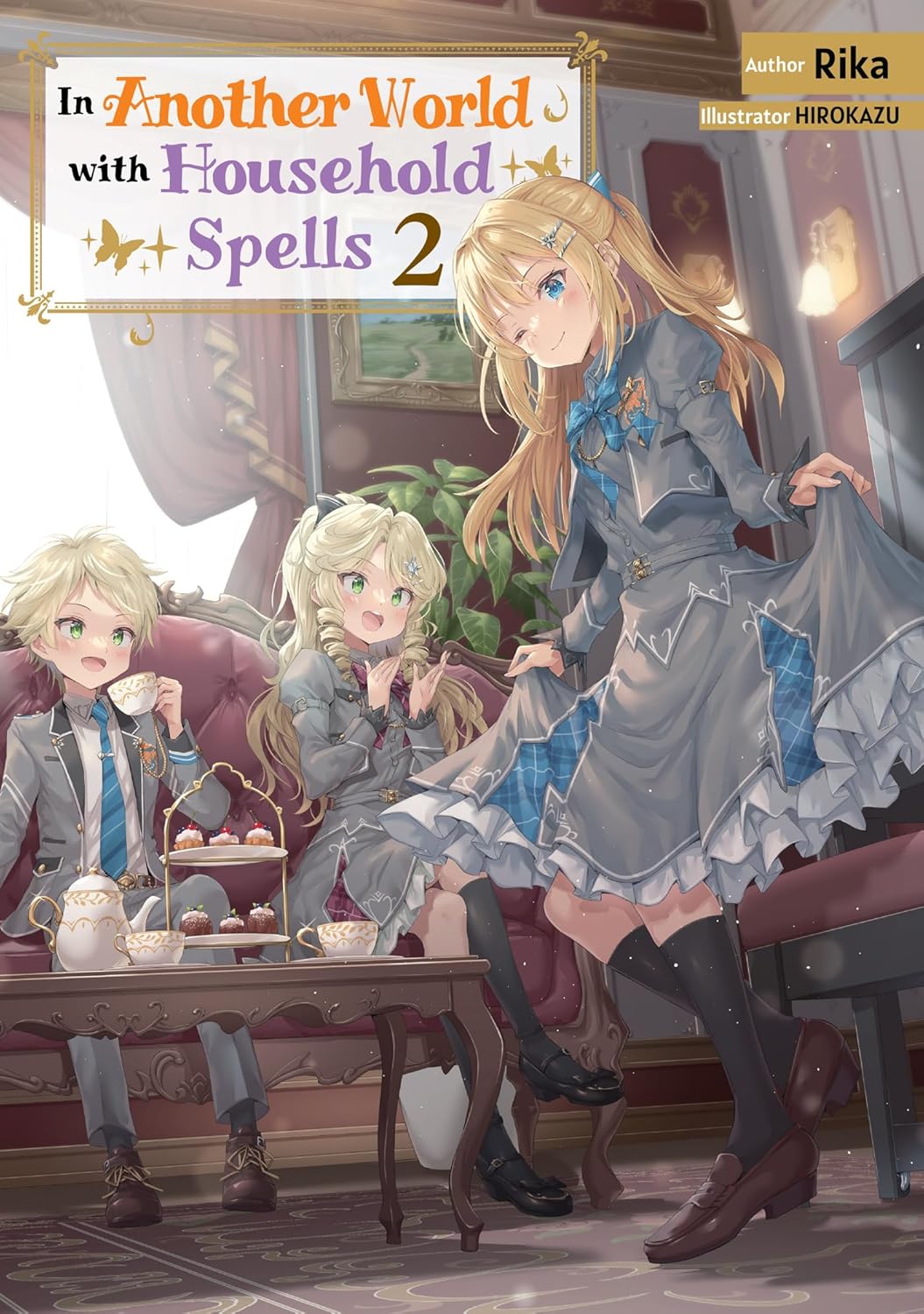
In Another World with Household Spells, Vol. 1

July 9, 2025 by Sean Gaffney

By Rika and HIROKAZU. Released in Japan as “Isekai ni Kita kedo, Seikatsu Mahou shika Tsukaemasen” by Mag Garden Novels. Released in North America by J-Novel Club. Translated by sachi salehi.

This is the definition of “Fine, I guess”. It doesn’t really do anything wrong, apart from one thing I’ll mention later. The heroine is a classic “I just want a quiet life where I can earn money to help my family” type who does not realize that every single thing that she does draws a tremendous amount of attention to herself. She’s seriously OP, but not in a flashy way. She doesn’t invent mayonnaise, but she does pretend that Mozart and Bach compositions are her own. There’s a royal family, but they’re pretty nice, and the prince her age clearly has a crush on her that is coming out as “you’d better watch your step!”. But there is nothing here to make someone who has read large amounts of “woman is reincarnated as a noble girl and attends a magic academy” books want to add another one to the pile. It feels like the bulk of the book was written to keep up with the trends.

One day Kaoru Aoyama is working her office job and living in her apartment, the next she wakes up as Patience Granger, a ten-year-old noble girl. She wasn’t even hit by a truck! Patience is, unfortunately, recovering from near death. In fact, it appears the real Patience DID die, and now Kaoru is in her body, with a sort of soul of the real Patience insider her yelling when she does things that are not appropriate for nobility. Unfortunately, their family is flat broke, as her father was fired from his royal position for reasons that we never actually find out in this volume. Fortunately, after recovering, she’s taken to the church and told she has “household spells” for magic, one of the most common types. That’s fine with her, though, and like so many other protagonists in these books, she experiments without knowing what not to do and winds up really overpowered.

First off, I understand that it’s in the original, and that there’s not really a Western alternative, but man, when the heroine talks about being a shotacon all the time, I don’t care if she insists “but not in a pervy way!”, it reads wrong and makes you like her less. There has be be a way around the word. Patience’s main trait, besides being oblivious to her own misguided attempts to not stand out, is her adoration of her two cute younger brothers, as well as the kids her own age, who her 25-year-old self sees as cute little ‘uns. If you can get past that steep hurdle… I did like her relationship with the first ;princess, who she is clearly rehabilitating. It’s implied that her late mother and the Queen had some history, and everyone and their brother talks about how their family is supposed to be filled with genius scholars, so there’s clearly a lot of backstory still to dole out. As for romance… she’s ten. Let’s table that for a while.

I’ll read the next volume of this – I do want to see what’s up with her otherwise nebbish dad. But for those who have to much to read already, there’s no reason to add this as well.

Filed Under: in another world with household spells, REVIEWS

Yuri Tama: From Third Wheel to Trifecta, Vol. 4

July 8, 2025 by Sean Gaffney

By Toshizou and Kuro Shina. Released in Japan as “Yuri no Ma ni Hasamareta Watashi ga, Ikioi de Futamata Shite Shimatta” by Overlap Bunko. Released in North America by J-Novel Club. Translated by Tristan K. Hill.

Two years is too long between volumes, and the author apologized but it was still a wrench to remind myself exactly what was going on. Fortunately, the author’s self-awareness bleeds into the work – indeed, this is a book that you have to read with your tongue in your cheek. I think I’ve already talked about how insufferable this series would be if Yotsuba were a guy, but apparently some people are finding Yotsuba insufferable anyway. And sure, I get it. This is a giant failwhale of a teenager, who cannot go for half a page without talking about herself like she’s a food wrapper on the side of the road, and yet for some reason she has two woman in love with her and agreeing to both date her at the same time, a childhood friend who’s a famous idol who confesses to her, and she cannot walk ten feet without another girl going “well, maybe”. She’s a chad.

Oh no, Yotsuba’s in a big pinch! She’s already secretly dating the two hottest girls in the school, but now her childhood friend and celebrity idol has transferred into her class! And she and her two girlfriends are getting all passive aggressive! Worst of all, it’s time for the culture festival, and the class comes up with an idea for a concert! Makina is fine with this… provided she’s not the focus, so Rinka and Yuna get roped into being an idol trio! But wait, even worse, Mai is so stressed out by Makina upsetting the balance of power among the hotties that she’s skipping school, and Yotsuba has to dress in a maid outfit and bathe/massage her to help! And… really, Yotsuba should actually resolve this love square thing and go back to her love triangle! Yotsuba’s in a pinch!

There are some things here that aren’t ridiculous. We get Mai’s backstory at last, and it turns out to be Maria-sama Ga Miteru gone wrong, as she was Yotsuba at her old girls’ private school, but fumbled it and left everyone full of anger and resentment. As such, seeing Yotsuba somehow manage to always manage to do the right thing while at the same time being a giant goofball irks her greatly. Yuna and Rinka’s “dates” with Yotsuba are sweet, and as for Makina… well, Yotsuba still has to do something about her, and having her meet the parents is not helping. Best of all is the finale, where Yotsuba works out why she’s been so worried and stressed since this book began and manages to work up her gumption and do something about it, which also inspires the rest of the class. Once a volume there’s an amazing point where you understand exactly why everyone falls for Yotsuba, and this is the one this time.

That said, this is half a book, even though it’s 250 pages. The author assures us there will be a Book 5 with the actual festival, and the good news is that it is already out in Japan, so hopefully it won’t be two more years. This grows on me more with each book.

Filed Under: REVIEWS, yuri tama

The Too-Perfect Saint: Tossed Aside by My Fiancé and Sold to Another Kingdom, Vol. 3

July 8, 2025 by Sean Gaffney

By Fuyutsuki Koki and Masami. Released in Japan as “Kanpeki Sugite Kawaige ga Nai to Konyaku Haki Sareta Seijo wa Ringoku ni Urareru” by Overlap Novels f. Released in North America by Airship. Translated by Tiffany Lim and Amelia Mason. Adapted by Shaenon K. Garrity.

I must admit, I used to get upset when I saw this sort of thing in Japanese light novels, but now I just laugh. is there some meme picture that is the opposite of the guy sweating over which button to push? Because I think if you presented two buttons to a light novel author, one of which said ‘tragic and nuanced villain who the audience empathizes but does not sympathize with’, and the other of which said ‘villain who will happily destroy the world for petty spite and also drinks puppies’, the average light novel author would not think twice before slamming Button #2. And needless to say Fuyutsuki Koki is exactly the same. Heck, we’re introduced to the villain and given a legitimate sympathetic reason for their villainy, but then it turns out to not be enough, they have to go full ham. Fortunately, the heroine of this series also goes full ham, albeit stoically.

All is well. The evil from Book Two has been defeated, Philia and Osvalt are engaged and planning their wedding, and the anime managed to fix a lot of the problems the second book had with pacing. Surely nothing could go wrong now… oh, what’s this missive from the Church? It turns out that the Pope is dead, and Philia has supposedly been chosen as the new Pope in his will, surprising everyone, not least of all Philia herself, as a Saint has never been made Pope before. But everyone agrees that she has to obey the declaration that she is Pope or risk being excommunicated and starting a Holy War in Parnacorta. It’s fine! She can even still marry Osvalt! But she has to live in Dalbert now, this world’s Vatican City. Philia, though, starts to smell a rat, especially when she hears about Archbishop Henry, who everyone THOUGHT would be the next Pope…

As with so many light novels, this is not a series to read if you like subtlety. Leaving aside the villain, who has an epic revenge that involves destroying Philia’s happiness and ruining the country of Parnacorta, and has plans to resurrect the dead and also command an ancient God to do his bidding, there’s also Philia herself, who hears about a divine spell that can let someone talk to the dead, hears that no one has ever done it as divine spells are lethal if done slightly wrong, and just does it anyway, in an Ace-Attorney style finale that has her calling the dead back to testify TWICE. The good news is that Mia, who was mostly sidelined in book 2, gets things to do here, and she also gets to show off that she is not only as OP as her sister, but can also get a prince to propose to her. If there’s a flaw in this book, it’s that no one ever really feels in danger when these sisters are around.

You’d think this was the last in the series, but no, we’ve got a long way to go. Next volume is the wedding picture cover art one, though. Fans of the anime can happily start here.

Filed Under: REVIEWS, too-perfect saint

From Old Country Bumpkin to Master Swordsman: My Hotshot Disciples Are All Grown Up Now, and They Won’t Leave Me Alone, Vol. 7

July 6, 2025 by Sean Gaffney

By Shigeru Sagazaki and Tetsuhiro Nabeshima. Released in Japan as “Katainaka no Ossan, Kensei ni Naru: Tada no Inaka no Kenjutsu Shihan Datta noni, Taisei Shita Deshitachi ga Ore o Hōttekurenai Ken” by SQEX Novels. Released in North America by J-Novel Club. Translated by Hikoki.

Last time I wrote a review of this, the anime was just starting, and as I write this one, the anime has just ended. Most people agree that it was stolid, unremarkable, did not really do anything wrong but was nothing to write home about except the fight scenes were very well done. Folks also agree that the Japanese voice of Beryl really nailed the part, that sort of world-weary “I am forty years old, sigh” quality that he has a lot of the time. I thought the voice was excellent, and it also helps as I read this seventh volume in the series, where Beryl’s soul-searching monologues are at an all-time high. And while it’s just a coincidence, the fact that folks who finished the anime and decided to buy this new book get a volume that is almost a direct sequel to the end of the anime is very nice.

Beryl has been asked to help provide security for the wedding of Princess Salacia to Prince Glenn of Sphenedyardvania, a wedding that, of course, takes place in that country, which also recently resurrected the dead, including Mewi’s sister, and is in the middle of a holy war. So, extra protection is recommended. After stopping off in Flumvelk to rest and so that Beryl can get seduced (spoiler: he does not get seduced), they arrive there to find everything seemingly going well… until the wedding is invaded by undead, and the city outside is invaded by horrible chimera. Fortunately, Beryl and Allucia have help, including a mysterious masked woman, as well as… the enemies from the last book?

As always, it can be very hard to take Beryl’s aw shucks attitude in large doses, and there’s an extra helping of that in this book. I am hoping that it’s because he’s actually trying to figure out how to live going forward beyond “be best at sword”. He loves being a dad, and I think would be happy for Mewi to have a mother, he has no real concept of what a wife would be like. This is most obvious in the scenes with Shueste, who does everything short of lying naked on his bed and saying “take me now, big boy”. He clearly GETS it, but the idea of another woman liking him, be it student, noble, or anyone, makes him deeply uncomfortable. Which is a decent ongoing dilemma for a harem series to have, but dragging it out too long loses readers, who won’t always be happy with 100 pages of cool fights. I’m honestly rooting for Shueste, but I suspect first girl Allucia still has the advantage right now. We’ll see how shopping for swords goes next time.

If you enjoyed the anime, you know what you’re getting with Beryl. So as long as you’re not the sort who asks if there is snu-snu, this should make you perfectly happy.

Filed Under: from old country bumpkin to master swordsman, REVIEWS

The Twelve Kingdoms, Book One: Shadow of the Moon, Shadow of the Sea, Part 1

July 6, 2025 by Sean Gaffney

By Fuyumi Ono and Akihiro Yamada. Released in Japan as “Tsuki no Kage, Kage no Umi” by X Bunko White Heart. Released in North America by Seven Seas Entertainment. Translated by Kim Morrissy. Adapted by Monica Sullivan.

There’s isekai, and then there’s ISEKAI. This is one of the OG isekai, back before it was a genre, and around the same time as the other majorly influential OG isekai, Fushigi Yuugi. Almost twenty years ago, Tokyopop published the first half of the series, but it then got cancelled due to poor sales, as happened a lot back then. Now it’s back, with a new translation and a spiffy looking cover. And after reading this first volume, I cannot help but feel a sneering contempt for those modern wannabe isekai. Oh, the poor guy who gets truck-kun’d into another world, and all he has its a cool sword, a bunch of catgirls, and a guild that lets him explore all the dungeons he wants for money. Or he’s summoned to be the savior of the world… well, actually, that is SORT OF how Twelve Kingdoms starts. But things go very bad very quickly. This book is dark as hell.

Youko Nakajima has been having bad dreams. Dreams of being trapped in darkness, unable to move, while hungry killer beasts are running towards her. They are making life difficult for her at her private all-girls’ school,. where she tries to keep up good grades, be a nice girl that’s easy to get along with, and ignore the bullying of other girls lower on the totem pole. Then one day, while in the teacher’s office where they’re getting annoyed about her red hair – again – suddenly a man shows up, says she needs to come with him, and tries to drag her off. Then she’s attacked by the same animals that were in her dream, who burst through the window and injure the faculty. Then she’s being told to kill then with a sword that is handed to her. Then she is possessed by a creature that can manipulate her body so she can swing the sword. Then… she’s flown to another world.

For those who saw the anime when it came out in 2002 and wonder where the other two Japanese kids are, they’re not here. (OK, Sugimoto is here to get bullied, but she doesn’t get isekai’d). Youko is all alone – indeed, very much all alone, as she quickly loses the handsome guy insisting that she come with him to fulfill her destiny and ends up in a hostile country. The book is very well written, with evocative descriptions, and Youko’s descent from terror into confusion into anger into just giving up is incredibly well done. That said… in Japan, the next volume came out one month later, and I’m going to assume that things get better for her in that. That does leave this volume, which is just unrelenting. She’s torn from Japan and told she can never return. She’s imprisoned, and told she’ll likely be executed. She meets one or two nice people… who immediately turn out to be not-so-nice. By the end of the book she can’t accept that anyone being nice to her isn’t secretly evil, and is on the verge of starvation, exhaustion, and death because she’s also having to battle countless youma every single night. This is a MISERABLE isekai for her.

That said, this is a 30+-year-old series, so I know things get better for her. Eventually. Till then, this is gorgeous trauma.

Filed Under: REVIEWS, twelve kingdoms

The Otome Heroine’s Fight for Survival, Vol. 5

July 5, 2025 by Sean Gaffney

By Harunori Biyori and Hitaki Yuu. Released in Japan as “Otome Game no Heroine de Saikyō Survival” by TO Books. Released in North America by J-Novel Club. Translated by Camilla L.

Apparently, according to the afterword, having a volume that LOOKS like it’s going to be a typical otome game “nobles at the academy” book and then not having it be that at all is a habit with this author. In my last review I mentioned that I would like some academy hijinks and a few less stat screens, and I absolutely did not get my wish. In fact, there was apparently more academy content in the webnovel version that was cut out, in order that we could add more fights. Because, rest assured, this series still knows what its readers really wants, and that’s – no, not stat screens – pages and pages of Alia fighting and brutally murdering many, many, many bad guys. They can be traitorous knights, zombie villagers, or vampire demons, and none of that matters. If they are threatening Elena, they are going to die. That said, there really are an awful lot of them, and worst of all, they seem to have a plan…

We are now finally at the start of the game. Elena is there, with Alia as her aide and bodyguard. Clara is there, destroying her life and health in order to try to figure out a way to be with the man she loves (surviving has become secondary). Karla is there, and she’s still trying to live her best life, which is to say having a double-murder with Alia in the smoking remains of the world. Elvan is there, and boy, he’s a wet rag, isn’t he? And Alicia is there, which might be surprising, given Alia *is* Alicia. But another Alicia is there, and even though she’s not quite the right one, she’s still doing her best to get with all those otome game hotties. And if that means that she ends up destroying the actual game plot, oh well! As for the kingdom itself, well, political assassinations, kidnapping, and upheaval. You know how it is.

There is not quite a “the bad guys win” ending at the end of this volume, but the good guys certainly are having a tough time. I have to admit that I was a bit disappointed that the fake Alicia was not one of the hundred or so people that Alia slaughters in this book, because my god, not only is she annoying, but she’s unintentionally doing what the kingdom’s enemies are trying to do deliberately – weaken the crown prince and make him a wussy puppet they can control. Elena has been emboldened by her encounters with Alia, and cares deeply about the kingdom, so all those who want to manipulate everything for their own ends think she’s a horrible potential ruler. As such, they send assassins, they send kidnappers, and even the demons are in on the fun. Half this book may just be Alia cutting folks, but there’s a good reason for it.

So Elena and Alia are not dead, but they’re not in a great place right now! This remains a fun series, though folks who want standard otome game villainess stuff might look elsewhere. Alia has murdered the typical story in its sleep.

Filed Under: otome heroine's fight for survival, REVIEWS

Who Killed the Hero?, Vol. 1

July 4, 2025 by Sean Gaffney

By Daken and toi8. Released in Japan as “Dare ga Yuusha wo Koroshita ka” by Kadokawa Sneaker Bunko. Released in North America by Yen On. Translated by Kim Morrissy.

It’s always hard to try to review a book whose very nature requires that the reader is surprised as it goes along. It’s even harder to do this when the book is excellent, as your review essentially amounts to “You’ve got to read this, it’s great!” “Why?” “I can’t tell you, spoilers!”. But here we are, and this book is great, so let’s settle down and try to do this. At its heart this book takes a long look at the fantasy standard “hero’s party goes to defeat the demon lord” cliche. There’s a prophecy, there’s the hero/swordsman/mage/healer party composition, there’s a promised reward of a royal daughter, and, inevitably, there’s a death. Because the book is called “Who Killed the Hero?”, I can at least talk about that. The death, in turn, leads the book and its cast to ask about the nature of the hero, why they have to defeat the demon lord when others cannot, and how a story can be turned on its ear by a simple investigation.

Four years earlier, the hero, Ares, led an elite team to defeat the demon lord. There was noble swordsman Leon, beautiful priestess Maria, and intelligent yet cynical mage Solon. They succeed… and yet, when they return, Ares did not come back with them, and they said that he perished on the return visit. Now someone is going around, getting the word on the street, talking to the other members of the hero’s party, as well as the prophet who made the prophecy about the hero in the first place, to try to figure out what happened. Because no one’s quite sure. Some say Ares was killed by a rogue demon. Some say the other members of the party killed him as there was a love triangle going on. And even the person who is going all around the capital trying to figure things out has their own agenda. What happened?

This is, by necessity, not a book with a large cast, and I enjoyed all the characters tremendously. My favorite was undoubtedly Maria, theoretically a girl devoted to God but in reality someone who will have a boy go and get her the “best” bread every day because it amuses her… only to be stunned when he actually manages to learn the things she was theoretically teaching him. I also was fond of the young princess, who listens to the hero say that he’ll defeat the demon lord, but he’s not coming back, and refuses to accept that. There are a lot of cynical people in this book, and it’s dealing, through almost its entirety, with a death. Despite that, I was amazed at how life-affirming and happy it is, and that once you get all the answers in the end even the one person whose life you assumed would end here ends up being forced into happiness.

There’s two more volumes of this, which seem to have a similar premise but a different cast. Similar to Brunhild the Dragonslayer, I think. In any case, despite not being able to give much away, this is a very rewarding book. Seek it out.

Filed Under: REVIEWS, who killed the hero

The Do-Over Damsel Conquers the Dragon Emperor, Vol. 7

July 2, 2025 by Sean Gaffney

By Sasara Nagase and Mitsuya Fuji. Released in Japan as “Yarinaoshi Reijō wa Ryūtei Heika o Kōryaku-chū” by Kadokawa Beans Bunko. Released in North America by Cross Infinite World. Translated by piyo.

It’s sometimes very hard to separate this series, where a young woman decides to get engaged to the man who may one day try to destroy the world in order to change her own fate, and at every single turn of the page worry that she’s going to fail and the book will end with most of the cast dead and a BAD END screen, and not compare it to I’m the Villainess, So I’m Taming the Final Boss, by the same author, which has the exact same plot. And both series also have an antagonist, someone who sets herself diametrically opposite our protagonist and does everything they can do fix things. It’s just been harder to spot it in Do-Over Damsel, as Faris just hasn’t shown us much. Fortunately, in this book we get to see her dealing with a very, very useless goddess (no, not that one), and also bond with Jill over a mutual enemy. It’s sweet. Also, it makes her evil at the end hit even harder.

Jill is headed off to the Lehrsatz Duchy for a meeting with Faris, the queen of Kratos. Hadis is staying behind, with one of the candidates to be his wife handling things on his end, and being better at it than Jill, much to her chagrin. Unfortunately, when they’re flying to the duchy, Jill decides to investigate a mysterious village that may be home to the Order of the Ark, a group of religious terrorists who wants the Gods dead. As it turns out, she then manages to get accidentally abducted by those same terrorists – accidentally as the ones they really want to abduct are Raw, presumably so they can control dragons… and Faris, who they have already abducted and who is near unconscious due to the anti-magic barriers surrounding her. Can Jill break them out and manage to get to the conference? And what will Hadis do when he hears about this?

This was supposed to be the short story volume. CIW says that it is still coming, but they did this volume first. I’m assuming that, unlike, say, Re: Zero or Index, this is not causing us to miss all sorts of nuance in this current volume. Not that nuance is something Jill is good at. Her strength is indeed her strength, as well as her temper, as she realizes the best solution is to simply punch everything until it stops. Again. Her weakness is that this isn’t good enough this time, and Faris, who seems to only have the strength to break her ditzy goddess spear, is much better at crafty plans that you cannot punch your way out of. Hence the cliffhanger. There’s also the usual “Jill gets jealous and mad, Hadis panics and feeds her to make up for it” wackiness – these two know each other really well by now. That was fun.

Will we get Vol. 8 next? Or short stories? And yes, I did deliberately leave out all the reveals near the end. A great series, assuming you can get past the premise, which is still hard to get past.

Filed Under: do-over damsel conquers the dragon emperor, REVIEWS

I Want to Be a Saint, But I Can Only Use Attack Magic!, Vol. 1

June 30, 2025 by Sean Gaffney

By Fuyu Aoki and Bodax. Released in Japan as “Seijo-sama ni Naritai no ni Kougeki Mahou shika Tsukaenain desu kedo!?” by GC Novels. Released in North America by Cross Infinite World. Translated by Kashi Kamitoma.

As I was about three minutes into the book, I joked that it should be called “Bocchi the Mage!”. Little did I know. There is a scene, with art to match, where Yuffie, the heroine of this novel, wears a party outfit to what turns out to be a standard noble’s ballroom party. It consists of big sunglasses, one a heart and one a star, and a T-Shirt saying Let’s Party. When you combine this with her hideous social anxiety and desire to abase herself, it’s really hard NOT to think of Bocchi. Or Monica, because she also gets invited to the student council, which feels very much like the one from Silent Witch. Unlike Monica, she’s only here to go to school and make a friend or two, if that’s possible for someone like her. Unfortunately for her, she lives in a world where magic is gender-binaried… and she’s just broken that binary.

Yuffie is a girl who lives in the middle of nowhere with her family, who aren’t abusive per se, but seem to be of the “why can’t you be like the normal children?” sort. She’s got crippling social anxiety, and her attempts to make friends have been laughably bad. When they team up for school activities, she’s always with the teacher. But she has a secret. When she was seven, she saw a saint using magic, and realized that’s what she wanted to be when she grew up. So she practiced magic. Every day. For seven years. By teaching herself. She manages to learn some healing magic… slow healing magic, but it’s there… and shows her parents, who say she should go to the magic academy! She’s delighted. Or horrified. One of those. See, she has a secret. She has immensely powerful attack spells like fireballs and lightning blasts. But… only men can use that sort of magic. It’s in their religion. Not good.

If seeing girls having a panic attack and debasing themselves constantly is not your thing… well, don’t skip the book, but you’ll need patience. Yuffie does get better by the end of the book, but it’s a long, painful road. She accidentally makes friends with most of the current student council. She’s trying to hide her attack magic, so the rest of the students and her teachers hate her. Oh yes, and it turns out that the demons are trying to attack humanity, starting with this school, and the only thing powerful enough to wipe them out is Yuffie. She self-taught herself magic so well she’s the most powerful attack magician in the country, and that means that it’s not – for once – just her paranoid fantasies,. she really COULD be imprisoned and experimented on. Fortunately, this school seems to mostly have good, if eccentric nobles. One seems to be a predatory lesbian, but it’s more of an “I’m taking her home with me!” cute fetish than anything sordid. Heck, even the bullying ojou-sama is almost immediately tamed by Yuffie’s apologies and delicious burdock roots.

This is not a must-read, but if you can get past Yuffie’s complete mess of a self-image, it’s a decent power fantasy, though it’s not so much a trans allegory as just another “what if I were OP as hell?” fantasy.

Filed Under: i want to be a saint but i can only use attack magic, REVIEWS

Heroine? Saint? No, I’m an All-Works Maid (And Proud of It)!, Vol. 3

June 29, 2025 by Sean Gaffney

By Atekichi and Yukiko. Released in Japan as “Heroine? Seijo? Iie, All Works Maid desu (ko)!” by TO Books. Released in North America by Airship. Translated by Matthew Jackson. Adapted by Michelle McGuinness.

This was the best volume in the series to date, mostly as a) it managed to actually get through to its heroine/saint/maid and make her realize that her “aw shucks, this is just normal maid magic” thing is absolute hogwash, and b) it actually started pushing back on her omnipotence and perfection, showing her screwing up several times over the course of the book, and also having another crisis of faith, this one even stronger than the one she had in the second book. Melody loves maids, and loves to be a maid, but at heart this is a heroine reincarnated in a fantasy world book, and nine times out of ten when that happens the main character is a workaholic. Melody does not know what to do with time off. She literally has no outfits other than maid uniforms. And, despite riding her way through an obvious event flag, she remains completely uninterested in romance. She is not here to be a romance heroine, thank you very much.

It’s summer break, and time for Luciana and her entourage of servants to go back to the main estate and tour their lands. Though this journey is thrown off slightly by the arrival of Maxwell, who is here to invite Luciana to the Summer Ball, something that absolutely flummoxes her, and she asks for time to think it over. After this, they head off on the long journey there, and watch Melody literally build a two-story mansion from scratch… and also store it in a snowglobe for later use. You know, just Melody things. Unfortunately, as they’re almost there, an earthquake rocks the land, and her family estate is totally destroyed! Even worse, the three villages that make up what remains of their domain are suffering from a blight AND a poor harvest. Will this finally be a problem even Melody can’t solve?

This has a classic otome game dilemma at its heart, which is that the game’s plotline wants to happen even though Melody has completely broken it. It keeps trying to ruin and kill Luciana, to the point where the poor girl is literally dreaming of the game creators discussing her death, though she has no idea who they are. We meet another love interest here, and he’s a smiling villain if ever there was one, and he also falls hard for Melody (who is uninterested, but less uninterested than she is with everyone else.) Most of all, Melody spends an exhausting night curing all the blight and poor crops… only to have it come back almost immediately. Some dark force wants this family and region destroyed, and I suspect we’ll get more of hat as the series goes on.

So while there is still a lot of ludicrous maid stuff, Melody *and* the series itself are getting more serious. Which is good, as it’s a long-runner, and you can’t get by on oblivious OP maid forever.

Filed Under: heroine? saint? no i'm an all-works maid, REVIEWS

Nia Liston: The Merciless Maiden, Vol. 7

June 28, 2025 by Sean Gaffney

By Umikaze Minamino and Katana Canata. Released in Japan as “Kyōran Reijō Nia Liston: Byōjaku Reijō ni Tenseishita Kami-goroshi no Bujin no Kareinaru Musō Roku” by HJ Bunko. Released in North America by J-Novel Club. Translated by okaykei.

For those people who don’t enjoy seeing me trying to wring 500 words out of a review, you may as well stop now. The book is fine. The end. For those who really love seeing me struggle, welcome to my hell. This is primarily a tournament arc. I had enough trouble writing those up when I did manga reviews here, I don’t need to have to do it with light novels. Boy, that sure was a close fight. Boy, that sure was a one-sided fight. Repeat as needed. Even Nia doesn’t really have a huge presence in this book till near the end, mostly as she is (of course) not allowed to fight. She is there to film the show for magivision, though, so we do get to see some of her fighting rage come as she tries to get fighters to sit for an interview. Oh, and to take out dangerous assassins trying to kill her student.

Now that all the money has been raised and all the preparations have been done, it’s finally time for the fighting tournament. Which is a bit bigger than everyone was expecting. There are over 10,000 entries. Winnowing this down to 300 or so finalists is thankfully not Nia’s problem. Things are helped by dividing the preliminaries into weapons and no weapons tiers, but it’s still a LOT of fights. Some folks don’t know their own strength (Gandolph). Some folks have a very tough time f it (Fressa). Some folks are being overwhelmed by having to be the celebrity poster child of the entire tournament (Lynokis). And some folks are realizing that no matter what the outcome of this tournament, they’ll likely have to flee the country and start a new life somewhere else (Anzel). Needless to say, you can guess who the assassins are after.

One of the better things I liked about this was seeing folks realize how different a fight is when it’s under the pressure of a match, and especially when you aren’t actually supposed to murder your opponent. A few really strong folks end up losing as they struggle to not kill anyone, and Fressa manages to win her fight only because of that rule. Some fighters are going to get better fast. That said, Nia’s students are clearly a cut above the rest, and it shows – the comedic highlights of the book were Gandolph accidentally breaking the leg of his opponent by just putting up a chi defense, and Lynokis realizing that the adventurer she wanted to be like growing up is really just a violent thug, and one-shotting him in horror at her past self’s shallowness. The dramatic highlight is the finale, where we see an old assassin who is very very good at killing anyone he wants to but cannot fight against the horrors of normal aging. I wonder if we’ll see him again.

The 8th volume only came out in Japan last month, so it may be a bit will we get more. Till then, punching things, yay.

Filed Under: nia liston, REVIEWS

Lady Rose Just Wants to Be a Commoner!, Vol. 3

June 27, 2025 by Sean Gaffney

By Kooriame and Nami Hidaka. Released in Japan as “Lady Rose wa Heimin ni Naritai” by Kadokawa Beans Bunko. Released in North America by J-Novel Heart. Translated by Caroline W.

Content warning: this book is filled with suicide ideation, and has several attempts near the end, though none are successful.

I know that it’s not economically feasible and would not be popular, but sometimes when you get a light novel series like this I wish that it could have been one 800-page book. Or at least have all three come out on the same day. Because this third and final volume of the Lady Rose series really requires you to remember everything from the first two, and the series rewards going back and checking on certain scenes over and over again. That said, if you did what I did, and read the books as they came out, and tried to recall what was going on, you should still be okay here. Fii’s story is done, and she doesn’t even play a major role in this book till near the end. Unfortunately, that’s just in person. In the background, Fii trying to escape her noble life and become a commoner turns out to drive a heroine to dark, depressing thoughts. And that’s just when she’s five years old.

Stop me if you’ve heard this one before, but our protagonist is hit by a truck (while pushing a girl out of the way of the same truck) and winds up in the world of Savior of Nations: Lady Rose. She is THRILLED. She doesn’t even care that she’s in the body of the villainess, Liliana. This means that she gets to see her favorite character, SETH! Immediately deciding to learn reading, writing, and proper etiquette, despite the reactions of her father and servants, she does succeed in meeting Seth, as well as Melvin, who she declares a “friend of convenience”. Unfortunately, when Liliana turns five, Felicia arrives on the scene, and Liliana gets an immediate lesson in the difference between one who tries her hardest and one who is simply perfect. Unfortunately, over the next ten years or so, this means that Liliana gradually loses her grip on reality.

The first few books already had a tinge of psychological horror. With this third book, it goes beyond tinge and gets into the deep waters. I haven’t seen a light novel get so far down the path of fucked-up narration since I Swear I Won’t Bother You Again!. Even when Liliana begins to realize the possible cause for her mindset… grief at her happy, loving life being cut senselessly down by a truck… she rationalizes that it’s too late now. The bulk of this book is Liliana trying to find a way to die. Fortunately, we know how that goes, as we read the second book, but still. This book also has a few surprises in store – notably one of the busiest Truck-kuns I’ve ever seen in an isekai – but for the most part it is best when focusing on Liliana’s desperate attempts to fix things, then fix everyone but herself. The one flaw is the almost total lack of Seth. The author says that having Seth in the book more would have given away the twist, and yeah, I guess, but I still think the impact of the end might have been better if he’d had a larger presence.

This series is now done, though I do wish we’d seen the stories that were only suggested where she apologizes to her maids. Liliana’s inability to really read people at all has affected her maids more than anyone else, and I hope they get some comfort and relief. As for Liliana herself, I think things will be fine now. She’s had magic bread, after all.

Filed Under: lady rose just wants to be a commoner!, REVIEWS

Saving 80,000 Gold in Another World for My Retirement, Vol. 8

June 25, 2025 by Sean Gaffney

By FUNA and Keisuke Motoe. Released in Japan as “Rōgo ni Sonaete Isekai de 8-Man-Mai no Kinka o Tamemasu” by K Lanove Books. Released in North America by Kodansha Books. Translated by Luke Hutton.

(A reminder that the English Vol. 8 is the equivalent of the Japanese Vol. 9.)

I mentioned last time that I think the series has gotten into a bit of a rut, and while this volume does not remotely solve that issue, it is nice to see the author deliberately leaning into the rut. The first long-ish chapter has Beatrice reminding Mitsuha that she was promised an even bigger party when she comes of age, which means Mitsuha has to whip out fireworks and light shows and the like. This infuriates Sabine, who notes that when *she* comes of age in three years or so, Mitsuha will need to get even GRANDER! Likewise, Mitsuha’s promise to keep a princess safe are taken as keeping her KINGDOM safe, and Mitsuha deciding to solve the problem using only her own men and minimal deaths means the winning nation can’t take any advantage of it. Mitsuha is a realistic isekai protagonist – in that she never thinks ahead.

This book, like a lot of this series, is divided into chunks that may as well be short stories. 1) The above story, where Mitsuha is asked to pull out all the stops for Beatrice’s coming of age party; 2) Mitsuha talks with an Earth scholar about ways to analyze the other world… and things that she didn’t think of when inviting other scientists over there; 3) The empire who attacked last time is now desperate, and decides to attack a different kingdom… one which has Princess Reina (remember her? Princess Kaa-Kaa-Kaa?), who Mitsuha promised to help if she was in danger, which means we need to resort to attack helicopters; 4) One of Mitsuha’s young noble lady-run businesses is attacked, the young lady has her arm broken and face beaten, and a guard is killed. Sadly, the cops and the nobles are on the side of the company that did this, which means it’s time for Mitsuha to snap and go on a roaring rampage of revenge.

I’ve called this series the “Easy Mode” of the three FUNA series, and I still think that. Compared to Mile, and DEFINITELY compared to Kaoru, Mitsuha gets off very lightly. Her dimensional travel has become so blase she not only talks about how she’s managed to teleport herself while leaving her sweat behind, but has to clarify that she does not leave behind her poop – though she does teleport to Japan to use the toilet every time. These are the little details of Mitsuha’s life that I did not need to know. Likewise, her desire to have as few people die as possible in a dangerous war between nations contrasts nicely with her swearing of total vengeance on the company that murdered and beat employees in her company. Mitsuha may grump about everyone thinking she’s twelve, but she acts like it much of the time, especially when someone goes after anything she cares about. Of the three series, this is the one most likely to end with the world being destroyed by a temper tantrum.

Next time apparently Colette is attacked, so we may see even more of this. You know what I’m about to say. Recommended for FUNA fans.

Filed Under: REVIEWS, saving 80000 gold in another world

  • « Go to Previous Page
  • Page 1
  • Interim pages omitted …
  • Page 10
  • Page 11
  • Page 12
  • Page 13
  • Page 14
  • Interim pages omitted …
  • Page 342
  • Go to Next Page »
 | Log in
Copyright © 2010 Manga Bookshelf | Powered by WordPress & the Genesis Framework