MICHELLE: MJ, after we finish this one we will have done as many columns in 2019 as we did for the entirety of 2015-2018! Go us!
MJ: *laughs weakly* Yes… “go us.” Um. Wow. When you put it that way, we sound terribly unimpressive.
MICHELLE: Well, the alternative would’ve been to let it disappear, so I think we deserve a bit of credit for resuscitating it! Anyhow, I expect that you’ve been reading some manga!
MJ: I suppose you’re right! WE ARE BASICALLY GODS.
…
 Okay, maybe not. But yes, I have indeed been reading some manga, or at least rereading, which is to say that I took some time this week to look at the new omnibus edition of CLAMP’s four-volume manga, Wish, originally published in Kadokawa Shoten’s Mystery DX, adapted into English in the early 2000s by TOKYOPOP, and resurrected just a few weeks ago by Dark Horse Comics, with their usual omnibus treatment—larger trim size, very nice-looking print, and a somewhat refreshed translation.
For those who missed Wish the first time around, it’s the story of an angel, Kohaku, who has been sent to Earth to find Hisui, one of the four “Master Angels” (why they don’t just say “Archangel” is a mystery to me, but maybe there’s something I don’t get), who disappeared from Heaven after a visit to the bridge between Heaven and Hell. During their mission, Kohaku—who appears human-sized during the day but reverts to tiny cherub form at night—is rescued from an attacking crow by Shuichiro, a local human doctor. Complications ensue when it turns out that Hisui actually defected to Earth in order to be with Kokuyo, the actual son of Satan, with whom they have fallen in love. Meanwhile, Kohaku becomes confused by their own growing feelings for Shuichiro.
There’s a whole lot packed into this short series, including more angels and demons, time travel, reincarnation, messenger rabbits, cats (some of whom are actually demons), and a tree fairy, but generally speaking it’s all just incredibly CLAMP from start to finish, and if you’re into that, you know what I mean. Someone even sacrifices an eye. This thing honestly couldn’t get any CLAMPier. It’s not my favorite of their series—I could live very happily never reading another manga about angels for the rest of my life—but as most CLAMP fans will know, the big deal about this edition is the translation, which is certainly what caught my attention.
In CLAMP’s original vision, there is no gender in Heaven or Hell, but in early 2000s publishing, it was unthinkable to convey that in English, especially when it came to the angels, who, in Japanese, referred to themselves with genderless pronouns. This led to a decision to choose genders for each of the angels, based on heteronormative standards regarding appearance and romantic entanglement, outraging some fans but satisfying style guides. Fast forward to 2019, when publishing has finally recalled that singular “they” is a thing, and our angels are genderless at last.
I’ve already mentioned that Wish is far from my favorite of CLAMP’s work, so I wasn’t especially eager to reread it, but I was surprised to note just how much more enjoyment I got out of it this time around. As someone who identifies as nonbinary, I realize this may be of greater importance to me than most, but whatever CLAMP’s intention really was when they filled their comic with genderless angels, it feels like representation, and for something originally published in the 1990s, that is kind of a big deal. Freeing the angels from gender expectations breathed new life into them for me, made the story richer, and opened up its universe to the notion that love and attraction might be based on something other than a person’s gender expression or whatever reproductive organs they happen to possess. These are not novel ideas for many of us, but with all the hand-wringing over this series back in 2002, it feels revolutionary. Mostly, though, what I’m struck with as I read this edition, is how easy it would have been to publish it exactly as it is now, then. The sentences are not awkward. There is nothing that feels labored or unnatural in this translation. How has it actually taken publishing this long to figure that out?
MICHELLE: It’s been a long time since I read Wish, and it was also not my favorite, but I definitely feel a greater spark of interest when I imagine a translation that represents the angels as genderless! It makes me want to shake TOKYOPOP and demand, “Would that have been so hard?!?!” (They had other similar issues back in the day, too, and not just with genderless protagonists. I distinctly remember a character in GetBackers being assigned feminine pronouns when, in fact, he is very much a dude and if anyone had actually bothered to learn anything about the series they were translating, they would’ve known that. SIGH.) I can totally see how it would make the whole story richer as a result.
MJ: Yeah, nobody could be more surprised than I am to be describing Wish as “rich” in anything other than CLAMP’s beautiful, swirly artwork, but I genuinely enjoyed rereading it, and I’d even recommend it, at least to fans of shoujo manga, and particularly to other enbies. It’s an unusual treasure of representation for the time period. And messenger bunnies! Who doesn’t love messenger bunnies?
There is one jarring panel in the first volume, where one of the demons seems to misgender Kohaku as “she,” but I don’t know if that was an editorial oversight (that’s how it’s translated in TOKYOPOP’s version, too) or if it was actually written that way in Japanese. But in over 800 pages, that one panel wasn’t significant enough to mar my enjoyment overall.
So what did you read this week, Michelle?
MICHELLE: Maybe that demon was intentionally being a jerk.
 I checked out the first volume of Hitorijime My Hero by Memeco Arii, one of the first boys’ love manga published in print by Kodansha Comics. (They did release a handful of others digitally in 2018.)
As a kid, Masahiro Setagawa hated tokusatsu shows because he knew that, no matter how miserable his life was, no hero would come to save him. But when he fell in with a group of delinquents in middle school and became their gofer, a hero did come in the form of Kousuke Ohshiba, the so-called “bear killer,” who defeated the thugs and ended up with Setagawa as his new underling. Setagawa befriended Ohshiba’s younger brother, Kensuke, and as the manga begins, some time has passed. He’s dealing with the fact that Kensuke is now in a relationship with another boy named Asaya Hasekura and that Kousuke is a teacher at their high school.
Almost immediately, Kousuke is confronting Setagawa about the feelings he believes Setagawa has for him, saying, “Even if you feel that way I won’t be able to return those feelings.” Setagawa is too dumbstruck to deny it, and then Kousuke (an adult) keeps sending him (a teenager) mixed signals, like suddenly smooching him or calling him “the guy I like.” It turns out that Kousuke is basically trying to make Setagawa realize he is gay. This eventually works. And then they do it. Eyeroll.
Because this series is a spinoff from an earlier series, we’re just kind of thrown into a confusing timeline and a mix of characters without a lot of context. I’ve seen the first couple of episodes of the anime, and they handle all of this material far more clearly. The manga does a little to show why Setagawa likes Kousuke—he’s strong, smart, and capable—but none at all to show why Kousuke likes Setagawa, aside from one page where he talks about how his devotion helped him retain his humanity or something. Really, it’s all pretty disappointing so far. I know it’s a popular series, so I’m hoping it gets better.
MJ: I can’t help but roll my eyes along with you. This basically sounds like a collection of my least favorite BL tropes, though maybe (hopefully??) at least without the younger, smaller guy wincing in pain and horror every time they have sex? Please tell me it at least doesn’t have that. Though maybe it doesn’t matter. I know the student/teacher thing is a common trope too, but I really hate it, especially when it’s the main romantic plot line. I know it’s a popular series, but I honestly can’t imagine reading it by choice.
MICHELLE: To its credit, it absolutely does not have that. It’s fully a fade-to-black scenario with some evidence afterwards that Setagawa enjoyed himself tremendously. As for the student-teacher thing, this is a slightly different variation in which the two people concerned knew each other for years before Setagawa came to the school where Kousuke teaches, so the power imbalance between them is not so much that Kousuke is in an official position of authority but that Setagawa has kind of idolized him.
MJ: Either way, I’m guessing it’s not for me. I’ll wait to hear what you think of future volumes before taking the risk.
MICHELLE: Okay. I can handle at least one more. Speaking of Kodansha’s advances into the realm of print BL, would you care to do the summary honors for our mutual read this time?
MJ: Sure!
 This week, we both read the first volume of the much-anticipated series 10 Dance, by Inouesatoh, also from Kodansha Comics, as Michelle mentioned above.
The story involves two ballroom dancers with similar names—Shinya Sugiki, who is an international champion in Standard Ballroom, and Shinya Suzuki, who is the Japanese national champion in Latin Dance. Their relationship with each other is both admiring and rivalrous, and when Sugiki asks Suzuki and his partner to train with with him (and his partner) for the 10-Dance Competition (combining the 5 Standard and 5 Latin dances), Suzuki finds it impossible to refuse.
Over the course of the first volume, the four dancers train together—the men in particular working to be able to lead in each other’s specialty—and that’s literally all that happens in the story, but as we watch the two of them butt heads (and other things) throughout the training, it’s honestly just riveting. This story is all about personality and relationships, and certainly we’re expecting some steamy romance between the two male leads down the line, but even in this preliminary volume, where nothing overtly romantic happens, there’s so much interpersonal entanglement to enjoy.
The two men couldn’t be more different. Suzuki, who grew up in Cuba, has been dancing with his partner since childhood, while Sugiki changes partners constantly, never quite settling in with anyone. Suzuki’s strength is showing passion on the floor, while Sugiki’s is the elegance of his form. And though things are slowly heating up a bit, I honestly believe I would be happy just watching them dance together as I learn new details about Standard and Latin ballroom rules, pretty much forever. It’s that entertaining.
MICHELLE: I enjoyed it tremendously! From the start, the cover art reminded me of est em, and the content within does, too. With est em, I was always struck by the way her characters would talk while engaged in intimate acts, and although Sugiki and Suzuki aren’t having sex, they’re still engaged in physical activity—indeed, they’ve been dancing until dawn together for months—that puts them in close proximity, gettin’ sweaty, maintaining eye contact, et cetera. And they’re talking throughout, gradually becoming closer and revealing details about their personal lives in the process. I love the slow development of their relationship and how this, in turn, makes small moments so pivotal. The one that stands out is when Sugiki has gone to London to defend a championship title. When he succeeds, it’s Suzuki that he calls, and when this reserved man actually smiles when being told “Hurry up and come home,” it has such impact! Of course, they go right back to butting heads after that.
MJ: I agree on est em, though I’d go even further and say it feels like an est em/Fumi Yoshinaga hybrid, with the additional warmth of their observations about each other’s habits and idiosyncrasies and the scene where they dance together at a restaurant, because trying to make points about dance while sitting at the table just isn’t working. It’s got all of est em’s sexiness and suave, along with Yoshinaga’s warm goofiness, and the underlying elegance of both.
MICHELLE: “Warm goofiness” is a great way to describe the scene where Sugiki, frustrated by Suzuki’s attempts to lead the waltz, gets Suzuki to adopt the woman’s role and proceeds to very thoroughly make him feel like a princess. “I feel like I could pop out a dozen babies for you right now!” And you’re absolutely right about elegance, too; these dance scenes are drawn so beautifully.
If you’ll forgive somewhat of a non-sequitur, although I don’t know the kanji used for Sugiki and Suzuki’s given names (and, indeed, it might not even be the same), one definition for “shinya” has a meaning that’s very applicable to the story. Check it out.
MJ: I believe I read somewhere that the kanji for each of their names is slightly different from the other, but I’m tickled by that meaning all the same. It certainly is appropriate!
Bottom line, I can’t wait to read more of this series, and I’m thrilled that Kodansha brought it over for us!
MICHELLE: I enthusiastically concur!
Thanks for joining us for another installment of Off the Shelf! The winner of last column’s giveaway is Joseph Miller! Joseph, send over an email or drop a message to MJ on Twitter to collect!
 MICHELLE: I finally took the plunge and read the first two volumes of
  MJ: Okay, so I’ll admit that the parade of Sohma children just reminds me how irritated I was by the neat pairing-off of everyone that happened at the end of the original series (Ayame, seriously??) so it’s probably getting off on the wrong foot with me from the start. But more than that, I’m struck by your description of the kids talking soooo much about their parents, like some kind of weird collision of “let’s make more money off of Fruits Basket” and “let’s assume that nobody actually read Fruits Basket and we have so much explaining to do!” Or maybe it’s just “let’s make more money off of Fruits Basket, but in only a few volumes, so DUMP THAT INFO.”
  MJ: This week, I dug into the debut volume of
 MJ: I would! So, I just finished reading
  MICHELLE: Continuing with the VIZ shoujo trend, I just finished the first two volumes of
  Futaba Yoshioka was a shy junior high school student with no interest in boys, except for Kou Tanaka, whose quiet sweetness mirrored her own. She thought something might happen between them, but when she turned up to meet Kou for a summer festival at his invitation, he never showed, and then his family moved away. Now, she’s in her first year of high school, and when she discovers that Kou is at the same school, she imagines them starting over. But the truth is, they are both so changed, they might as well be different people. He’s become a prickly underachiever to cope with his broken family life, and she’s become a tomboy to stay on the good side of her catty group of friends.
  It’s the story of Minare Koda, a waitress with a gift of fluency that catches the attention of a local radio producer, Mato. After secretly recording her drunken rant about her thieving ex and playing it over the air, he eventually takes the chance of giving her her own weekly show in a late-night time spot where she has the freedom to do some really kooky things. The first episode, for example, is a surreal audio drama about murdering said ex, Mitsuo. The next week, it’s time to bury the body on Mt. Fuji!
 Yaichi is a single dad, earnestly raising his young daughter, Kana, whose life is upended by the arrival of Canadian visitor, Mike, husband to Yaichi’s estranged twin brother, Ryoji, who has just passed away. Yaichi greets Mike with awkwardness and not just a little homophobia, but is forced to invite him to stay after Kana, blissfully unaware of her father’s discomfort, insists that he must be welcomed into their home. Mike, stricken with grief, but anxious to connect with Ryoji’s family and childhood, gratefully accepts Yaichi’s grudging hospitality and settles into Ryoji’s old room.
  Asahi is spending a pleasant afternoon with her parents and she’s just about to go in and have some cookies when the backyard pond reaches out and ensares her, transporting her to another world. There, she meets a friendly boy named Subaru who unfortunately has some very ruthless parents, who immediately decide to offer Asahi to the water dragon god to obtain prosperity.
 So, nobody will be surprised to hear this, unless they’re just surprised that it took so long, but I’ve been reading the first two volumes of
  I’m talking a lot of plot here—also an Ohba trademark, of course—so let’s get down to the business of reviewing this thing. I generally expect to have a love-hate relationship with an Ohba/Obata manga, and my expectations were even lower going into this one, since I tend to be bored by angel stories. Interestingly, I get the sense that Obata might feel the same way, as his angel characters are the least imaginatively drawn in the series so far. But that said, I came away from these first two volumes actually hating very little.
  Specifically, I’ve been reading volume three, but I’ll give you a short introduction to the series in case you’re not familiar. Fifteen-year-old Tatara Fujita had nothing that he was especially good at. When he is saved from bullies by a champion ballroom dancer named Sengoku, he doesn’t have the courage to tell the other man that he was actually looking at a part-time job advertisement and not a flyer for the dance studio. Once he sees a recording of Sengoku in action, looking confident and self-assured, he vows to change himself by also entering into the world of dancesport. It doesn’t hurt that his lovely classmate, Shizuka Hanaoka, is also one of the top amateurs.
 MJ: I will give it a go, sure! Our mutual read this week was the first volume of Ryoko Fukuyama’s
  This week, we both dug into the first volume of
  This nine-volume series is about a girl called Anise Yamamoto who was given a choker by her father with the warning, “If you ever remove it, a truly terrifying punishment will befall you.” She duly wears it until one day a bat-like creature flies into her. The choker disappears, but in its place is a card. By kissing it, she can summon Kaede, her hot-headed classmate. Turns out she’s some sort of sovereign that has knights at her disposal. Instead of Anise going around collecting the rest of the cards, the bat (Ninufa) just gives them to her, so now she has four bishounen at her beck and call. Anise wisely wonders, “This isn’t punishment, is it?”
 MJ: I’ve finally now caught up on the latest volumes of one of my favorite series, Fumi Yoshinaga’s
 MICHELLE: Well, one of the things I read was the latest volume (17) of a much-beloved series,
  MJ: Well, I’ve also been spending time with the latest volume of a beloved series, though in my case, the series is Jun Mochizuki’s
 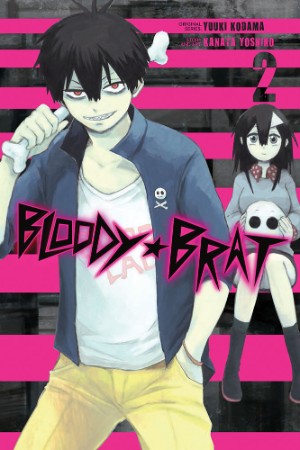 MICHELLE: Well, I seem to recall that we both found Yuuki Kodama’s Blood Lad to be an unexpected delight. I’ve also been reading the related
  MJ: I did indeed! Finally, this week, I caught up with the first two volumes of Tomu Ohmi’s
  We’ve been away from this column for a while, for various reasons, and to crank things back up again, we thought we’d take a look at a couple of recent releases from one of our favorite publishers, Vertical, Inc. First on the docket is a rare classic from the late Satoshi Kon,
  MICHELLE: Alrighty!
 MICHELLE: Sure! I suppose I’ll just start with the one I read first, which was the debut volume of
  MJ: I would! Our second read this week was the first volume of Maki Enjoji’s
  Off*Beat tells the story of Christopher “Tory” Blake, an exceptionally smart teenager who lives with his divorced mom in Queens. Tory’s a capable kid, but the sense of abandonment brought on by his father’s absence has manifested itself in an odd habit—meticulous record-keeping of every single thing that happens to him and those around him. And when a new kid, Colin, moves onto Tory’s block under potentially mysterious circumstances, Tory’s obsessive attention becomes focused on him, and he goes so far as to get himself transferred to Colin’s private school on Long Island, even though it takes him two hours (by subway, rail, and bus) to get there every day. Tory soon discovers that Colin and his guardian are involved in some sort of top-secret scientific project, and he’s able to convince himself that it’s the project he’s obsessed with, but it clearly all comes around to Colin.
 My solo read this week was the first volume of
  MJ: Sure! So, we’ve been delving into quite a number of Viz’s digital re-releases of older shoujo series—particularly those from their now-defunct “shōjo” imprint. So far, we’ve been focusing on supernatural and schoolgirl-in-another-world series such as


 Originally published in Ichijinsha’s action-heavy, BL-tinged shoujo magazine Comic Zero Sum, Loveless was a great fit for Tokyopop’s lineup, alongside titles like Kazuya Minekura’s Saiyuki Reload and Shiho Sugiura’s Silver Diamond, but after the demise of Tokyopop’s North American publishing division, fans of the series were left hanging with no new releases after 2008’s release of volume 8. Fortunately, Viz Media has come to the rescue, not only releasing the series’ subsequent volumes (now standing at 11, both here and in Japan), but also re-releasing its earlier volumes in omnibus format.


 So, as a reminder,
  Like Red River,
  MJ: Sure! Hmmmm… now the question is, which one? I guess I’ll start with the book I read last, since it’s freshest in my mind, and that would be

 MICHELLE: Sure!
 Moving swiftly from contemporary to classic, our second read this week was the first omnibus volume of Kazuo Koike and Goseki Kojima’s


