• Skip to primary navigation
  • Skip to main content
  • Skip to primary sidebar
  • Home
  • About Us
    • Privacy Policy
    • Comment Policy
    • Disclosures & Disclaimers
  • Resources
    • Links, Essays & Articles
    • Fandomology!
    • CLAMP Directory
    • BlogRoll
  • Features & Columns
    • 3 Things Thursday
    • Adventures in the Key of Shoujo
    • Bit & Blips (game reviews)
    • BL BOOKRACK
    • Bookshelf Briefs
    • Bringing the Drama
    • Comic Conversion
    • Fanservice Friday
    • Going Digital
    • It Came From the Sinosphere
    • License This!
    • Magazine no Mori
    • My Week in Manga
    • OFF THE SHELF
    • Not By Manga Alone
    • PICK OF THE WEEK
    • Subtitles & Sensibility
    • Weekly Shonen Jump Recaps
  • Manga Moveable Feast
    • MMF Full Archive
    • Yun Kouga
    • CLAMP
    • Shojo Beat
    • Osamu Tezuka
    • Sailor Moon
    • Fruits Basket
    • Takehiko Inoue
    • Wild Adapter
    • One Piece
    • After School Nightmare
    • Karakuri Odette
    • Paradise Kiss
    • The Color Trilogy
    • To Terra…
    • Sexy Voice & Robo
  • Browse by Author
    • Sean Gaffney
    • Anna Neatrour
    • Michelle Smith
    • Katherine Dacey
    • MJ
    • Brigid Alverson
    • Travis Anderson
    • Phillip Anthony
    • Derek Bown
    • Jaci Dahlvang
    • Angela Eastman
    • Erica Friedman
    • Sara K.
    • Megan Purdy
    • Emily Snodgrass
    • Nancy Thistlethwaite
    • Eva Volin
    • David Welsh
  • MB Blogs
    • A Case Suitable For Treatment
    • Experiments in Manga
    • MangaBlog
    • The Manga Critic
    • Manga Report
    • Soliloquy in Blue
    • Manga Curmudgeon (archive)

Manga Bookshelf

Discussion, Resources, Roundtables, & Reviews

executioner and her way of life

The Executioner and Her Way of Life: Wish Upon a Star, Pray to a Flower

August 16, 2025 by Sean Gaffney

By Mato Sato and nilitsu. Released in Japan as “Shokei Shoujo no Virgin Road” by GA Bunko. Released in North America by Yen On. Translated by Jenny McKeon.

Well, back to reality. After a volume where I actually managed to enjoy it from beginning to end, we’re back to business as usual for The Executioner and Her Way of Life. The first 40% or so of this book is absolutely dire, and I was once again wondering why I had not dropped the series. The difficulty is that most of the people who remain in the cast are profoundly unlikable and selfish, and it’s not fun to read about them. This is also a book whose plot synopsis can best be summed up as “everyone is ignoring everyone else’s feelings and desires for the sake of their own”. Now, frequently this is understandable. The color soldiers are looking for a new homeland, and worry that this will cause the humans to try to eradicate them. (Correctly.) And Menou’s grand plan for saving Akari amounts to “kill myself”, so it’s not surprising that Momo is not down with that. Everyone is, frankly, at the end of their tether, and it shows.

Menou, Maya, and Sahara have fled to the Mechanical Society with Abbie’s help, but Michele, Momo and Hooseyard are hot on their trail, and trying to work out a way to break in there. Menou’s goal is the Starseed, but things prove more complicated than expected when they discover that another one of the Four Evils, Gadou, is still alive. After dealing with the fact that Gadou has literal split personalities, Menou puts her plan into action, despite the fact that her memory has gotten so bad that she’s forgotten Flare, Momo, and everything else about her past. Momo, meanwhile, has an Akari-in-a-Box, and a plan to get Menou and Akari both back with their memories attached, but this plan sort of relies on killing Menou first. Just for a bit. A little killing.

This book really does get good in the second half, as everyone starts to fight for their lives and their goals, and realize that there’s no way that everyone can end this alive. Indeed, Menou’s self-hatred and death wish is about all that’s fueling her now, and it helps the reader to sympathize with Momo a great deal, even when she tries to solve a problem by taking Akari from her luggage and hurling her at Menou’s head. Momo and Akari still hate each other, for obvious reasons. That said, Momo’s plan wouldn’t have worked without Akari, so they can at least be grateful for that. By the end of this book, most of the cast are almost back to normal and we’re at the end of the arc. If only Ashuna were back in the series I’d be perfectly happy. (Monkey’s Paw twitches) Oh no…

So yeah, Ashuna is the cliffhanger, and I am no longer happy. I suspect in this world that runs on war, death, and genocide, a lot of other people aren’t going to be happy either. Still, at least with Menou and Akari back to normal, there’s potential for more yuri in Book 10. Recommended, but be prepared for the traditional slow start. Also, warning, this book contains Hooseyard, and she’s still really annoying.
Filed Under: executioner and her way of life, REVIEWS

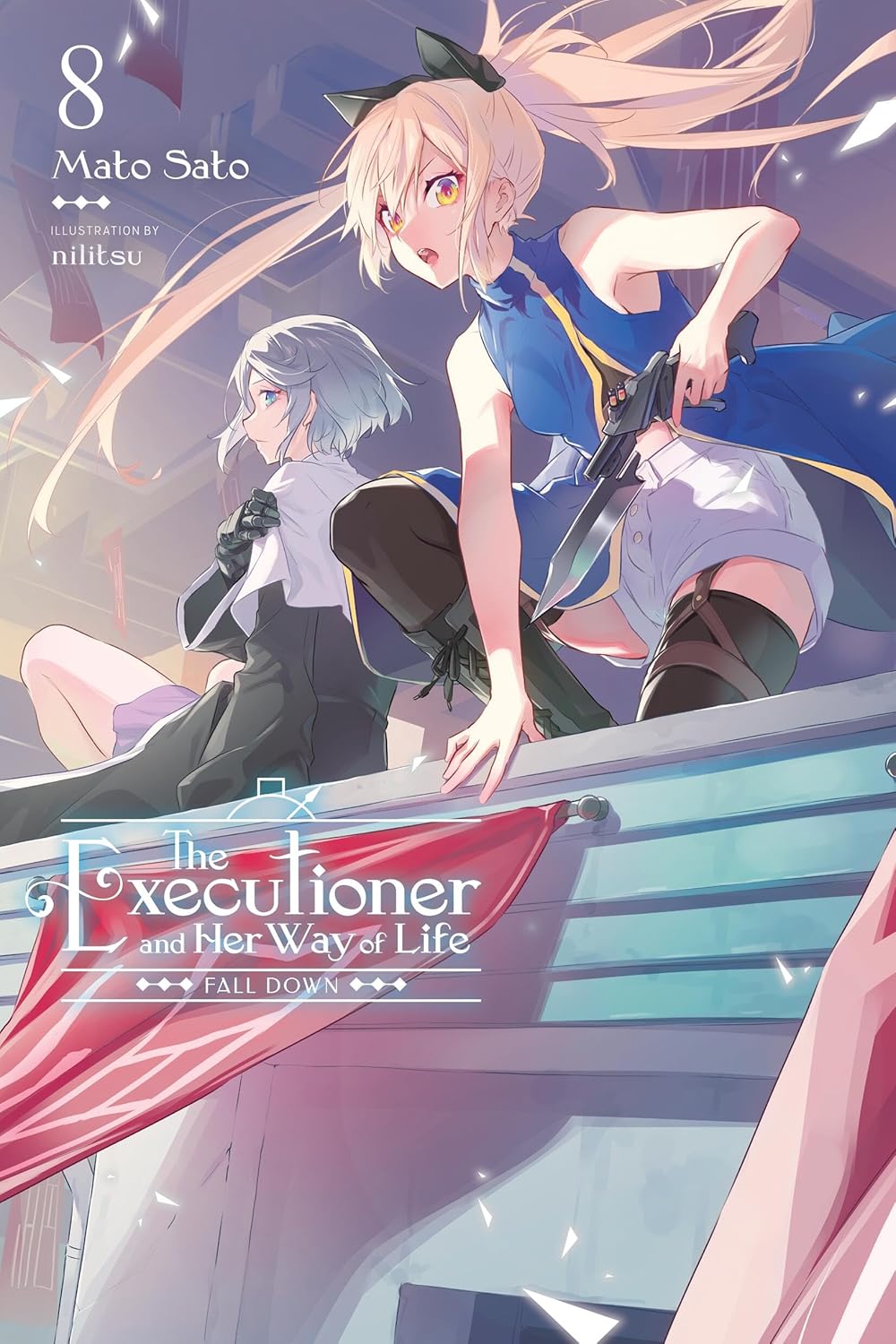
The Executioner and Her Way of Life: Fall Down

July 28, 2024 by Sean Gaffney

By Mato Sato and nilitsu. Released in Japan as “Shokei Shoujo no Virgin Road” by GA Bunko. Released in North America by Yen On. Translated by Jenny McKeon.

First of all, big props to the author for actually keeping my attention through the first half of this volume. I’ve talked before about how the first half of these recent books have all been dire, so this is a definite step up. More seriously, I also noticed while reading this volume how compact the cast list is. This is basically a variation of shonen battle manga, in a sci-fi sort of vein, and each volume needs to escalate the danger because our heroes need a bigger threat. But the threats we’re seeing have been around since the start, they’re just coming back because everyone in this series is damn near impossible to permanently kill. Hell, even one of the cast from a thousand years ago is a supporting character in this book due to (handwaves) reasons. The “new” antagonist who threatens our heroines with bigger and bigger guns turns out to have been accidentally stifled by Sahara four books ago, and she doesn’t even remember it. So sad.

Menou, Abbie, Sahara and Maya have arrives in the wilds of the north, where they come across the stunning city of ruins, which is not only still intact after so long but is also technically TWO cities… there’s a second one upside down above the first. Unfortunately, they can’t simply sit around and watch terrible movies about sharks in space – not only is one of the biggest mobster bad guys around trying to kill the woman who killed off Flare, for tragic backstory reasons, but also Pandaemonium is here somewhere as well, and Maya, for obvious reasons, wants to try to stop her. Fortunately, the four of them have some help in the form of an ally thought long dead. UN-fortunately, Momo is there as well, and she’s got her own agenda, one that Menou really isn’t going to like.

As usual, I loved Sahara here, who continues to be forced to care and be heroic against her will. The final scene where she takes out one of the big bads because, among many other reasons, she never got breakfast OR lunch today is hilarious but also dead on. Sometimes you’ve got to let compassion fall by the wayside because you’re too cranky. More impressively, I really enjoyed reading Menou in this book. I’ve made no secret about the fact that Menou is my least favorite of the many “good guys” in this series, but here she’s given subtext that makes you pay attention to her – she’s losing more and more of her self. She’s already forgotten everything about Momo, which does not bode well for when the two inevitably meet up again, but seeing her casually take a scripture because she can’t remember why she wouldn’t be using one is chilling because she REMINDS us why earlier in the book. She’s falling to bits. Still not optimistic this will end with any of the main cast alive.

The yuri may be thin on the ground these days, but it IS driving most of the character motivation deep down, so that’s fine. This was good. I look forward to the 9th book. Which only came out in Japan 6 months ago, so we may have to wait more.

Filed Under: executioner and her way of life, REVIEWS

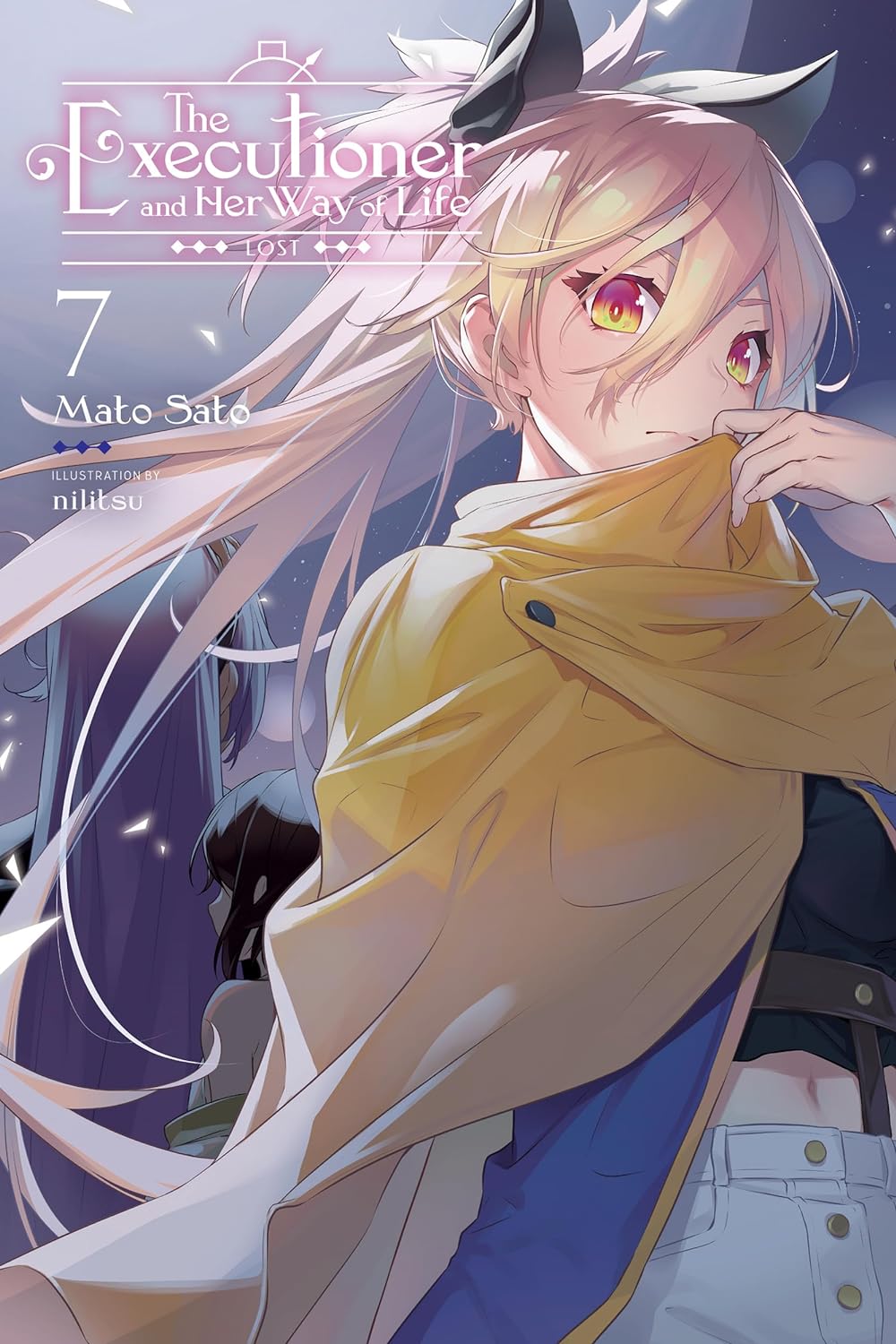
The Executioner and Her Way of Life: Lost

April 7, 2024 by Sean Gaffney

By Mato Sato and nilitsu. Released in Japan as “Shokei Shoujo no Virgin Road” by GA Bunko. Released in North America by Yen On. Translated by Jenny McKeon.

I urge the author to do something for the next book. After writing the novel, throw the first half of it out, and replace it with a summary. Then publish the second half. This way we get all the good bits, and we avoid the crushing first half that this series always has, because the prose works best when it’s in fast action sequences and compelling character dramas, and not “moving people from place to place”. It doesn’t help that my three favorite characters in the series are Akari, Momo and Ashuna, and Akari is AWOL for plot reasons, Ashuna simply never appears, and Momo shows up on the final page. This leaves us with Menou, who I like well enough but who is essentially “the serious one”. And we also get someone who is so obviously a replacement for Akari that the text has to call it out. Fortunately, the book also has Sahara. I love Sahara. Even more so here, as she has character development, 100% against her will.

We pick up six months after the end of Book 6. Ashuna has gone back home to essentially announce that the ryals are joining the revolutionaries. Momo is in charge of watching over Akari’s body. And Menou is busy being the world’s most wanted terrorist. She’s assisted by Abbie, a conjured soldier who regards Menou (and most everyone else) as her “little sister”, and also Maya, once Pandaemonium, who has her memories of a thousand years ago back but that’s led to all sorts of issues. Chasing them is the Church, led by her old instructor priestess (unclear if Teach is her name or her job, but she’s only called that), and Michele, the new Priestess in Charge, who works for, and honestly worships a bit, Hakua. Things start to go south when Maya gets separated from Menou and Abbie. But it’s OK! Sahara will help her!… maybe?

I grumped a lot on Twitter about this, so I will admit: I really enjoyed the second half. Specifically, I enjoyed everything involving Maya and Sahara. Maya’s subplot, as she tries to reconcile her Pandaemonium memories (she’s still very bitter about Manon’s death, even though, as Sahara points out, Manon was actively seeking her own death) with her memories as a Japanese girl who was being tortured over and over for her Concept. No wonder she tries to reach out to Hakua even though she knows it’s a trap. But Sahara, oh my God. She has all the best lines in the book, and as you’d expect is lazy, jaded, and quick to avoid work and shift responsibility onto others… until she isn’t. It’s a surprise to Maya, but it’s an even bigger surprise to Sahara, who is startled to find herself trying hard to protect Maya even at the cost of her own life. It made me smile.

That said, events towards the end promises the fun times are still not happening. Menou has lost a very important connection… and that connection seems to know it. Expect fireworks next time. Probably in the 2nd half of the book.

Filed Under: executioner and her way of life, REVIEWS

The Executioner and Her Way of Life: A Casket of Salt

March 24, 2023 by Sean Gaffney

By Mato Sato and nilitsu. Released in Japan as “Shokei Shoujo no Virgin Road” by GA Bunko. Released in North America by Yen On. Translated by Jenny McKeon.

You will pardon me if I am just a bit exhausted after reading this volume of the series. It consists entirely of payoff, which makes the plot more interesting, but also means that we don’t really get to relax and take in anything. And, frankly, we’re still inhibited by the actual writing. The anime was quite successful when it was released, and I think it showed off that the ideas and concepts in this series work best when they’re taken away from the author’s control. This book is a slog, no mistaking it, and while I realize some of that is simply because the events in it are unrelentingly grim that’s not the only reason. It doesn’t help that I get the feeling this series was supposed to end with this book (and Flare’s plan), but the upcoming anime had the publisher tell the author “we need to extend the series, can you make everything worse instead?”.

This book is about the battle between Menou/Akari and Flare, and it does not need supporting characters getting in the way, so Ashuna quickly departs (after confirming what we all knew already, that it’s Momo she’s really into). As for Momo herself, she falls for a fairly obvious trap and spends most of the book in a literal cage. This is not to say that Menou and Akari are getting all the cool and awesome things to do, though Menou does pretty well. Unfortunately, the new character from last volume has shown up, and she is absolutely the new antagonist and wants to let you know it by removing Akari from the board. The one thing that Menou has been trying to avoid this entire time has now happened, and what’s worse, she’s not a wanted traitor. Can she possibly find a way to set things right?

It’s hard to talk about this book without spoiling everything (as you can see by that awkward paragraph above), but I do want to say that a lot of the ideas and themes here are really good. We finally get revelations about Menou’s past, as well as Akari’s past, and they fit thematically. Everything about the Pandaemonium subplot was fantastic, and almost made me have an emotion. That’s probably the part of the series I look forward to seeing most in the next book. There’s generational stuff here, as we see the relationship back in the day between Flare and one of her isekai’d victims was similar to Menou and Akari’s. An anime of this would probably kill. It’s just… it all feels so flat on the page. I kept checking to see how long it had to go. The author’s writing has no style, no pep, no verve.

There’s enough here for me to grudgingly continue, if only to see if Ashuna can actually do something next time. But for the average reader wanting to see what comes next, I recommend waiting for a Season 2 of the anime.

Filed Under: executioner and her way of life, REVIEWS

The Executioner and Her Way of Life: The Promised Land

October 10, 2022 by Sean Gaffney

By Mato Sato and nilitsu. Released in Japan as “Shokei Shoujo no Virgin Road” by GA Bunko. Released in North America by Yen On. Translated by Jenny McKeon.

There is a famous quote (actually he said it a number of times) by Anton Chekhov about dramatic principles. One of the quotes says “If in the first act you have hung a pistol on the wall, then in the following one it should be fired. Otherwise don’t put it there.”. This is a perfectly fine dramatic tenet to use, and I have no real issues with it. That said… you still need to write something OTHER than the pistol hanging on the wall. You can’t just have 90 minutes of ‘pistol on the wall, la de da’ and expect the audience to stay invested. In case you’re wondering where I’m going with this, the 5th volume of The Executioner and Her Way of Life does have some guns go off near the end of the book. But the first half of this volume may be one of the most boring I’ve seen in Japanese light novels, as everyone walks around aimlessly, reiterates what we already know, and waits for Menou to have some revelations about herself.

Everyone’s arrived at the Holy Land. Flare has taken Akari, put her in an ivory tower, and given her an existential crisis to keep her busy for most of the book. Momo and Ashuna arrive there, and have some warmed-over banter before Ashuna promptly exits the plot after seeing a future plotline. Momo is, to her surprise, taken in by the Archbishop and put to work with Hooseyard, who is a summary of all the “naive but nerdy” glasses girls in anime. Manon, Pandaemonium, and Sahara have arrived to wreak havoc. And Menou has arrived to fight Flare and lose, because she knows that’s going to happen. The problem is that she’s right for the wrong reasons. Something she figures out when they fight and it becomes clear that Menou has surpassed her master… in all ways but one.

The book turns around, as I said above, once Menou has a horrific realization: she’s only killed strangers she barely knew, and when she tries to kill someone close to her, like, say, Flare… she can’t do it. In other words, despite forcing herself into the role of a “villain”, she has empathy. Surprise! That said, it is pretty dramatically satisfying, and I enjoyed her burst of hysterical laughter. Akari has the misfortune of spending most of the book in a state of shock after realizing that if Menou dies, and she has to rewind time again,. she’s probably going to start losing her memories of her time with Menou, which nearly destroys her. Of course, there’s an obvious answer to this for both of them, one that Flare (who seems to be trying to commit suicide by cop throughout this book – Menou is the cop) is trying to hammer home. By the end of this book, we’ve finally moved past “I’m going to kill Akari/Only Menou can kill me”, and it will be interesting to see where things go next, especially after seeing the last few pages, which confirm something hinted since the start of the series.

I’ll keep going with this, because I want to see what happens to the characters. But “writing style” is not a reason anyone should read this series, and it makes the front half of this volume sheer murder.

Filed Under: executioner and her way of life, REVIEWS

The Executioner and Her Way of Life: Crimson Nightmare

May 9, 2022 by Sean Gaffney

By Mato Sato and nilitsu. Released in Japan as “Shokei Shoujo no Virgin Road” by GA Bunko. Released in North America by Yen On. Translated by Jenny McKeon.

For the most part this fourth volume of The Executioner and Her Way of Life is a bit of a breather volume. There’s pretty much zero gore, which is nice. Akari and Momo prove to be highly amusing together as they pettily snipe at each other, and both are more interesting away from Menou. And the running gag of various enemy agents being forced to admit they’re sex pests to avoid giving away their cover runs long enough to be funny and just that long. Plus we get the addition of several old villains, and they’re almost pleasant. All this and hot springs. The whole thing would be lovely if it were not for the fact that Akari is still a ticky ticky timebomb… or is she? As Menou slowly figures out… or is straight up told… various parts of the plot, she rapidly realizes that killing Akari to save the world might not be what’s actually going on. Unfortunately for her, her Master has come to take over.

Akari and Momo, reluctant allies – very reluctant – take a train to a nearby hot spring town in the mountains. Neither one wants to be around the other, but they both have one thing in common, which is that they want to save Menou’s life. Unfortunately for them, Menou managed to go after them much faster than expected due to the obvious solution of “ask Ashuna for money and a ride”. Good news for Ashuna (and the reader), this involves Menou dressing in a butler uniform. And, as it turns out, EVERYONE is arriving at this little mountain town, including Pandaemonium, who lacks power but is still dangerous, Manon, who is resurrected with a new body, and one other surprise guest. Things do not build to a furious climax, alas, but peter out, as Akari ends up spirited away by the one person whose presence has suffused this whole series.

The best parts of this book were the parts with Akari and Momo. Their constant insults and angry bitching is funny, yes, but as the book goes on we get to see how both of them are generally a lot kinder than they’d like to let on, and Akari in particular feels less upset by Momo’s attitude after she realizes that Menou is pretty much all Momo has. We also get a lot of stuff explained to us here, such as the nature of Conjurations, why Akari has to be killed, and what really happened in the past. This even ties in with Japoan, not only because the hot springs mountain town is the closest we’ve seen to Japanese culture in this world, but also because there may be a way to get Akari back after all. If she wants to go. And if she can put up with mass murder. And of course Flare, near the end of the book, shows us, unsurprisingly, that she’s not going to arrive to save the day.

This series has a cast that are interesting and fun to read about but are all, except maybe for Menou, various shades of unpleasant. It makes for an intriguing read.

Filed Under: executioner and her way of life, REVIEWS

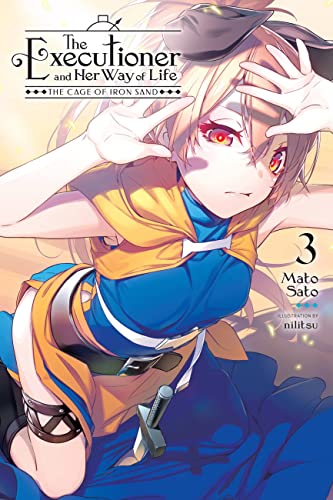
The Executioner and Her Way of Life: The Cage of Iron Sand

November 25, 2021 by Sean Gaffney

By Mato Sato and nilitsu. Released in Japan as “Shokei Shoujo no Virgin Road” by GA Bunko. Released in North America by Yen On. Translated by Jenny McKeon.

This series continues to go back and forth between things I quite enjoy and things that kind of irritate me, and in this book they’re about fifty-fifty, meaning it gets a reluctant recommendation. There’s far less Akari in here than I’d like, though her scene with Momo was the highlight of the book, and promises good things for the book after this. We also get an amusing new addition to the cast, a colleague of Menou’s who seems to be a airheaded flirt, though it’s implied throughout that this personality is a front. Which is a shame, as I liked it better than the personality that showed up later. There’s lots of cool fights, all of which seem to point to the value of “being pretty good at everything because of working really hard” rather than “has an innate natural gift”. Which I’d appreciate more if it was not undercut by the implication that the supposedly hardworking woman is in reality Very Special Indeed.

Menou and Akari are making their way through the desert, which turns out to be another area that was completely devastated because of a Japanese isekai gone horribly wrong. Things start off badly as Akari has already been kidnapped as the book begins, and Menou has to infiltrate a criminal organization to rescue them. There she runs into an old colleague from the orphanage, Sahara, and the three of them proceed to a nearby oasis city, with Menou now having to suffer the attention of *twp* bokes. Arriving at the city, she and Momo get the help of Princess Ashuna, who is essentially in this book to be cool and not much else. Unfortunately, she and Menou have to fight off a dangerous crime lord, so Menou sensibly leaves Akari back at the hotel. Which ends up being the biggest mistake she makes in the book.

The problem I have with Sahara is likely down to the character skewing away from my tastes. I really like the ‘sleepy ditzy flirt’ sort of character, and when Sahara is revealed to in fact be a ball of jealousy and envy, I wonder what the point was in having her be likeable for 3/4 of the book at all except to annoy me. Then again, when the reverse happens – i.e. when Akari gets her suppressed memories back – I actually tend to like her more, so hey. And yes, everyone is angry at Menou for being ‘the chosen one’, and Menou keeps insisting that she’s not all that great and is just a fairly normal person, which is fine except it’s pretty clear that she’s also got a past that’s been completely suppressed. Which just makes me more annoyed.

Basically, it’s hard to like anyone in this series because they could turn into something completely different down the road. I know that “change is a process” is the theme of the books, but there’s a bit TOO much change. Right now, Momo is my favorite character because she’s at least consistent. That said, sure, I’ll read more.

Also, naming the new character in your desert-themed book Sahara is kind of like naming your dog Spot.

Filed Under: executioner and her way of life, REVIEWS

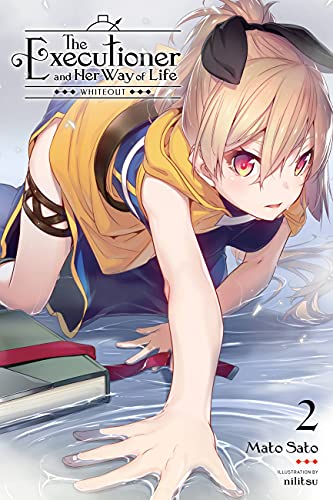
The Executioner and Her Way of Life: Whiteout

August 7, 2021 by Sean Gaffney

By Mato Sato and nilitsu. Released in Japan as “Shokei Shoujo no Virgin Road” by GA Bunko. Released in North America by Yen On. Translated by Jenny McKeon.

The second volume in this series picks up right where the first one left off, with Menou and Akari arriving in the Port City Libelle. Akari is here to have a vacation, Menou is here to try to kill her, and makes an attempt, but it fails as the others have. More worryingly, the terrorist organization we saw on the train in the first book has also got a hook into this city, and it appears to actually have the approval of the royal family – or at least the royal princess, who seems somewhat… detached from life. Menou’s not getting any help from the Church – they loathe her. The fight-loving princess finally meets her, but, unsurprisingly, just wants to fight. And Momo is doing her best to help, but things might be a little more difficult than any of them had assumed. Why is one of the four Human Errors out of her fog prison? Why does she know Akari? Even more chillingly, why does she know Menou?

So, first of all a warning: while this is not quite as bad as, say, Roll Over and Die 4, it is a very gore-filled and violent book. Pandæmonium is our villain here, and she’s a little girl who can essentially resurrect herself from her own body and blood – meaning that she can be killed endlessly and literally crawl out of her dead body. This is, needless to say, disquieting, both as a concept and as prose. She’s a classic type – the killer little girl – but that does not make her any less difficult to deal with. Akari’s own subplot is also rather chilling, as we get a lot more time in the head of the original Akari, the one who is not an airhead (though both are in love with Menou – indeed, that’s pretty much the one trait they share). The revelation from Book 1 is gone into further, and I wonder if a happy ending is truly possible for her – or if death is the only solution.

Not that the world has really had a solution to the isekai’d heroes before. We don’t get much more backstory, and a lot of it is filtered through Pandæmonium, who sees everything in terms of a movie, but it’s pretty clear there’s more going on here than just “the four human errors turned evil and were all destroyed”. For one thing, the one who put them down has also vanished from history… maybe. We get hints here and there as we go through this book that Menou’s past is tied to the human errors more than she’s aware of. (She’s also mostly figured out what Akari is doing, so it’s not simply making her ignorant on purpose.) As with the first book, everything ties back to her mentor Flare, who she gets her nickname (Flarette) from. Good news! They may reunite soon! That is the end of the good news.

Apologies for being somewhat oblique, but this is the sort of book that runs on mysteries, and I’m not ALWAYS a giant spoiler factory. If you’re reading this for the yuri, you may be disappointed – it’s there but isn’t a focus. If you’re reading this for lots of cool action, dark mysteries, and a bit of existential horror… OK, more than a bit… then this should serve you quite well. If you got off the Roll Over and Die train after Book 4 caught up to Japan, pick this up.

Filed Under: executioner and her way of life, REVIEWS

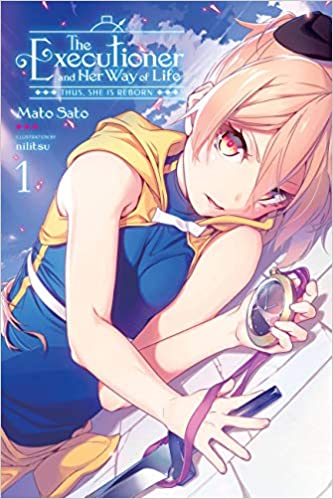
The Executioner and Her Way of Life: Thus, She Is Reborn

March 14, 2021 by Sean Gaffney

By Mato Sato and nilitsu. Released in Japan as “Shokei Shoujo no Virgin Road” by GA Bunko. Released in North America by Yen On. Translated by Jenny McKeon.

As we see more and more deconstructions of the basic isekai light novel and its tropes, it’s inevitable that some of those deconstructions are going to involve “isekai is bad, really”. Yeah, taking a young, immature Japanese man and dropping him into a fantasy world with monsters and magic, where he inevitably starts plotting how to “invent” mayonnaise and miso soup, is not necessarily the best decision one can make. Indeed, this is not even the first book we’ve seen in English with this plot, as Isekai Rebuilding Project already wandered down this road. That said, this world is pretty hardcore about stopping it. Isekai’d Japanese people, in the past, have created horrors of apocalyptic form. There’s no stopping them, all you can do is put them out of their misery. And, well, if you have to kill them before they even gain access to their powers, well, this is a sacrifice that will have to be made. This book is about one of those killers, and the girl she can’t kill.

We are introduced to Menou, the titular executioner, when she meets a young man who was brought to this world from Japan… and then promptly kicked out. Not spoiling much, but… he is not our hero. Menou fills that role. The heroine is actually Akari, the girl who was brought to this world at the same time, and who Menou also kills… but Akari can control the element of Time, and this the clock rewinds her body back to being unhurt. She also doesn’t seem to remember Menou doing this, so Menou continues to pretend to be helping her while, in actuality, leading her to the Church, which apparently can do a better job of wiping her out. She’s helped by her assistant Momo, who is basically Shirai Kuroko from Index in pink, and, albeit inadvertently, by Ashuna, the princess of the royal family who started this whole mess. That said, Menou will rapidly find that there’s far more going on here than meets the eye.

Getting the bad out of the way, this book’s afterword sells itself as “grimdark”, and it’s not kidding. There’s lots of dead and eviscerated people in this, Menou’s backstory verges on terrifying, and the ending implies that the entire series may end in a tragedy. And, because this is a Japanese light novel, we’ve got to have lots of talk about Akari’s big breasts and art of them being big. This ends my negative comments. Everything about the book that is not those two things was fantastic. The magic system is well thought out, and integrates nicely with the world’s religion. The characterization of the four leads manages to make them all obvious “types” that anime fans will be VERY familiar with, but then also turn around and give most of those people (Ashuna does not get much to do here, to be fair) a depth that also works the way a good mystery does – after reading the ending, you want to go back and read the start again. When we first meet Akari, there’s a bit of her own narration that is 100% at odds with everything we get for the next 150 pages… until the climax, when it all comes together and you go “OOOOOOH!”. Love it. Even Momo, who I was sure would be the one character that irritated me throughout, gets a touching backstory, an actual reason for her behavior, and a terrific romantic afterword, though I have bad news for her if she hopes to be best girl.

So yes, definitely recommended. Even the title and subtitle have a sense of “grand epic” to it. Oh yes, and there’s also a tinge of yuri to it, so folks who enjoy that will also want to read it. Plus, anime coming soon! Basically, get in on the ground floor of this one.

Filed Under: executioner and her way of life, REVIEWS

 | Log in
Copyright © 2010 Manga Bookshelf | Powered by WordPress & the Genesis Framework