• Skip to primary navigation
  • Skip to main content
  • Skip to primary sidebar
  • Home
  • About Us
    • Privacy Policy
    • Comment Policy
    • Disclosures & Disclaimers
  • Resources
    • Links, Essays & Articles
    • Fandomology!
    • CLAMP Directory
    • BlogRoll
  • Features & Columns
    • 3 Things Thursday
    • Adventures in the Key of Shoujo
    • Bit & Blips (game reviews)
    • BL BOOKRACK
    • Bookshelf Briefs
    • Bringing the Drama
    • Comic Conversion
    • Fanservice Friday
    • Going Digital
    • It Came From the Sinosphere
    • License This!
    • Magazine no Mori
    • My Week in Manga
    • OFF THE SHELF
    • Not By Manga Alone
    • PICK OF THE WEEK
    • Subtitles & Sensibility
    • Weekly Shonen Jump Recaps
  • Manga Moveable Feast
    • MMF Full Archive
    • Yun Kouga
    • CLAMP
    • Shojo Beat
    • Osamu Tezuka
    • Sailor Moon
    • Fruits Basket
    • Takehiko Inoue
    • Wild Adapter
    • One Piece
    • After School Nightmare
    • Karakuri Odette
    • Paradise Kiss
    • The Color Trilogy
    • To Terra…
    • Sexy Voice & Robo
  • Browse by Author
    • Sean Gaffney
    • Anna Neatrour
    • Michelle Smith
    • Katherine Dacey
    • MJ
    • Brigid Alverson
    • Travis Anderson
    • Phillip Anthony
    • Derek Bown
    • Jaci Dahlvang
    • Angela Eastman
    • Erica Friedman
    • Sara K.
    • Megan Purdy
    • Emily Snodgrass
    • Nancy Thistlethwaite
    • Eva Volin
    • David Welsh
  • MB Blogs
    • A Case Suitable For Treatment
    • Experiments in Manga
    • MangaBlog
    • The Manga Critic
    • Manga Report
    • Soliloquy in Blue
    • Manga Curmudgeon (archive)

Manga Bookshelf

Discussion, Resources, Roundtables, & Reviews

condemned villainess goes back in time

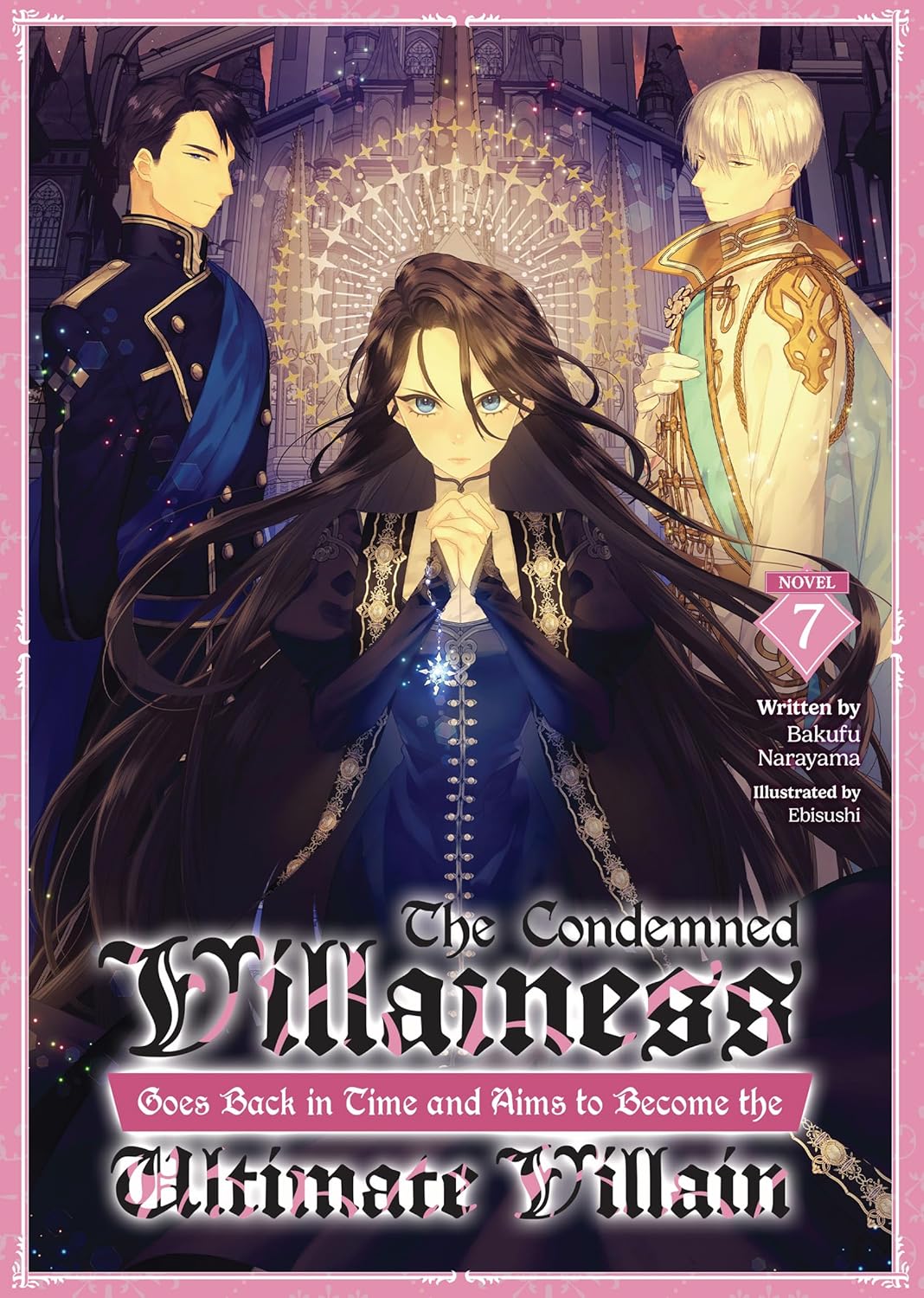
The Condemned Villainess Goes Back in Time and Aims to Become the Ultimate Villain, Vol. 6

November 1, 2025 by Sean Gaffney

By Bakufu Narayama and Ebisushi. Released in Japan as “Danzaisareta Akuyaku Reijō wa, Gyakkō-shite Kanpekina Akujo o Mezasu” by TO Books. Released in North America by Airship. Translated by Alyssa Niioka. Adapted by Vida Cruz-Borja.

Last time I felt that the series got a bit too dark, and I’m pleased to see that this one is not quite as bad. Despite the fact that this volume contains ghosts, ritual sacrifices, and the like, Claudia’s worries are far more about the fact that she’s getting bullied by all the older women in the kingdom – at the request of the Queen, of course. Let’s face it, if you’re going to be the future Queen, you need to be better than everyone at everything, and that includes how to handle petty bullying. If there’s just one issue with the book, it’s that these two plots don’t intertwine as well as I wanted them to, and it felt at times as if the author had two books that they couldn’t quite make work and so decided to combine them into one. It’s still a very readable series, and I like Claudia, but I am starting to tap my fingers a bit.

Claudia continues to go on her Princess Training World Tour, with several stops organized by Lady Sunset, whose husband is the Queen’s older brother. Lady Sunset is there to ensure that Claudia does not wilt under pressure, or (even worse) snap and get angry under pressure. We see Claudia attend a tea party, an embroidery party, and a ball, all of which feature catty middle-aged nobles whose job it is to belittle Claudia and hit her where it hurts – which usually means talking bad about her stepmother. In addition to all this, she and Helen go off to a monastery for two weeks, to learn asceticism and see how difficult it can be for people who don’t have servants to do everything for them. Unfortunately, the remote castle where the monastery is has a small problem… ghosts.

There are as always some things here I found quite interesting. The embroidery party shows off how each of these catty women trying (at the orders of the Queen) to bully Claudia has territory of their own, and that territory naturally has specialties. Claudia being Claudia, she’s able to tell that the tea “accidentally” spilled on her embroidery is from the spiller’s own land, and praises it. As for the embroidery itself, she praises the wool being used, and wouldn’t you know it, the woman whose territory specializes in wool is struggling to find buyers right now. Claudia doesn’t need to make connections with these women – she’s hella powerful already – but she knows by doing so it makes the country stronger. I also liked the ghost story’s suggestion that a woman in the past may also have been living a second life, and her “precognition” was just her not being quite as good at Claudia at hiding that. Perhaps this world just does time-looped villainesses every so often, as a treat.

This was a decent book, though I felt it didn’t pull together as well as it might have. The bigger issue may be that I’m checking to see when the series is scheduled to end, and the answer is “not for the foreseeable future”. Where’s my wedding cover art?

Filed Under: condemned villainess goes back in time, REVIEWS

The Condemned Villainess Goes Back in Time and Aims to Become the Ultimate Villain, Vol. 5

June 21, 2025 by Sean Gaffney

By Bakufu Narayama and Ebisushi. Released in Japan as “Danzaisareta Akuyaku Reijō wa, Gyakkō-shite Kanpekina Akujo o Mezasu” by TO Books. Released in North America by Airship. Translated by Alyssa Niioka. Adapted by Lex Reno.

Content warning: this book’s main plot contains, and my review discusses, pedophilia, grooming, and brainwashing people through drugs and gang rape. The last two are implied but not seen, the first two are definitely seen. Reader discretion is advised.

I’ve called these books difficult to read before, but none of them quite hit like the middle of this book, in which Claudia has to deal with a village of people whose “Chieftess” (does that word get gendered?) is easily one of the worst antagonists in the series to date – see above for why. Fortunately, this is what Claudia and Sylvester are here to fix, though both of them castigate themselves that they didn’t even know it was happening till she conveniently got kidnapped. Sometimes being royalty means finding out about problems that people are deliberately keeping from you. Especially when they’re once again a plan of Nigel’s, the series’ overall big bad, who isn’t in this book but whose presence is felt. Corruption turns out to be – literally – an incredible drug.

By now everyone agrees that the running for the fiancee position is over, and Claudia and Sylvester’s engagement party date is set. Unfortunately, before this can happen, Claudia and Helen – out on the town incognito, with Claudia also disguised as a maid – run into a boy who is dressed as a child detective – because he is one, in fact – and he’s on the run from some goons. They quickly hide in a cart… which then drives off to a remote village, and that village turns out to be the one the boy (Kiel) was investigating. (Helen was able to get away and is getting help.) They find the villagers are all very happy and content… a bit TOO happy and content. The whole village feels a bit like The Stepford Wives. What’s more, people seem to occasionally disappear for no reason. What’s really going on?

So yeah, as indicated earlier, things are very screwed up in this book. What started as a discovery of a pain reliever that allows the village to make a bit of extra cash has suddenly become a village-wide “ritual” when the girls in the village have their first period or the boys have their first “nocturnal emission” to drug them with an aphrodisiac and then have the others in the village rape them till they grow happy with it. The girls in the village who have NOT gone through this yet are quick to side with Claudia and Kiel. The chieftess in particular is a hedonist and pedophile, who literally gropes Kiel to see if his balls have dropped, and openly leers at Claudia. The book is well written as always, and help arrives in the nick of time. But I have to ask, was this trip really necessary?

The series is still ongoing in Japan, and a glance at the blurbs of future books suggests things don’t get easier for Claudia even after her engagement. Hopefully, though, they involve a few less things for me to warn the reader about.

Filed Under: condemned villainess goes back in time, REVIEWS

The Condemned Villainess Goes Back in Time and Aims to Become the Ultimate Villain, Vol. 4

March 14, 2025 by Sean Gaffney

By Bakufu Narayama and Ebisushi. Released in Japan as “Danzaisareta Akuyaku Reijō wa, Gyakkō-shite Kanpekina Akujo o Mezasu” by TO Books. Released in North America by Airship. Translated by Alyssa Niioka.

It’s been a while since the start of this series, and it’s become very hard to remember that Claudia had a life before this one. I mean, we hear about her life as a sex worker on a regular basis in the series, but that’s not what I mean. I mean the “Condemned Villainess” part of the title. And since we haven’t thought about that part as much, it can be hard to remember, not to put to fine a point on it, how gullible and naive Claudia was, and how easily she was led around by the nose. That’s not the Claudia we have here, who is the belle of everyone’s ball, the apple of everyone’s eye, and saving the world one yakuza organization at a time. Unfortunately, there are still shadowy people in the background who very much want things to go badly for the main cast. And as a result, since Claudia can’t be a condemned villainess, someone else is going to have to step to the plate.

We’re dealing with another country next door, and things are pretty bad there. At a masquerade ball, the delegation from Parte, a neighboring country whose citizens seems to hate Harland more and more by the day, have arrived, and they bring with them Niamilia, a noble woman who ends up being suggested as the prince’s fiancee in order to prevent a potential war. But what of Claudia? Well, another of the fiancee candidates, calls her out at the party (can’t have a villainess book without public call out), saying Claudia is an evil woman who uses her mob to traffic in slaves and also murdered a noble the other day. Claudia is, needless to say, above most of these accusations, but given that she IS the secret mob boss of a yakuza organization, she decides to investigate… and finds that someone has been impersonating her.

So yeah, my favorite scene in the book is right at the end – in fact, it’s one of the extra stories added for the book. Throughout the book, we get Wendy, who if she’s been in previous books I’ve never noticed, and she is horrible. She’s easily led, falls for an obvious loser who is luring her into a trap to do his bidding, ignores the advice of the maids who have her best interests at heart, and ends up literally orchestrating murder to prove that Claudia is SECRETLY EVIL. It’s a good look at how conspiracy theories can take hold in someone, and she is teeth-grindingly annoying throughout this book. But at the end, as Claudia leaves the prison where Wendy resides till her exile, she realizes, Oh, that was me. That was literally me in my last life. And thus it affects her more than it otherwise would, and therefore affects us more as well. Claudia gets a time travel get out of jail free card Wendy probably ain’t getting.

All this plus our horrible antagonist from last time, who isn’t in this book in person but who makes his presence felt throughout. These books are difficult but rewarding reads.

Filed Under: condemned villainess goes back in time, REVIEWS

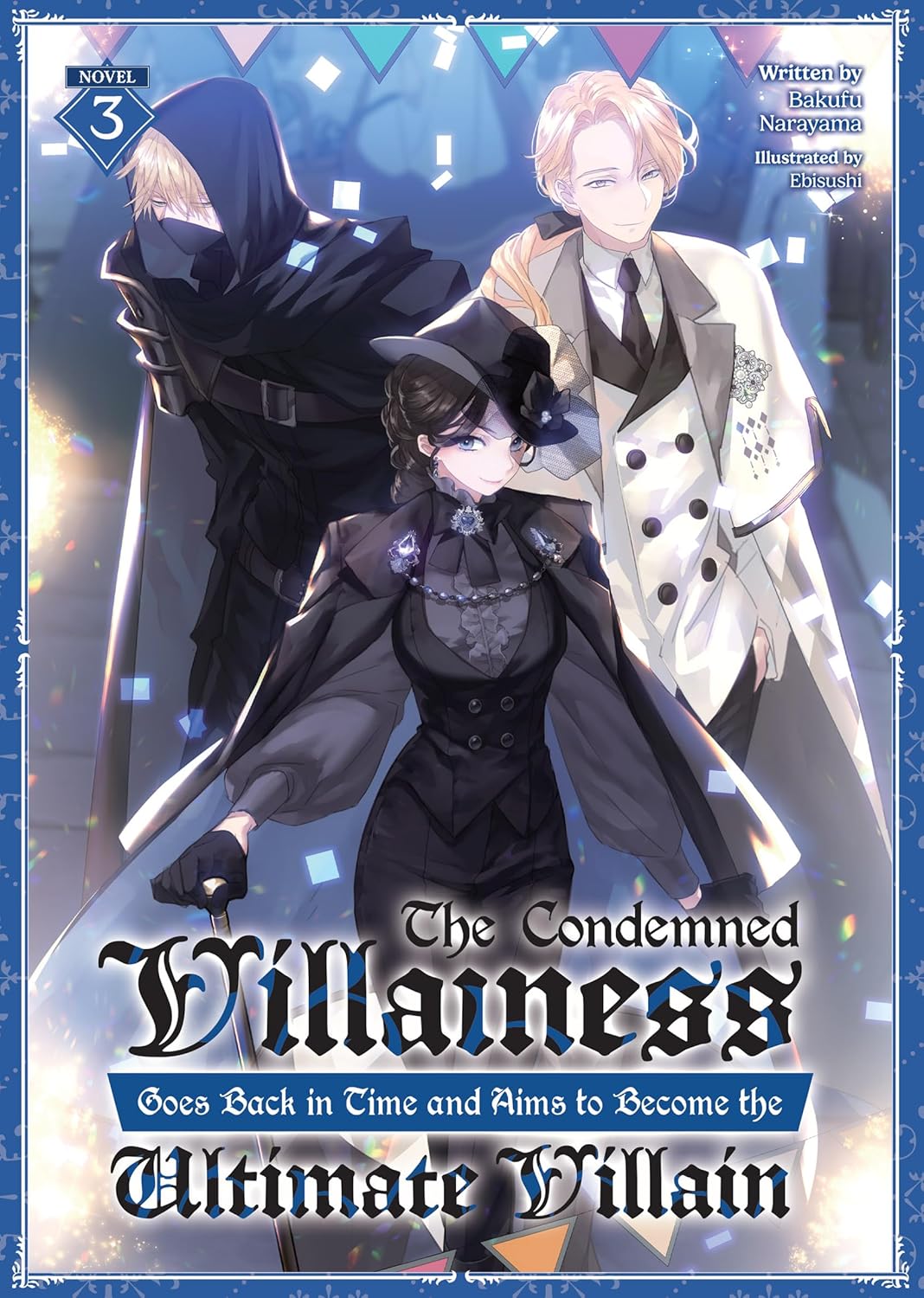
The Condemned Villainess Goes Back in Time and Aims to Become the Ultimate Villain, Vol. 3

October 26, 2024 by Sean Gaffney

By Bakufu Narayama and Ebisushi. Released in Japan as “Danzaisareta Akuyaku Reijō wa, Gyakkō-shite Kanpekina Akujo o Mezasu” by TO Books. Released in North America by Airship. Translated by Alyssa Niioka. Adapted by Vida Cruz-Borja.

The general premise of “heroine goes back in time to her earlier self” stories, which Japan calls Yarinaoshi Loop, is that our protagonist tries to change things in order to change the future and in the end ends up changing everyone else’s lives for the better as well. Sometimes this ends up being the entire kingdom, where we see her do things like unite various kingdoms and solve famine (looking at you, Mia). But occasionally our heroine has a narrower focus. Claudia, in her first lifetime, ended up being sold into a brothel, and had firsthand experience of what a wretched life it is, as well as how, for so many women, there may be no other choice. We’ve already seen her rescue Helen from that life in the first book, and in the second book disguise herself to invest in the brothel she used to work in. But she’s not done. Here we see she wants to make sex work legal. Light novels rarely venture into this area.

(As a side note, if your villainess does not look at least as hot as Claudia does in that suit and hat on the front cover, try harder.)

There’s another foreign prince arriving in town, this one from fantasy… Britain? Denmark? One of those. Prince Seraphim is there to visit Sylvester. They have a Church problem – Seraphim’s nation is not monotheistic, and therefore the church which rules over Sylvester’s nation, as well as most of the others, dislikes them and won’t trade with them at normal prices. Seraphim is looking for allies. Meanwhile, Claudia accidentally murmuring about business when she’s thinking about ways to save the sex workers means her father gifts her a business to run – actually, more accurately an entire shopping center. And wouldn’t you know it, it’s in Seraphim’s home country! Now they’re all traveling to try to do various things, the most important of which may be to stop the evil church guy that always pops up in Japanese light novels.

The most interesting part of this book, aside from its putting the plight of sex workers front and center, is the addition of the cardinal, Nigel. Towards the end of the volume, the book felt it was moving far too fast, and I briefly wondered if it was a two-parter. That’s not the case, but I get the feeling that the author realized as they were writing Nigel that he made a great antagonist for Claudia now that Fermina is out of the picture. Nigel fills a lot of villain tropes – besides being a churchman who loves luxury and will happily kill women and children to get minions to obey him, he’s also dreadfully bored and regards Claudia, an unexpected element, as a challenge. Clearly we’ll be seeing more of him.

This isn’t fantastic, but is on the high side of very good, and Claudia is a great lead character. I’m happy to read more.

Filed Under: condemned villainess goes back in time, REVIEWS

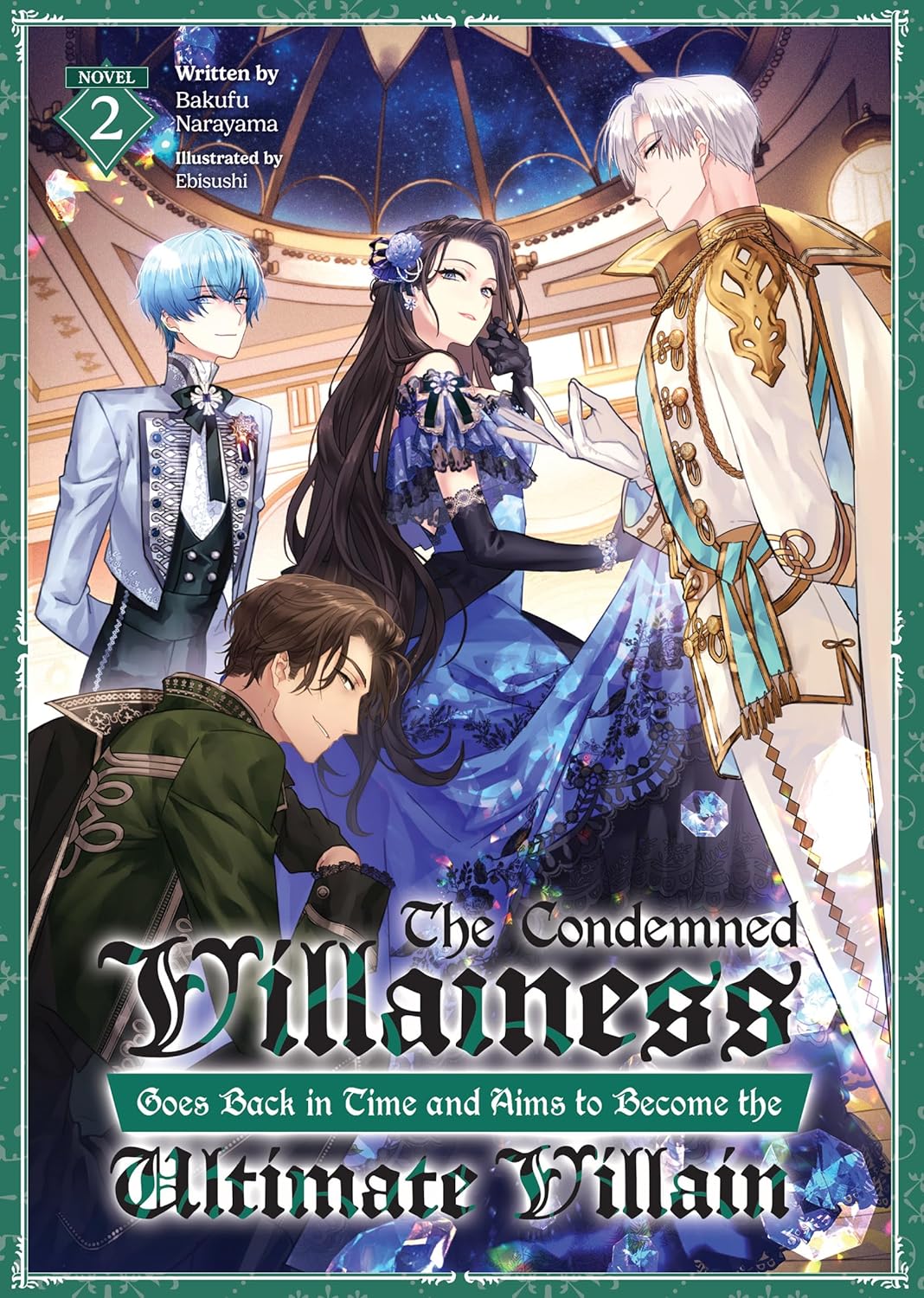
The Condemned Villainess Goes Back in Time and Aims to Become the Ultimate Villain, Vol. 2

May 19, 2024 by Sean Gaffney

By Bakufu Narayama and Ebisushi. Released in Japan as “Danzaisareta Akuyaku Reijō wa, Gyakkō-shite Kanpekina Akujo o Mezasu” by TO Books. Released in North America by Airship. Translated by Alyssa Niioka. Adapted by Vida Cruz-Borja.

Sometimes you know that the worst case scenario is not going to happen. Not because this series wouldn’t kill anyone off – there are one or two deaths in this book, and I expect that trend to continue – but more because sometimes the author hits on a new character who is so good that they cannot bear to pull the trigger and have them die, even if they happen to be the evil mastermind. Yes, that’s right, the major weakness of the first book was the “heroine” being a terrible character, and the author has gone above and beyond to fix it, to the point where, when Claudia manages to save the day, I went “thank God”. Sometimes you just want people to stick around. Well, OK, I mostly want them to stick around. More on that later. But it does make this volume stronger than the previous one.

Claudia has successfully managed to avoid her fate from her previous life, and her younger sister has been quietly sent off (and, thankfully, does not reappear here). Now she’s free to welcome a delegation from the nearby nation of Bari, which is having a bit of political upheaval at the moment, and has exiled the King’s younger brother, Raul, to Harland for the duration. Unfortunately, the political intrigue has gone away from Bari and come to Harland – Sylvester has to leave for several weeks to deal with a situation in a remote part of their nation, Raul’s faction are plotting to put him on the throne despite his own wishes, and his handsome and clever aide is clearly plotting something clever and dreadful. Worst of all, Claudia recognizes Raul from her past life, when he came to her brothel.

I really hate using the word “yuribait”, which these days has been loosely defined as anything that doesn’t end with a confession and a kiss. But if I *did* use it, this series would probably fall under the category. Claudia and Sylvester are still both in love, and the series, which has several opportunities to do so, never even comes close to admitting that lesbians exist. But in addition to the close relationship between Claudia and Helen, her maid, and her rival and best friend Louise, we also get Charlotte, a timid and large-breasted young woman whose parents are trying to get her to use her boobs to get her man, when this is the last thing she wants to do. By giving her incredibly good advice and also being, well, beautiful and cool, Charlotte falls deeply for Claudia, calling her “oneesama” (OK, yes, it’s translated). And then there’s Lestea, who goes from “evil lesbian stereotype” to “obsessive lesbian stereotype” over the course of the book. That was the one part of her arc I was unhappy with. Oh yes, and Claudia also dresses in a suit to secretly visit her old brothel, and manages to not only seduce all her old sex worker friends within thirty seconds but also agrees to fund it. This isn’t going to be yuri, but boy howdy it is an Akogare Festival.

Still, on the whole this was better than the first volume, and I look forward to seeing what happens next, and also hope it is shorter than 406 pages.

Filed Under: condemned villainess goes back in time, REVIEWS

The Condemned Villainess Goes Back in Time and Aims to Become the Ultimate Villain, Vol. 1

February 25, 2024 by Sean Gaffney

By Bakufu Narayama and Ebisushi. Released in Japan as “Danzaisareta Akuyaku Reijō wa, Gyakkō-shite Kanpekina Akujo o Mezasu” by TO Books. Released in North America by Airship. Translated by Alyssa Niioka. Adapted by Vida Cruz-Borja.

As I was reading this volume, I thought about the simple fact that there are too many villainess books at the moment. It’s inevitable, of course, just as there are too many isekai books (though that’s slowing down a bit), and that we briefly had too many high school romance books before that bubble quickly burst. And so I start to drill this new series down into subcategories. There’s no Japan or otome games involved, which is nice. Aside from the time travel, there’s no magic here. It’s one of those “person goes back in time” series like Tearmoon Empire, though this series is far more serious than Tearmoon. As expected, “becoming the ultimate villain” mostly involves things like trying to be a good person and avoid making the same mistakes, rather than “getting revenge” or anything. And, unfortunately, its biggest weakness is one that many other villainess books possess: there’s a “heroine” as well, and in order to balance against our clever villainess, the heroine is an amazingly annoying dipshit. Anti-Maria Campbell Syndrome.

Unlike a lot of other villainesses in this genre, Claudia Lindsey really was an annoying, petty villainess who tried to sabotage her half-sister Fermina, and is somewhat poleaxed to find that everyone hates her and she is not only not engaged to the Prince, but she’s being sent to a nunnery. Things do not improve when, on the way to the nunnery, her carriage is beset by bandits and she’s kidnapped and sold into a brothel. She spends the next few years there. maturing and realizing how shallow and selfish she had been. She also becomes a top-notch sex worker. Unfortunately, her one main ally dies from disease, and a couple of years later Claudia also passes away… and wakes up ten years earlier, in her 14-year-old body, on the day of her mother’s funeral. After realizing what’s happened, she takes advantage of “grieving” for her mother to completely redo her personalty, gain actual allies, and avoid the fate which Fermina manipulated her into last time. Because oh yes, Fermina is not a nice person, regardless of the timeline.

The strengths and weaknesses of this book are similar to other “serious” villainess books. The weakness is Fermina, who despises Claudia for having the life she feels she deserves, but without Claudia being shallow and vapid, Fermina can’t achieve anything she did in the past timeline, and is reduced to a one-note character we’re happy to see the back of at the end of the book. The strength is Claudia, who I greatly enjoyed. I liked that she is 10 years older in mind but still has room to mature, and in fact a lot of her actions are driven by her terror of Fermina somehow gaining the upper hand on her again. I also appreciate that this is a heroine who is allowed to have a libido: we don’t see her sex work, but she’s certainly more experienced in flirting than a woman of her age and noble status should be, and her growing horror as she realizes that teenage hormones means that she’s not able to put a lid on things as much as she’d like to is amusing. I also enjoyed her casual bisexuality, as she admits she finds one of the prince’s bridal candidates to be just as enticing as the prince.

The rest of the cast are good but stereotypical: the sadistic prince who loves Claudia because he can’t tell what she’s thinking; the beleaguered aide, the doting older brother, and the ludicrously loyal maid (who is her former mentor at the brothel in her former life, because nobles rescuing women from terrible fates and making them household workers is another villainess cliche). If you’re looking for something new, look elsewhere. If you’re happy with more of the same, this is quite good. It also feels like it ended with this volume, but there’s 4+ more out in Japan, so…

Filed Under: condemned villainess goes back in time, REVIEWS

 | Log in
Copyright © 2010 Manga Bookshelf | Powered by WordPress & the Genesis Framework