• Skip to primary navigation
  • Skip to main content
  • Skip to primary sidebar
  • Home
  • About Us
    • Privacy Policy
    • Comment Policy
    • Disclosures & Disclaimers
  • Resources
    • Links, Essays & Articles
    • Fandomology!
    • CLAMP Directory
    • BlogRoll
  • Features & Columns
    • 3 Things Thursday
    • Adventures in the Key of Shoujo
    • Bit & Blips (game reviews)
    • BL BOOKRACK
    • Bookshelf Briefs
    • Bringing the Drama
    • Comic Conversion
    • Fanservice Friday
    • Going Digital
    • It Came From the Sinosphere
    • License This!
    • Magazine no Mori
    • My Week in Manga
    • OFF THE SHELF
    • Not By Manga Alone
    • PICK OF THE WEEK
    • Subtitles & Sensibility
    • Weekly Shonen Jump Recaps
  • Manga Moveable Feast
    • MMF Full Archive
    • Yun Kouga
    • CLAMP
    • Shojo Beat
    • Osamu Tezuka
    • Sailor Moon
    • Fruits Basket
    • Takehiko Inoue
    • Wild Adapter
    • One Piece
    • After School Nightmare
    • Karakuri Odette
    • Paradise Kiss
    • The Color Trilogy
    • To Terra…
    • Sexy Voice & Robo
  • Browse by Author
    • Sean Gaffney
    • Anna Neatrour
    • Michelle Smith
    • Katherine Dacey
    • MJ
    • Brigid Alverson
    • Travis Anderson
    • Phillip Anthony
    • Derek Bown
    • Jaci Dahlvang
    • Angela Eastman
    • Erica Friedman
    • Sara K.
    • Megan Purdy
    • Emily Snodgrass
    • Nancy Thistlethwaite
    • Eva Volin
    • David Welsh
  • MB Blogs
    • A Case Suitable For Treatment
    • Experiments in Manga
    • MangaBlog
    • The Manga Critic
    • Manga Report
    • Soliloquy in Blue
    • Manga Curmudgeon (archive)

Manga Bookshelf

Discussion, Resources, Roundtables, & Reviews

alya sometimes hides her feelings in russian

Alya Sometimes Hides Her Feelings in Russian, Vol. 8

November 15, 2025 by Sean Gaffney

By Sunsunsun and Momoco. Released in Japan as “Tokidoki Bosotto Russia-go de Dereru Tonari no Alya-san” by Kadokawa Sneaker Bunko. Released in North America by Yen On. Translated by Matthew Rutsohn.

I’ve talked many times before about the stark contrast between the backstory of Masachika and Yuki and their family drama, the romantic plots with Alya and Maria both being in love with Masachika, and the wacky comedy shenanigans. The drama gets more attention this volume, and the shenanigans are confined to the middle of the book for the most part, and almost feel perfunctory. They read like the author watched a random anime and used that plot as the antics of the book. When I say “there’s a party with chocolates that have a small bit of alcohol in them”, the average fan could write the rest of that scene in their head and be 100% accurate except that it’s only one girl who gets drunk, not all of them. And there’s also an invented game that involves penalties, but since we already had the sexy antics earlier, these punishments are more just silly. The drama, though, is the main reason to get this.

The festival is over, but the aftermath of its events are still reverberating. Masachika’s mother was ill after his performance and had to go to the nurse’s office… and what’s more, Masachika found his father comforting her! Oh, and she’s also now sleepwalking. Masachika himself is filled with all-new self-loathing about his piano playing, which briefly impacts his ability to play until he gets some good advice which is basically “stop overthinking everything you do”. Oh, if only that advice would stick. As for Alya, well, she’s admitted that she’s in love with Masachika, at least to herself, and is briefly really, really happy. Can’t have that, of course. Enter Nonoa, who levels up here from minor supporting character to possibly the main antagonist of the entire series.

The big news here comes right at the cliffhanger for the book – Masachika is finally going to admit the truth about him and Yuki to Alya. This is good, because after overhearing him saying that Yuki will always be the most important person in his life, Alya has spent most of the volume dealing with agonizing unrequited love issues. These two are, frankly, very similar, which is why they’re such a good couple – or at least they will be, eventually, when the series is allowed to end. As for Yuki, she gets less to do here, but is also part of the cliffhanger. I’m not sure if her relapse will last longer than the next book, but it’s a reminder that she’s just as tied into the dark backstory as her brother, and is not simply about being a tease and making incest jokes. There is also a lot of Maria, of course, but even though she’s clearly deeply in love with Masachika, all her plots here are comedic. We know what that means.

And then there’s Nonoa, but let’s save her for another time. Till then, I enjoy wading through the most predictable comedy ever to get to the good bits.

Filed Under: alya sometimes hides her feelings in russian, REVIEWS

Alya Sometimes Hides Her Feelings in Russian, Vol. 7

May 14, 2025 by Sean Gaffney

By Sunsunsun and Momoco. Released in Japan as “Tokidoki Bosotto Russia-go de Dereru Tonari no Alya-san” by Kadokawa Sneaker Bunko. Released in North America by Yen On. Translated by Matthew Rutsohn.

I think I’ve mentioned before about how, when I saw that this series was licensed, I called it “The Angel Next Door Spoils Me Russian”. As it turns out, after seven volumes, the two series are not all that comparable except in the shallowest way. Alisa and Masachika could only wish their life was as easy as the couple in that series. Instead, we have a series where the tragic backstory is just not going away, and cannot be easily resolved with a trip back to the old hometown. Masachika still despises himself, Alya doesn’t know what love is and is hoping to be handed the answer in an easy to understand form, Maria suddenly realizes that the boy she fell in love with all those years ago is a young man with a libido, and for all that Yuki wants to show off she’s healthier now, if she overdoes it, not only does she feel worse, but everyone around her overreacts. There is so much drama.

If you know how anime and manga romantic comedies work, you knew this was coming. We’ve had the cultural festival, and so now it’s time for the sports festival. Which, of course, means another dramatic competition between the two student council rivals. Alya and Yuki have to participate in a cavalry battle, which might actually favor Alya provided Yuki doesn’t stack the deck and also be far more clever than her brother. But what are the chances of that happening? There’s also the problem of Masachika getting more popular after the events of the last book – in particular, his piano talent is now public, which just fills him with more despair as he feels that being good at something requires caring and working hard to achieve it. And Alya is starting to realize that there is something very, very wrong with Masachika’s family, but he won’t tell her what it is yet. However, most of this is the last quarter of the book.

If you’re familiar with this series, you know what the first 3/4 of this book is. Otaku references, in jokes, and fanservice. To be fair, they’re all handled pretty well here. I enjoyed the character of Elena, who is the classic “pervert girl who overdoes it because she’s secretly not”, and who gets along very well with Masachika because, unlike Masha or Alya, he can be himself around her. And yes, Yuki hops naked into the tub with her brother, which made me sigh. Honestly, I’d be more annoyed if I thought she was part of the romantic rivals, but I know she’s not, so it’s just a mild irritant. The best parts of the book involve Alya and Masha, who are both falling harder and harder for Masachika, and the collision when that comes out is going to be epic, and hopefully not as explosive as the collision involving Masachika and Yuki’s family.

So good stuff, even if it does feel a bit as if the author is pushing the inevitable resolution of this plot further and further away as the series gets more and more popular. Ah well. At least there are boob jokes. SO MANY boob jokes.

Filed Under: alya sometimes hides her feelings in russian, REVIEWS

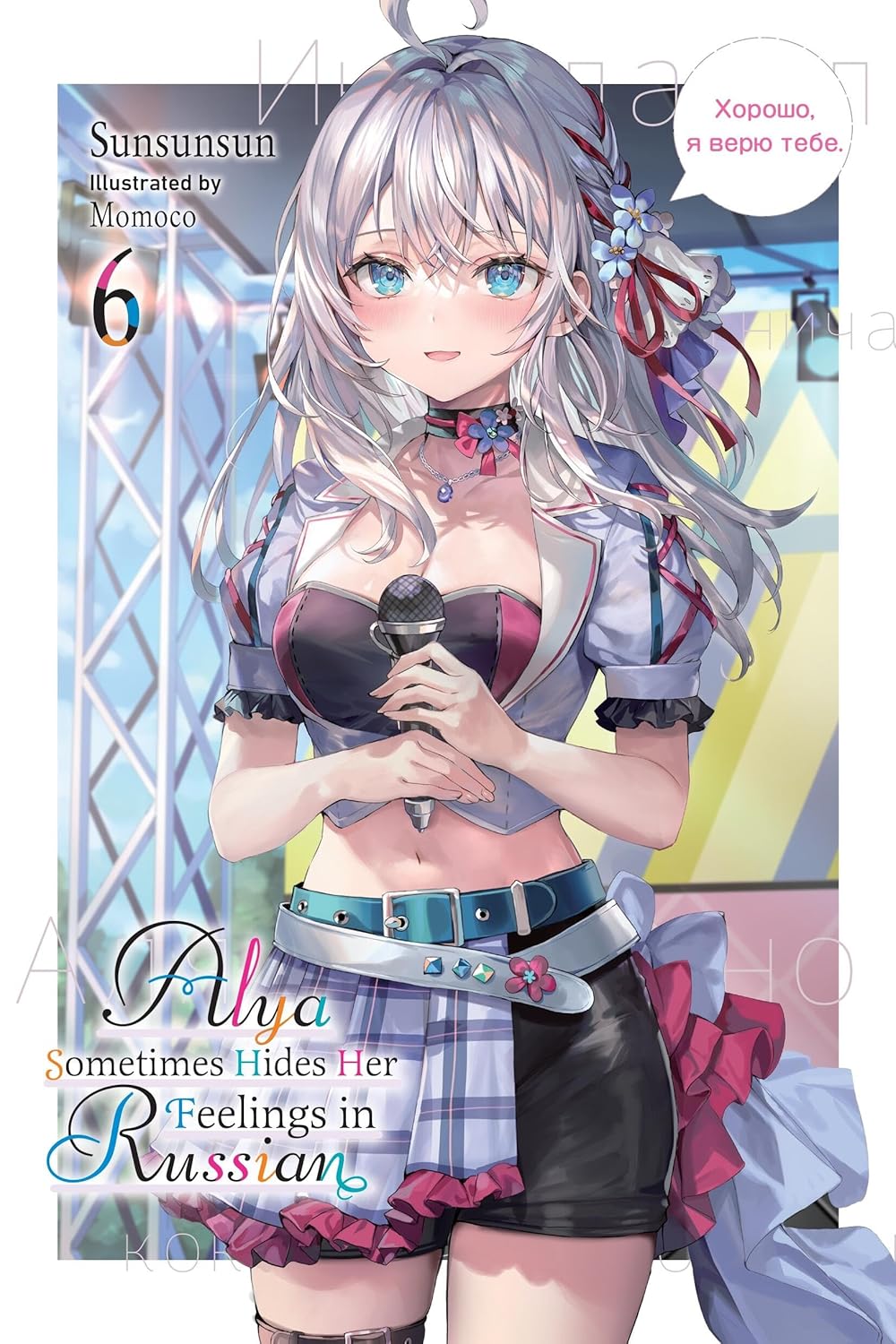
Alya Sometimes Hides Her Feelings in Russian, Vol. 6

December 12, 2024 by Sean Gaffney

By Sunsunsun and Momoco. Released in Japan as “Tokidoki Bosotto Russia-go de Dereru Tonari no Alya-san” by Kadokawa Sneaker Bunko. Released in North America by Yen On. Translated by Matthew Rutsohn.

I feel badly for Alya at times. This is, theoretically, her series. She’s the character on the cover art, she’s obviously going to be the winning girl, and she’s cute. But the overall plot of her arc is “I need to open up to others and not just rely on myself, and also I need to admit I’m in love with Masachika.” As arcs go, it’s simple. It’s not something that can carry a series. That’s Masachika and Yuki’s arc. Yuki’s not going to be the winning girl, for obvious reasons, but the screwed-up family she and Masachika are both in is what we’re going to be seeing more and more of. We get a bit of it here, and see that everyone is still carrying Expections, with a capital E, and that failing to meet them is worse than actually murdering someone. This has a lot of fluff in it, but the back half sets up darker things going forward.

The first half of this is pure fluff and fanservice, as we continue to have the school festival arc. We now see Alya dressed up as an elf, which frankly is perfect for her, and the sight blows everyone’s mind. Meanwhile, Masha is running a magician’s bar, and has some brilliant tricks… that she can’t perform in front of her sister because she’s always forced to be the goofy one in her presence. We get Ayano’s incredibly intimidating MAID SKILLS, which threaten to overwhelm Masachika when she maids a bit too hard at him. And, of course, the band get ready to perform. Unfortunately, it turns out that some mysterious person forged invitations to the festival, and there are now various pranksters, thugs, and bad guys there, who have been ordered to destroy it. Can the student council find out who’s responsible and save the day?

It’s really brought home here how this is a school for elites. Yuki, in an amusing takedown of one of the ringleaders, points out that his romantic angst would make a very poor subplot in a villainess book, and that’s kind of what we have here – not the villainess herself (though Yuki’s trying her best), but the “nobles rule the world” worldview. The elite families of many of the students are at the event – including Masachika and Yuki’s family – and they observe the chaos that’s been created with an amused eye, knowing that it will all come down to who controls the narrative and who can win the day. No great prizes for guessing who’s the man behind it all, but I did appreciate the ending, which does not revolve around Alya’s band performance (again, she’s not narratively important), but around Masachika’s, and his tendency once again to a) be miles ahead of everyone around him, and b) hate himself so much I worry he’ll end the series with a suicide attempt. Though I doubt it gets THAT dark.

The next book looks to be the athletics festival, and will no doubt once again be half otaku nerdery and half GRIPPING DRAMA.

Filed Under: alya sometimes hides her feelings in russian, REVIEWS

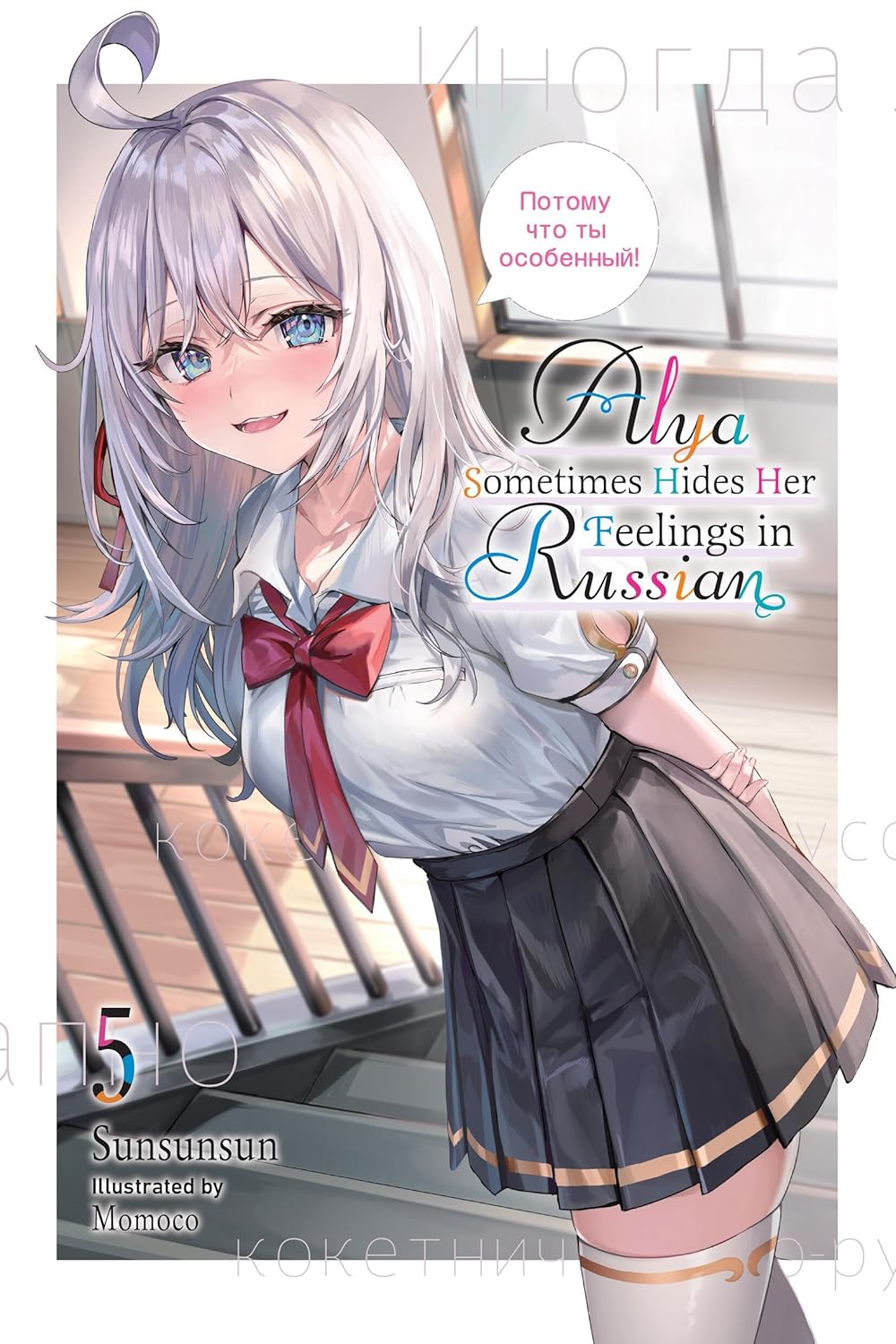
Alya Sometimes Hides Her Feelings in Russian, Vol. 5

August 29, 2024 by Sean Gaffney

By Sunsunsun and Momoco. Released in Japan as “Tokidoki Bosotto Russia-go de Dereru Tonari no Alya-san” by Kadokawa Sneaker Bunko. Released in North America by Yen On. Translated by Matthew Rutsohn.

It’s been about ten months since the last non-short story volume of Alya, and since then we’ve started the anime, which is doing a pretty good job, even if it’s also reminding us how hard it can be to watch Alya herself at times. It’s also facing stiff competition from Too Many Losing Heroines!, another anime that is very interested in light novel cliches. But while Makeine uses the tropes straight on occasion but for the most part wants to call attention to them and deconstruct them, Roshidere positively revels in the tropes. It will give you the fake incest, the boob measurements, the “I saw the girls I like changing” gags, walking in on a girl naked out of the shower is literally engineered here. Now, it’s not the point of the series. The point of the series is seeing Masachika and Alya both struggle to have any self-worth at all despite both being ludicrous geniuses. But it *is* why people obsess with this series.

We start by “resolving” the cliffhanger from the fourth volume. It’s not actually resolved at all, really – even if Masha isn’t already aware she’s the forgotten childhood friend, anyone in a light novel who confesses and then says you don’t have to give me an answer right away is already digging a massive hole it will be impossible to climb out of. In the meantime, it’s culture festival time, and the student council are stepping in where needed. In fact, they’re stepping even above and beyond – Hikaru’s band collapsed due to romantic drama, and they need three new band members… which might be a good opportunity to Alya to sing and show leadership skills. More importantly, there’s a quiz game where Yuki and Alya will be competing against each other. Supposedly a fun contest, you know it’s actually a proxy war in the election.

Alya is doubting herself. She wants to be able to stand on her own, to not have to depend upon Masachika as much as she has in previous books. (She also wants Masachika to ask her out on dates, but let’s leave that aside for the moment.) She does a great job in this book! Possibly too great a job. Masachika’s ridiculously huge self-hatred has driven everything he’s done in this series since the start, and we wallow in that in this book, whether it drives his cowardice in not actually asking Alya for that date, to his jealousy over seeing her get along with his other male friends, to his despair at realizing that she is growing and becoming able to stand on her feet… without him. His final words to her at the end of this volume imply that once she’s won, he’s going to quietly bury himself so that she can move forward without him holding her back. I do hope that before he finishes his self-loathing Samson act he at least crushes the asshole piano prodigy who’s trying to destroy Alya first, however.

If you enjoy seeing insecure and pessimistic kids avoid being in love with each other and lots of girls in underwear or even naked, this series is written just for you.

Filed Under: alya sometimes hides her feelings in russian, REVIEWS

Alya Sometimes Hides Her Feelings in Russian, Vol. 4.5

March 28, 2024 by Sean Gaffney

By Sunsunsun and Momoco. Released in Japan as “Tokidoki Bosotto Russia-go de Dereru Tonari no Alya-san” by Kadokawa Sneaker Bunko. Released in North America by Yen On. Translated by Matthew Rutsohn.

I joked on Twitter that after Agents of the Four Seasons (which was terrific) and The Deer King (which was sublime), anything read after it would always suffer in comparison, so I’d have to “sacrifice” a series and it might as well be Alya. Honestly, though, I think I’d have been ‘meh’ about this volume even if it hadn’t come after books that are much better than it is. First of all, and most obviously, my least favorite part of the series to date was the horrible hypnosis subplot in the third book, and so it’s not surprising that I greeted a short story that’s basically a sequel to that with numb horror. More to the point, though, the last volume was relatively disconnected to begin with, showing the cast on summer break, so I’m not sure why we needed another volume that shows the summer break stories we missed the previous time. Can’t we just get on with the plot?

The stories: 1) Sayaka and Yuki bond over their love of otaku stuff, but that also means they’re rivals; 2) A day in the life of Nonoa, whose facade hides a whole lot, and her underlings she has picked up from the bottom; 3) Alya and Ayano both suffer trying to cure their fear of spicy ramen; 4) Masachika and Yuki’s father gets home from overseas, and realizes that his son and daughter are a bit weird; 5) The cast try to clear up the “seven mysteries of the school”, which involves wandering around the school late at night; 6) Part 2 of this, involving Alya and Masachika getting “locked” in a gym storeroom; 7) Part 3 of the story, where we deal with Maria and Alya’s fear of ghosts, and discover that ghosts can be punched; 8) The story of how Touya and Chisaki met; 9) more hypnosis; 10) Maria and Alya go shopping for swimsuits; 11) the cast has a “guess who cooked what meal” competition; 12) the girls, late at night at the summer event, talk about love; and 13) Masachika and Alya, on the subway, discuss the kiss that happened in Book 4.

As with most of these collections, some stories are better than others. I enjoyed the “guess who cooked what” chapter more than I expected, mostly as it did not fall into the trap of anime cliches. Sayaka and Yuki being giant nerds was also amusing, though honestly we get that from Yuki all the time. Masachika and Yuki’s own father worrying they’re a bit too incestuous helps to show why the two of them have gotten away with hiding their sibling relationship for so long – people don’t want to pick the creepy option. And the final chapter was sweet and quiet, and probably should have been in the fourth book to begin with. Aside from the one I mentioned above, none of these were bad, but they weren’t essential – even the author admits they’ll never be brought up in the main series. It is a quintessential .5 volume.

Fortunately, Vol. 5 is next. Let’s hope for plot.

Filed Under: alya sometimes hides her feelings in russian, REVIEWS

Alya Sometimes Hides Her Feelings in Russian, Vol. 4

October 27, 2023 by Sean Gaffney

By Sunsunsun and Momoco. Released in Japan as “Tokidoki Bosotto Russia-go de Dereru Tonari no Alya-san” by Kadokawa Sneaker Bunko. Released in North America by Yen On. Translated by Matthew Rutsohn.

There’s a short story volume due out next, but quite honestly, this one also feels a bit like a short story volume, detailing the wacky adventures of the cast on their summer break. There’s no real through line of plot except Masachika’s crippling self-hatred, and the cliffhanger is one I had sort of guessed, so for the most part this feels a bit disconnected. It is also the horniest book in the series, and this comes from a series that is already pretty horny. That said, it does have one of my least favorite things about light novels, which is the idea, held by both boys and girls, that a man having sexual thoughts is the same as the man doing sexual deeds. There are a whole lot of wacky harem manga situations in this book, and a lot of them lead to Masachika having an erection he’s trying to hide. And that’s OK. He’s a teenage boy. But it’s not OK for him, and he continues to consider himself the worst person in the world. It’s annoying.

The student council is going on a summer vacation to a beach house, but before that we have a few plots involving Masachika and Yuki being themselves. This involves a great deal of sex talk, a fair bit of sibling violence, and an amusement park visit where their secret identities end up getting exposed to Sayaka (who is shocked) and Nonoa (who’d already guessed). Oh yes, and Alya keeps coming over to Masachika’s house when everyone out to do homework, and so far… they’ve done homework. Which annoys her. At the beach house, we get bikinis, swimming, bathing, room switching, and a festival with fireworks, all of which are reasonably cute. Unfortunately, Masachika keeps assuming that he’s screwing everything up, and overcompensates to try to fix it, and ends up hating himself even more by the end of it. He ends up going back to the playground where he played with the foreign kid… who turns out to be someone he knows.

As is pretty typical in the genre, the reader ends up sympathizing with Alya heavily here, despite her accidentally getting groped when Masachika tries to save her from falling onto jagged rocks. (She even trots out the “take responsibility and marry me” chestnut, which I haven’t seen in quite some time.) There’s a whole lot of muttered Russian in this book, which Masachika understands but has to pretend he can’t, but really, she could not be more obvious. Even he gets it at the end of the book. But, as with so many other books in this genre, only one thing is stopping the two from being a couple, and it’s the man’s idea that he’s not good enough for her. To be fair, he has the trauma to back it up, and the scenes we get from his childhood in this book are as depressing as you’d expect. But it’s like eating a marshmallow sandwich where the bread is misery.

Next volume… won’t resolve this cliffhanger. Short story volume. Till then, if you like self-loathing and boobs, this is the perfect title for you.

Filed Under: alya sometimes hides her feelings in russian, REVIEWS

Alya Sometimes Hides Her Feelings in Russian, Vol. 3

May 31, 2023 by Sean Gaffney

By Sunsunsun and Momoco. Released in Japan as “Tokidoki Bosotto Russia-go de Dereru Tonari no Alya-san” by Kadokawa Sneaker Bunko. Released in North America by Yen On. Translated by Matthew Rutsohn.

I must admit, I’m growing increasingly frustrated with this series. I really do enjoy the romance between Alisa and Masachika, which is cute. And I also definitely like the family drama that is Masachika’s backstory, as well as the “war” he’s currently having with his sister. So basically I like the rom and the drama. The problem is the com. This book frequently tries to be funny, and while the jokes sometimes land, much of the time it’s more annoying than anything else. Masachika thinks in otaku terms a lot, as does his sister, and the conversations the two have frequently deviate into bizarre and depraved topics. Which is in character. But sometimes it seeps into the main story. The entire hypnosis chapter was ludicrously bad, and I kept waiting for a deconstruction or reversal. But no, it was exactly what it seemed. The same goes with Ayano, whose gimmick is that she’s a masochist and constantly aroused. At least she doesn’t mention uteruses. This time.

We’re still in the race for Student Council President. One of the three contenders has dropped out (and is dealing with nasty rumors about dropping out), but the other ones are still going strong. Yuki and Ayano, frankly, have things in the bag almost certainly… but it’s the almost that’s the problem, as Yuki knows that with Masachika at her side, Alisa can pull off pretty much anything. Then fate steps in, as after working himself into a frenzy trying not to scream at his mother during parental visits, Masachika gets a bad cold and is bedridden for two days. This allows Yuki to force Alisa to try to campaign on her own… and she’s wretched at it. Can a now recovered Masachika manage to help Alya regain her confidence and give a suitably dramatic, powerful speech? Or is “powerful” not what they need here?

In case folks are wondering, no, she still doesn’t realize he speaks Russian. This is despite his Russian-loving grandfather appearing, which I was sure would spoil things, especially when he meets Alisa’s mother, and the fact that, at the climactic speech, he literally says something to her in Russian, which she interprets as him learning it specially for that moment to encourage her. I anticipate a big blow-up when she eventually finds out. For the moment, though, once you ignore most of the comedy (though I did laugh at “Dammit! I forgot I was human garbage!”, this can be quite sweet, particularly when Alisa takes the lead on their not-dates and Masachika allows himself to simply relax and enjoy her company rather than being… well, himself. As for Yuki, she’s deliberately playing the villain to get her brother to step up and try again, and it’s working, but I have to wonder what it’s going to do to her own life.

So this is a flawed romcom, but the dramatic moments are good, and the lead couple is sweet. Just… try to ignore the author being funny.

Filed Under: alya sometimes hides her feelings in russian, REVIEWS

Alya Sometimes Hides Her Feelings in Russian, Vol. 2

February 28, 2023 by Sean Gaffney

By Sunsunsun and Momoco. Released in Japan as “Tokidoki Bosotto Russia-go de Dereru Tonari no Alya-san” by Kadokawa Sneaker Bunko. Released in North America by Yen On. Translated by Matthew Rutsohn.

When this was licensed, I jokingly called it “The Angel Next Door Spoils Me Russian”, and my review of the first volume talks about this being in that “syrupy sweet romance” genre, but this second volume seems to have shed a lot of that, and it feels much more like a standard romcom now, complete with other potential romantic interests and a better look at Masachika’s backstory that shows it was not, in fact, as normal and mundane as I thought it was. Basically, the first volume was a bigger success than the author expected, o now we have to go back and make things a bit harder for our couple. Admittedly, given Alya’s deep embarrassment at, well, anything, that’s not too hard. The goal for the series seems to have changed as well, going from “get this tsundere girl to admit she likes the guy” to “get the guy to take up what he had abandoned and also kick his family in the teeth”. Which, yes, may include his sister, who’s happy to play the villain.

The last book ended with Masachika deciding to help Alya become student council president, and most of this book is about the fallout from that decision, as a lot of people have feelings about it. There’s Yuki, who is conflicted, but mostly seems to be happy that Alya has finally gotten Masachika to care about something again, even if it isn’t Yuki. There’s Ayano, who is Yuki’s maid (and used to be Masachika’s), and who is mostly comedy relief but also feels a bit betrayed by Masachika abandoning Yuki. And there’s Sayaka, the girl that Yuki and Masachika beat our for the student council in middle school, who is furious with Alya for using her looks and feminine wiles to steal Masachika away from the OTP. (Said OTP being his blood-related sister, I remind you, which is why he finds this so baffling.) Clearly there’s only one thing left to do. Debate.

This is decent. There’s one line from Ayano that I could very much have done without (I mentioned it on Twitter), but for the most part she’s an amusing “ninja maid” addition to the cast, and I hope she gains actual depth. As for Masachika, it’s now clear that his issues are not just “my parents split up”, but that he was the scion, and deliberately abandoned that role, pushing it onto his sister and adapting a “whatever” personality that everyone around him hates. Alya has been the only one who can really get him to break out of that, and he’s also proving to be the best thing for Alya in return, giving her confidence and the drive to succeed in her goals. (She too has a sister sacrificing things for her – the series is not ashamed to have its thematic parallels hit you in the face.)

So they’re a good couple… except they’re not a couple yet, and this series being the kind it is, I expect that won’t change soon. But will we have the student council election next time? If you like romcoms, this is solid.

Filed Under: alya sometimes hides her feelings in russian, REVIEWS

Alya Sometimes Hides Her Feelings in Russian, Vol. 1

November 26, 2022 by Sean Gaffney

By Sunsunsun and Momoco. Released in Japan as “Tokidoki Bosotto Russia-go de Dereru Tonari no Alya-san” by Kadokawa Sneaker Bunko. Released in North America by Yen On. Translated by Matthew Rutsohn.

High school romcoms have made a big comeback in recent days. Technically, they never really went away in Japan, but like sports manga in the 2000s, non-supernatural tinged light novels in the 2010s were forbidden. The gateway has now burst open, though, helped by the breakout hits such as My Youth Romantic Comedy Is Wrong As I Expected, Bottom-Tier Character Tomozaki and Chitose Is in the Ramune Bottle. And we have the “sweet” subgenre, characterized by minimal conflict and a lot of “awwwww” moments. Now there’s a good chance that when a new series hits big numbers in Japan, and makes the end of year lists, it’s likely to get a license. And this year’s golden girl is Alya Sometimes Hides Her Feelings in Russian. If you are asking “apart from the Russian, what’s so new about this variation?”, the answer is not much, though it does have an interesting twist I won’t spoil. But the main goal of this genre of books, being sweet and relaxing, works just fine.

Alisa Mikhailovna Kujou, aka Alya, is our heroine. She’s half-Russian, and is a transfer student into a school known for academic excellence who nevertheless ends up at the top of the grade charts. She’s known as the “solitary princess” for her general attitude, which is standoffish. Sitting next to her is Masachika Kuze, who is… look, just read any of the other books in this genre and you’ll know exactly what he’s like. Seemingly lazy and shiftless, secretly plagued by backstory and works hard when no one else can find out. That kind of guy. In class, Alya treats him harshly, scolding him, reminding him of the school rules, and calling him an idiot. That said, in reality she has a crush on him, and occasionally says things to herself in Russian to blow off steam about it. Unfortunately… Masachika knows Russian.

This is a good book. Likeable characters, fast and breezy writing, some amusing lines. Alya is a kuudere who does not really take much poking to get rid of the ‘kuu’ part, and honestly the main surprise was that they did not end up together at the end of the book – I suspect this was written with a longer series in mind, rather than as a “contest winner” one-shot. Masachika’s “tragic” backstory is rather mundane, but that ends up working well here, and reminds us that most teens don’t really need much to get derailed from their dreams. A divorce, a childhood friend disappearing, a realization that being a winner means there’s a loser… it’s standard stuff, but fits well here. And there’s also a lot of cute romcom scenes, helped out by Yuki, a fun character who appears to be the “other woman” in this book but ends up nothing of the sort.

Basically, I get why this is popular. If you like the genre, read it. If you want fast progress or more compelling drama, don’t read it.

Filed Under: alya sometimes hides her feelings in russian, REVIEWS

 | Log in
Copyright © 2010 Manga Bookshelf | Powered by WordPress & the Genesis Framework