• Skip to primary navigation
  • Skip to main content
  • Skip to primary sidebar
  • Home
  • About Us
    • Privacy Policy
    • Comment Policy
    • Disclosures & Disclaimers
  • Resources
    • Links, Essays & Articles
    • Fandomology!
    • CLAMP Directory
    • BlogRoll
  • Features & Columns
    • 3 Things Thursday
    • Adventures in the Key of Shoujo
    • Bit & Blips (game reviews)
    • BL BOOKRACK
    • Bookshelf Briefs
    • Bringing the Drama
    • Comic Conversion
    • Fanservice Friday
    • Going Digital
    • It Came From the Sinosphere
    • License This!
    • Magazine no Mori
    • My Week in Manga
    • OFF THE SHELF
    • Not By Manga Alone
    • PICK OF THE WEEK
    • Subtitles & Sensibility
    • Weekly Shonen Jump Recaps
  • Manga Moveable Feast
    • MMF Full Archive
    • Yun Kouga
    • CLAMP
    • Shojo Beat
    • Osamu Tezuka
    • Sailor Moon
    • Fruits Basket
    • Takehiko Inoue
    • Wild Adapter
    • One Piece
    • After School Nightmare
    • Karakuri Odette
    • Paradise Kiss
    • The Color Trilogy
    • To Terra…
    • Sexy Voice & Robo
  • Browse by Author
    • Sean Gaffney
    • Anna Neatrour
    • Michelle Smith
    • Katherine Dacey
    • MJ
    • Brigid Alverson
    • Travis Anderson
    • Phillip Anthony
    • Derek Bown
    • Jaci Dahlvang
    • Angela Eastman
    • Erica Friedman
    • Sara K.
    • Megan Purdy
    • Emily Snodgrass
    • Nancy Thistlethwaite
    • Eva Volin
    • David Welsh
  • MB Blogs
    • A Case Suitable For Treatment
    • Experiments in Manga
    • MangaBlog
    • The Manga Critic
    • Manga Report
    • Soliloquy in Blue
    • Manga Curmudgeon (archive)

Manga Bookshelf

Discussion, Resources, Roundtables, & Reviews

Friday Features

Follow Friday: The localizers

January 14, 2011 by MJ 4 Comments

Server outages and related angst have given us a a rough week at Manga Bookshelf, so today seems quite an appropriate time to spread a little goodwill over the manga industry twitterverse.

One of the things I’ve loved about Twitter, is that it’s given me the opportunity to interact with the people who make it possible for me to actually read manga. I’m referring, of course, to the localizers–the translators, adapters, and editors whose work I rely on to enjoy manga in English to the greatest extent possible.

Twitter is teeming with manga industry folks, and though I can’t possibly list them all here, I’ll pick out a few I’ve especially enjoyed.

William Flanagan is not only one of my favorite translators around, he’s also a great conversationalist and one of my favorite twitterers. You can also find twin translators Alethea & Athena Nibley lurking around the twitterverse.

Adaptor Ysabet Reinhardt MacFarlane brings a smart, thoughtful presence to the discussion.

And for a look into the world of manga editing, don’t miss the Twitter feeds of Asako Suzuki, Nancy Thistlethwaite, and Daniella Orihuela-Gruber.


This is merely a handful, of course–just a peek into the riches Twitter has to offer. Who are your favorite manga localizers to follow?

Filed Under: DAILY CHATTER, Follow Friday

Fanservice Friday: From the ladies

January 7, 2011 by MJ 22 Comments

… or at least one lady.

There’s been quite a bit of talk already about editor Sean Michael Wilson‘s assessment of female critics’ reaction to AX: A Collection of Alternative Manga, most of it much smarter than anything I might offer up (posts from Brigid Alverson and Kate Dacey among them).

Still, as a North American lady-perceived person, I feel compelled to examine Wilson’s argument, my personal reaction to it, and why I feel this is appropriate for Fanservice Friday. As I proceed, please keep in mind that I have not read AX, so my reactions are to Wilson’s theory about the tastes of North American ladies, not about those ladies’ reactions to that work in particular. This is important. Please remember it.

First, the increasingly famous words from Wilson:

Now, onto ‘AX alternative manga’ book. It has had a huge amount of reviews, and overwhelmingly positive … However, one aspect has surprised both myself and Asakawa, the Japanese editor – quite a few female American reviewers have taken issue with the large amount of scatalogical toilet humour and also the sexual content of the collection. Somehow they seem to find it offensive, or unpleasant, or immature. It was surprising to me to see this kind of reaction, as it never occurred to me at all – as a British person – that these could be seen as negative …

Now, I don’t mean that ‘I am right,they are wrong’ and certainly don’t mean to upset these reviewers – its their opinion, and I’m interested to see it. It’s been an illuminating thing for me to see such reactions. What hits me the most is that it’s perhaps an example of cultural (and gender within culture) difference on perception of such things. I say that because I noticed that all the people making such comments are North American ladies. I have not seen a single man say it, or any women from outside North America. Therefore, I presume that it MAY be something in the shared cultural values and norms of such commentators coming through that makes them react negatively to such toilet humour and sexual content – perhaps? In Britain toilet humour is one of the main types, and our attitude towards sexual content is relatively ‘liberal’, it seems. Asakawa, as a Japanese person, was also rather surprised, for perhaps similar cultural reasons.

Given that this is Fanservice Friday, I’ll leave the discussion of toilet humor to others and move on more appropriately, to sexual content, because here is where I must emphatically disagree with Sean Michael Wilson.

North American ladies don’t like sexual content? Has the man never cracked open a Harlequin romance? I can easily imagine that many men might be unaware of things like the enormous volume of sexually explicit fanfiction churned out by North American women on the internet every day, but sexual fantasy is big business in this part of the world, and there’s no shortage of demand for it from women.

Even in the (relatively small) North American manga market, we women like our fanservice just the same as anyone. Sure, some of that comes down to chaste romance and slashable bishounen, but many of the best loved and most eagerly anticipated manga among female readers in North America derive their main appeal from sexual content, ranging anywhere from coy bedroom scenes to outright pornography. Fans of yaoi in particular (me included, perhaps), have not usually been known for our delicate tastes.

What I think Mr. Wilson is more likely encountering is that we, many of us, also have other standards, at least when we’re engaging with something that believes itself to be Art. We see merit in sexual content, but we expect it to have meaning beyond shock value or pure titillation. Hell, even in our pornography, we expect some level of craft, either visual or narrative in nature.

Speaking for myself, having come from a prose background, I’ll cut the artwork quite a bit of slack, but if the sex doesn’t drive the story (at least when it’s onscreen) I’m probably going to be unimpressed. In fiction, as in life, effective sex scenes require effort, and I don’t have a lot of patience for slogging through otherwise. I’m over forty. I’ve seen it all. You can’t shock me with your content. But there’s an excellent chance that you’ll bore me if you don’t have something more to offer. And if your point is simply to be subversive, you’ll likely bore me with that as well.

Now, obviously AX is not concerned with fanservice. Nor is it, I expect, concerned with having fans. “Experimental” work is generally about social commentary, self-expression, Damning The Man, and other perfectly noble causes, none of which are guaranteed to produce art.

Having not read the collection, I’m not prepared to comment on what its contributors have produced, but if my fellow Ladies haven’t appreciated it, I’m fairly certain it’s not the sex.

Really, quite certain.

Filed Under: Fanservice Friday, FEATURES

I Wish I Wrote That!

December 17, 2010 by MJ 9 Comments

It’s been an interesting month in the manga blogosphere, some of which is due, no doubt, to Noah Berlatsky’s recent, scathing criticism of the manga blogging community’s treatment of Moto Hagio’s A Drunken Dream and Other Stories. Now, my intent is not to bring more attention to that article, which has already gotten too much (from me and many others). It is far from Noah’s finest hour, and certainly not something that would inspire me to say, “I wish I wrote that!”

That said, though the main subject of my writer’s envy this month was not conceived as a direct response to Noah’s article, I’d bet that his article influenced its timing, and perhaps even some of its tone. That would be, of course, Erica Friedman’s wonderful guest review of Hagio’s collection, posted at the beginning of the month at David Welsh’s The Manga Curmudgeon.

A quote:

I think there’s a real risk, though, in over-analyzing this volume. Moto Hagio’s stories are, as I said at the beginning, masterful largely because she did not set out to be so. She wrote from the heart, stories that girls could understand, enjoy, identify with. She was the Stephanie Meyer of her time and only now, when we look back on a body of literature that spans decades, we see that it’s a little silly to dismiss it (or glorify it) because it’s shoujo manga. What A Drunken Dream offers is as much or as little as we want to see. If we stare too hard past the cute girl looking back at us in the mirror, we might in fact see the deathly crone behind her…but why would we want to do that? Can’t we just take the cute girl at face value? Isn’t she “important” enough on her own?

Thank you, Erica, for putting the work into real perspective, and for speaking eloquently without talking down to the stories’ intended audience. I wish I wrote that!


Other writings I’ve loved this month include Kate Dacey’s reworking of her early take on Osamu Tezuka’s Black Jack, proving that it’s entirely possible to admire and respect an important artist’s work while still addressing ways in which it may be problematic. Also, Vom Marlowe’s article, The cycle of criticism, filled me with quite a bit of joy and gratitude.

We’ll be taking next Friday off here at Manga Bookshelf, but keep an eye out the week after for our regular features and some exciting news to share! In the meantime, what do you wish you’d written this month?

Filed Under: I WISH I WROTE THAT!

Follow Friday: Braaaaaains

December 10, 2010 by MJ 5 Comments

Some bloggers and twitterati are must-follows quite specifically for their wealth of knowledge about manga, various genres of manga, and/or the the history and workings of the Japanese manga industry. There’s a lot of range to be found here, of course, and some are more useful than others. Sure, manga luminaries like Fred Schodt can be found on Twitter, but most of the time you can be certain that a guy who follows only 31 people is unlikely to have a conversation with you.

Since, for me, the internet is about conversation, whether it be the direct back-and-forth of Twitter, or the never-ending meta discussion that carries on, blog-to-blog, I find the most delicious brains are the ones who are not only willing to engage readers, but who are driven and energized by doing so. Fortunately, there are a lot of very knowledgeable people who fall into this category. I’ll name here just a few.

Erica Friedman of Okazu is not only the go-to blogger for yuri manga, but also quite knowledgeable about the industry as a whole, both in the US and Japan. She’s also an avid Twitterer, which means that readers have the opportunity to converse with her in a casual setting about nearly anything at all.

Sean Gaffney‘s fairly casual, under-the-radar blog can be a bit deceptive. He’s a guy who reads a lot of manga, both in English and in Japanese, and has a breadth of knowledge about the industry that I’ve certainly turned to for help from time to time. Sean, too, is very active on Twitter, where he’s always willing to share what he knows about manga.

Though professional duties take precedence nowadays, Ed Chavez the blogger is not dead. He may not have the same time to devote to keeping us up-to-date on the latest doujinshi and other news from Japan, he’s still a guy who knows more than most of the rest of us put together. Keep up with him on Twitter for whatever he’s got time to share.

For in-depth thought on the state of the American manga market, career bookseller Matt Blind is the guy you want to befriend. Though his blogging has taken a hit lately, thanks to a whoooole lot less available time, he still shows up on Twitter as often as he can.


That’s just the tip of the iceberg, of course. The are a whole lot of brains out there to be tasted and enjoyed. Where do you find some of your favorite brains?

Filed Under: Follow Friday

Fanservice Friday: Sundome

December 3, 2010 by MJ 2 Comments

Welcome to the second monthly edition of Fanservice Friday!

Today’s column is actually collaborative in a sense, and not hosted here in its entirety. Just yesterday, I appeared as a guest on the Manga Out Loud podcast, hosted by Ed Sizemore (Manga Worth Reading), where we discussed the manga series, Sundome, written by Kazuto Okada, and published in English by Yen Press.

The series mainly follows two Japanese teenagers, Hideo and Kurumi, who develop between them something very close to a classic dominant/submissive relationship (Hideo as the submissive party and Kurumi as the dom), presented in a fairly dark context of obsession and deep emotional damage (though not without some surprisingly warm moments).

For in-depth discussion of the series, please check out the podcast, though given the purpose of this column, I will take a moment to specifically mention the series’ dense volume of fanservice. There is so much of it in this series, in fact, I’m not entirely sure it can be properly categorized as “fanservice” which perhaps indicates something extraneous to the story. In the case of Sundome, “extraneous” could not be a less accurate description.

The entire series is steeped in erotic imagery, some of which could be characterized as quite crude, but with such a strong emotional core, it’s difficult to think of it as obscene, even in its most explicit moments. That the characters are high school students only makes the level of eroticism more disturbing, yet again, it’s so appropriate to the narrative and especially to Hideo’s point of view, it’s difficult to imagine the story working well without it. Eroticism is so much a part of the fabric of the story, anything less might just seem unbelievably coy.

One particular type of imagery, however, is used more prominently here than in any other manga I’ve personally encountered (which, in terms of this type of manga, is admittedly not all that much). That would be the constant presence of the cameltoe. Shots down the shirt or up the skirt are incredibly common, even in pretty mainstream shounen and seinen manga, but Okada’s obsession with the cameltoe is something new for me.

Observe.

Now, obviously I’m not necessarily the most appropriate judge in terms of appeal, but not only do I have difficulty finding this attractive, it mostly looks… kinda painful. Ouch.

As I mentioned in the podcast, given the sexual themes in the manga, I actually find the rather stunning wealth of male-oriented fanservice in Sundome mainly inoffensive, as it seems so integral to the series’ tone and plot. I find it quite a bit less offensive, in fact, than random, less explicit panty-shots tossed into standard fantasy or adventure manga.

What say you, readers?


Be sure to download this week’s Manga Out Loud podcast, and let us know what you think!

Filed Under: Fanservice Friday Tagged With: sundome

Failure Friday: Fat girls have faces too.

November 26, 2010 by MJ 21 Comments

Last month on Failure Friday, I discussed a deeply flawed manga that I love despite its flaws. This month, I’m going to go in the other direction. Though it would be incorrect to state that I “hate” this manga, I find one of its flaws is so distasteful, it ultimately fails to work for me as a reader.

The manga I’m getting around to here is Ugly Duckling’s Love Revolution by Yuuki Fujinari, published in English by Yen Press.

Ugly Duckling’s Love Revolution is the story of Hitomi, an overweight student surrounded by impossibly pretty boys at her elite high school. Even more impossibly, all of the school’s prettiest boys live in the apartment building where Hitomi resides with her brother. Furthermore, they all seem to have an attachment to Hitomi in one way or another, bringing us to the real point of the story: Will Hitomi become romantically involved with one of them, and will she have to lose the weight to do so?

In case you haven’t guessed by now, this manga is based on a dating sim. And though this accounts for the simplicity of its plot, that wouldn’t necessarily be a bad thing. I genuinely enjoy romance, even sometimes of the harem variety, so the overall lack of thematic complexity is not in itself a deal-breaker. Even the brother character’s blatant sister complex is not enough to drive me away.

What makes this manga’s simple-minded approach less palatable, is its portrayal of Hitomi, particularly in terms of her relationship to food and to her own body. As any obese person can tell you, there is absolutely nothing simple about a young fat person’s daily life, and as a result, the manga’s approach seriously marginalizes its heroine and any readers who might genuinely identify with her.

Let’s begin just with the artwork. Here are a few things I wrote in my (not uncomplimentary) discussion of volume one:

While the series’ other characters get relatively detailed facial features–shaded eyelids, carefully lined, large eyes, real contour to the nose and cheeks–Hitomi gets two dots for eyes, a comic-strip nose, a Simpsons-quality mouth, and a couple of giant circles on her cheeks. She’s like a permanent chibi. Furthermore, the story’s other overweight character (a boy who supplies her with cookies, natch) is drawn in the same caricatured way. Newsflash, people: Fat girls have faces too.

Even just with the character design, the artist has already made it clear that fat kids aren’t real people. They may be kind and helpful, and others may even like them, but they can’t actually be fully-realized human beings until they’ve adequately slimmed down. Hitomi’s not working so hard so that she can finally get some romantic attention from the hot neighbor boys, no, she’s fighting to earn irises and normal NOSE. And while a more thoughtful artist might indeed use something like this as a metaphor for Hitomi’s actual feelings about herself, a concept like that is clearly well out of Fujinari’s depth.

Now, I mentioned that my discussion of volume one was not uncomplimentary, and that’s true. Even with this major caveat, I thought the series had some good points. As I made my way through volume two, however, my patience began to wane. Here Hitomi endures nasty comments, some pretty grueling exercise (thin people, try climbing a mountain with a 100-200 lb weight wrapped around your torso, and you might have some idea of what it’s like for Hitomi), and some physical symptoms of dieting she didn’t quite expect. And while these are certainly realistic things, there’s absolutely no sense of Hitomi’s real feelings about them.

She gets momentarily angry at the mean, thin girl who treats her like dirt, she feels tired from the exercise, and she worries about her split ends. This is seriously the extent of her emotional range on these issues, which makes one wonder how she even became overweight to begin with. Fat people eat for a reason, and any one of these might do, but nothing seems to have much of an effect on our easy-going heroine, whose only real stumbling block seems to be an occasional, vague longing for her beloved cookies, which is easily dismissed by her newfound sense of duty.

I have to wonder, is there anyone involved with this manga (or the game it was based on) who has struggled with overweight? It seems impossible that there could be. Even taking into account the game’s backstory, yet to be revealed in the manga but uncovered by Brigid Alverson in her review of the series, the entire thing reads like a thin person’s perspective on obesity. The series exists in that stereotypical mindset where physical fitness is as simple as a balanced diet and exercise, and fat people are lazy gluttons who simply lack willpower (and possibly basic intelligence). It’s simplistic, insulting, and just blatantly not true, which begs the question, who is this manga actually for? Surely not fat girls, or at least not real ones.

All this said, it would be reasonable for one to ask why I’ve bothered reading this manga at all. What did I expect from a series based on a dating sim? Why don’t I just walk away?

The truth is, it’s hard to walk away, when this highly flawed story is still the only manga I’ve personally encountered that features an overweight, female romantic lead. And isn’t that just sad?


So, readers… Ugly Duckling’s Love Revolution: failure or not?

Filed Under: Failure Friday Tagged With: ugly duckling's love revolution

I Wish I Wrote That!

November 19, 2010 by MJ 2 Comments

Time for another installment of I Wish I Wrote That! This month’s roundup will be rather brief, not because there hasn’t been a lot of great writing going on in the manga blogopsphere, but because I’ve had less time than usual to read it!


This month’s centerpiece is about comics, but not manga, and that would be Vom Marlowe’s recent ode to one of my favorite webcomics, Hyperbole and a Half by Allie Brosch. Here’s a little taste of Vom’s reaction to first reading Allie’s Boyfriend Does Not Have Ebola, Probably and its Better Pain Scale:

“I laughed so hard I made unattractive snorting noises and startled the dog, who looked around for invading postmen or other villains.

Now when I have to rate the pain, I admit fully and upfront that I often ask myself, “Am I being mauled by a bear?”

It never fails to make things a little better.”

Vom’s entire post is delightful, and she points out quite a few of the comic’s most charming moments, particularly posts about Allie’s new dog and her recent cake epic. If I actually had written this, I think the only thing that would be different is that mine would have included maybe a thousand additional words on This is Why I’ll Never be an Adult. “Clean all the things?”


In the category of “Less ‘I Wish I Wrote That’ than ‘I’m So Glad She Did'” I submit Kate Dacey’s recent review of 13th Boy, which fills me with pure joy and reassurance that I’m truly not alone, and also Caddy C.’s Friday Feminism with Fumi Yoshinaga, because everyone should write more about Fumi Yoshinaga, including me.

And lastly, in the category of “Stuff That Resonates With Me in a Weirdly Good Way,” this somewhat ambivalent take on Viz’s March Story by David Welsh. What I enjoyed so much about this is David’s process as he tries to figure out how he feels about the book, and the fact that he displays all of that right there in the review.


That’s all for this month! See you in December for more I Wish I Wrote That!

Filed Under: I WISH I WROTE THAT!

Follow Friday: The Reliable Reviewer

November 12, 2010 by MJ 10 Comments

Welcome to November’s Follow Friday! This month, I’m going to focus on The Reliable Reviewer. You know the one I mean… the critic whose priorities and tastes in fiction match up so closely to yours, that you know you’ve got at least a 95% chance of liking anything he/she likes. Most of us have a few of these amongst our daily reads, and they’re likely to be different for everyone. Today, I’ll focus on mine.

David Welsh (The Manga Curmudgeon) – I can count on one hand the number of David’s opinions I’ve disagreed with over time, that’s how reliable he is for me as a reviewer. If he likes something, that’s a good signal for me to buy, with little to no risk involved. He tends to shop in the same genres and demographic categories as I do (which is to say, nearly all of them), offering up reliable opinions in shojo, shonen, seinen, josei, and boys’ love manga. He’s also got quite a way with the English language. You can follow David on Twitter @MangaCur.

Michelle Smith (Soliloquy in Blue) – Much like David, Michelle is an omnivorous reader with genre tendencies very similar to mine. We have a few contentious series between us (Nabari no Ou, anyone?) and some contrasting pet peeves, but for the most part, her recommendation of a series is all that’s required for it to earn a place on my to-read list. She’s also a smart, witty writer whose reviews are worth a read, regardless of the quality of their subjects. You can follow Michelle on Twitter @swanjun.

Katherine Dacey (The Manga Critic) – Though Kate is frequently critical of series I like quite a lot, when she makes a recommendation, I can take that to the bank. Kate is a very particular type of Reliable Reviewer for me, because, though we have different priorities when reading a work, her overall assessment of a series she actually likes is 100% reliable for me–something that can’t even really be claimed by critics with tastes that more closely match mine. She’s sharp and perceptive, and her standards are impeccable. You can follow Kate on Twitter @manga_critic.

Ed Sizemore (Manga Worth Reading) – Unlike the three critics listed above, Ed’s typical demographic/genre range overlaps less with mine. He reads primarily seinen and mature shonen (with some dabbling elsewhere). He’s a man’s critic, but with an especially thoughtful tone that draws me in to his reviews nearly every time. Though I’m less likely to be able to refer to him for opinions on the latest Shojo Beat release, his thoughts on the books he chooses to review always resonate with me deeply, even on the rare occasion in which we disagree. You can follow Ed on Twitter @edsizemore.


Readers: Now that you have a list of reviewers I count on, who do you turn to for your reliable reviews?

Filed Under: Follow Friday

Fanservice Friday: A Girl’s (G)Fantasy

November 5, 2010 by MJ 60 Comments


Many female manga fans regularly read shonen manga. This is simply a fact. Women are infinitely adaptable and generally omnivorous readers. We like romance, intrigue, action, drama, satire, comedy, tragedy, and sometimes, porn. Most of us spent our school days reading books written by men, the classroom philosophy being that girls would read books written for boys, but boys would rarely read books for girls.

Popular entertainment thrived on this principle also, ensuring that most film and television with any real money behind it would be geared to male viewers. We’d come along too, the executives figured. And sure enough, we did. In fact, in 2009, women dominated the movie-going market, though only a couple of big hits were deliberately made with us in mind.

Though the Japanese manga industry offers girls a veritable treasure chest by comparison, girls still spend a lot of time in the shonen section of the store, enough so that publishers deliberately court a female audience, even for manga created for boys.

Watching the industry from the English-language side, we’re not always privy to Japan’s subtler trends. Titles are generally chosen here with American tastes and habits in mind, and Japanese demographic categories frequently become meaningless. Casual fans rarely know or care how their favorite titles are marketed in Japan, let alone what magazines they ran in.

But for those of us who read a lot of manga, and who are likely to identify books with their publishers, certain things eventually become apparent. This entry concerns a trend that’s become particularly fascinating to me as a female reader who enjoys quite a bit of shonen manga.

All of the cover art displayed above belongs to manga series that run in the same magazine. That magazine is Square Enix’s Monthly GFantasy. Its demographic? Shonen.

So why are these shonen titles plastered with fanservice… for girls?

Some of the licensed titles that have run in GFantasy include Switch, Gestalt (both published by Viz Media), Black Butler, Pandora Hearts, Zombie Loan, and Nabari no Ou (all from Yen Press). Something all these titles share in common (besides a gallery of drool-worthy bishonen covers) is that they’re all written and drawn by female mangaka. Though women drawing shonen is hardly revolutionary, a collection of so many in a single magazine seems notable indeed. And with the kind of artwork that’s being displayed to market this manga, it seems likely that Square Enix has gathered them for a reason: to draw in a female audience.

Though each of the titles I’ve mentioned contain fanservice for girls, some of it is so subtle, you’d never know from a quick glance. Gestalt, for instance, contains as much (or more) fanservice for male readers, with its female lead, Ouri, prancing around in outfits that reveal a bouncing bosom any shonen manga would be proud to display. All the women in Gestalt are voluptuous, while most of its men are somewhat nerdy, especially glasses-wearing Father Olivier who begins as sort of the hero of the piece.

Yun Kouga’s trick is in text more than in pictures, where she reveals in the first volume that curvy Ouri is actually a man, lending new, exciting undertones to a scene like this.

Gestalt is an older manga than the others on this list, running from 1992 to 2001, which may account in part for its more traditional boobs and butts. Kouga’s artwork, too, though attractive, lacks the excessively pretty bishonen that dominate many of the magazine’s current series.

Still, the story’s gender-bending heroine provides titillation for both its male and female readers, while bringing to mind Deb Aoki’s recent question on Twitter, where she asked if Shonen Jump manga might be the gateway drug to yaoi.

Of course, some of GFantasy‘s titles are more subtle than others.


Yana Tobaso’s Black Butler, in particular, makes use of heavy BL subtext (as well as actual parody text as illustrated above) to please its female readers, particularly playing up the relationship with butler Sebastian and underaged Ciel, tapping into not just BL fans but shota fans in particular.

While that particular type of fanservice is not at all my cup of tea, elements of shotacon can be found even in my favorite GFantasy series, Jun Mochizuki’s Pandora Hearts, a serious fantasy tale that uses inter-dimensional time incongruities to create a gap of quite a few years between hero Oz and his devoted valet, Gilbert. Though the fanservice to this end is far more subtle than in Black Butler, the situation allows for lots of lingering glances and tense undercurrents.

Mochizuki’s real talent for fanservice, however, shines through in her character designs and costuming. She fills the pages of Pandora Hearts with long, tousled bangs and oversized shirt and coat sleeves, infantilizing even her creepiest characters in a spectacularly cozy way. Though this effect is used indiscriminately, both on male and female characters, the males’ top hats, long coats, and careless tendrils enhance the look significantly.

Sometimes, of course, her artwork is just very, very pretty.

In the face of all this girl-centric fanservice, the question burning in my mind has been, “Is shonen really the demographic for this magazine?” GFantasy runs other series, of course, that don’t fit the picture I’ve been painting, but even so, series like Black Butler or even Nabari no Ou seem especially crafted to please a female demographic. Yet a quick (and even not-so-quick) web search reveals no conversation on the topic whatsoever.

Unsatisfied, I turned to Twitter to seek out those more knowledgeable than I, and received some interesting responses from some folks who regularly buy and research magazines in Japan.

Sean Gaffney, in particular, had some interesting things to say. “… as the years have gone buy, and ‘comics for boys’ and ‘comics for girls’ have come more and more to mean ‘comics for people who have money to spend’, the genres have been busted down as the magazines cater to what people want to buy … And if that means pretty boys, hey, then pretty boys it is. Square Enix does not have a dedicated shoujo magazine, the way their competitors do … As a result, when they have a female friendly title, it has to go into one of those books.”

“But you’re right, no other title seems to lie about its genre more than GFantasy.”

And Tanbishugi pointed out these interesting facts: “Saiyuki and Loveless were originally serialized in GFantasy and later moved to Comic Zero-Sum which is a female-oriented magazine. Tactics also briefly ran in GF before it moved to another publisher.”

Also, regarding the BL background of some of the series’ authors, “Yana Toboso got her start writing Prince of Tennis doujinshi and Gackt RPS, and original BL under the pen name Yanao Rock. Naked Ape have also been fairly active in the doujinshi scene.”

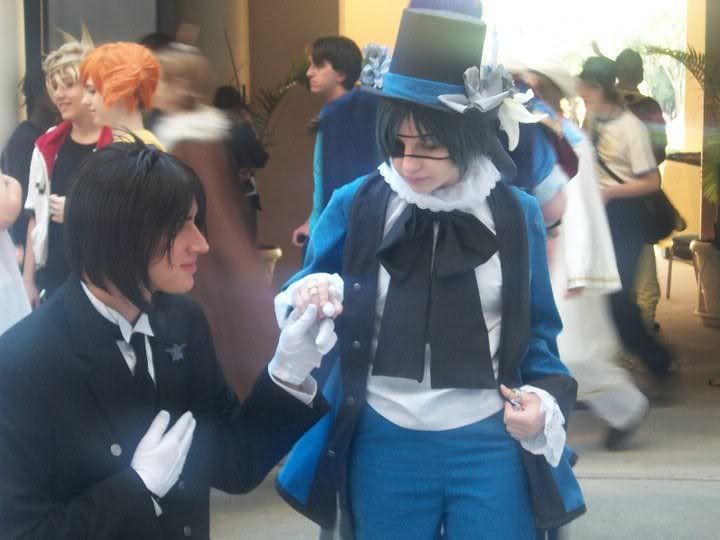
And who do American publishers see as their primary market for these books? My request for insight from Yen Press received no response, but photos from last month’s Yaoi-Con suggest that women are good bet, at least for some titles.

So readers, male and female, do you read GFantasy titles? Manga Bookshelf wants to know!


******

Images copyright Yun Kouga, Peach-Pit, Naked Ape, Yana Tobaso, Jun Mochizuki, Square Enix, Viz Media, & Yen Press

Many thanks to David Welsh who proposed the title for this feature! Check back for more Fanservice Friday on the first Friday of every month!

Filed Under: Fanservice Friday

Failure Friday: Failing With Love

October 29, 2010 by MJ 11 Comments

When, just a few weeks ago, I brought to Twitter a need for a new feature for my then-empty Fridays, four great ideas were offered up, which I’ve begun rotating throughout the month. Two of these features have already debuted, Follow Friday and I Wish I Wrote That! The third came from the mind of David Welsh–a feature called “Failure Friday,” in which I could discuss bad manga. I rejected the idea at first, mainly on the premise that I love a lot of very flawed manga, at which point David pointed out that this might actually make the column more interesting.

He was right, of course, as David generally is, and when I sought out a failed manga for my very first Failure Friday, I found myself drawn to an early example of “very flawed manga” that I loved quite a lot. Not only does it have a Halloween-appropriate theme, but it was also a special challenge for me as a newbie critic. Though I’d certainly enjoyed manga of varying quality before I read this book, it was one of the first manga I was given to review formally, which put me in the position of having to analyze why I liked it despite its glaring failure. It also forced me to find words to express that, something I’ll take a second stab at today.

The manga is Heaven’s Will by Satoru Takamiya, published in English by Viz Media, a single-volume shojo manga about a girl, Mikuzu, who can see spirits (or oni). Mikuzu’s terrified of men, so it’s fortunate that when she meets our young hero, Seto, he’s all dressed up as a pretty, pretty girl. Besides cross-dressing, Seto eats cake, exorcises spirits, and hangs out with his quiet (but devoted) companion, Kagari, a vampire who can change into a wolf.

If you think this is beginning to sound cracktastic, we’ve barely even begun.

As it turns out, Seto cross-dresses in honor of his younger sister, whose death he feels responsible for–so much so, in fact, that he plans to get a sex change when he’s made enough money, after which he’ll transfer his sister’s spirit into his body, effectively killing himself in order to bring her back to life. Horrified by this revelation, Mikuzu is determined to convince Seto not to end his life, a conviction made even stronger by her own encounter with Seto’s sister (her spirit’s stuck in a fan Seto carries with him everywhere), who begs Mikuzu to save him.

So, here’s the thing. None of the above has anything to do with the failure of this manga. As over-the-top as this story’s premise and characters are, these are the things that Takamiya does well. She’s created an outrageous fantasy, sure, but within that fantasy, there’s believability in her characters and in their relationships with each other. Has anyone ever heard of a vampire who changes into a wolf? I certainly have not. But it doesn’t matter in the slightest, because that detail is so far from the point. Kagari is believable because his feelings and actions are believable, and this applies to everyone in the story.

There’s enough emotional complexity here to fuel a ten-volume series. Unfortunately, that’s where things break down. The concept is ambitious, but its execution falters the moment the story takes a turn that might allow it to effectively play out. Seto coerces Mikuzu into joining his exorcism business, which naturally would lead to a series of supernatural cases, each standing alone as its own story while moving the overarching plot along. It’s an overused construct, but proven to work. Still, Takamiya stumbles almost immediately, with a weak investigation into a haunted piano that offers little-to-no stakes for anyone involved and so easily solved, it’s difficult to imagine that there was any purpose to begin with. And at this point, the manga is abruptly ended.

As a critic, it’s impossible to ignore the artist’s obvious failure. Yet as a reader, I can’t help falling in love. I’ve said before that I tend to give points for ambition, and while that’s definitely the case here, it’s not the only thing drawing me back to this series. It’s Takamiya’s characters who have worked their way into my heart, and even now, I wish I might continue to follow them down their strange, poignant path.

My original review has been reprinted here, and re-reading both that and the book itself, I’m surprised to find that I actually look more kindly upon it now than I did then. Whether this is due to evolving tastes in shojo fantasy or simply an increased sentimentality as I’ve entered my forties is anyone’s guess. What both write-ups reveal to me, however, is a very clear sense of what I value as a reader. While, as a critic, I’m obliged to note things like outrageous melodrama and clumsy plotting, my personal satisfaction is derived from the story’s characterization and emotional content. And if those things are solid, I can forgive nearly anything else.

So, Heaven’s Will: “failure” or not? What do you think, readers?

Filed Under: Failure Friday Tagged With: failure friday, heaven's will

I Wish I Wrote That!

October 22, 2010 by MJ 8 Comments

Welcome to the second of my new, recurring Friday features, “I Wish I Wrote That!” (concept thanks to the awesome Deb Aoki) in which I highlight manga discussion and criticism so awesome I wish I’d written it myself.

Since this is my very first stab at this feature, I’m going to let myself talk about some pieces that aren’t necessarily new, and even one that has nothing to do with manga.


First off, wow, do I wish I’d taken part in the wonderful AXed Twitter roundtable. Besides being great conversation, it was a wonderfully creative use of the medium. Here are links to parts one and two, and a bit of an excerpt:

  MangaCur Let’s start with the stories, in order: “The Watcher,” by Osamu Kanno.

That piece felt very much like a “Chef may use peanuts in some recipes” kind of warning, if that makes sense. Not that every story is going to have kind of ugly art, dogs peeing into skull wounds, and creepy nudity, but some do, so… Or if not precisely set the tone, at least made sure nobody would be surprised that the collection would go weird places.

debaoki Yes, that’s true – like the first song in an soundtrack or concept album, “The Watcher” set a certain tone as the first story in AX. I didn’t really get what Osamu Kanno was going for with The Watcher, other than to make fun of selfish suburbanites

Toukochan Bleah. It seems Japan also has what I dislike about indie comics in its own manga. The art in The Watcher reminded me of Leo and Diane Dillon’s work for Dangerous Visions, for some reason.

factualopinion “The Watcher”: probably one of the best last panels of all the stories available. Little too long, i’d say.


The latest installment of the Manga Moveable Feast, this time hosted by Sean Gaffney, led Manga Curmudgeon David Welsh to repost his older review of Setona Mizushiro’s After School Nightmare. After reading that review, I realized that I never need to move beyond my own first volume review. I’ll simply point people to David’s. An excerpt:

  In a lot of manga aimed at an adolescent audience, the characters’ objectives are sunny and straightforward. Do your best! Be true to yourself! Learn! Grow! Befriend! Love! You can dress those objectives up however you like and contextualize them in sports or sorcery or pop stardom, but the bottom line is basically the pursuit of happiness.

What makes a book like Setona Mizushiro’s After School Nightmare (Go! Comi) so alluring is that it’s about the aversion of unhappiness. The objectives here are just as straightforward, but they’re bleaker and probably more honest. Keep your secrets. Hide your flaws. Try not to hurt anyone more than you can avoid, but a teen’s got to do what a teen’s got to do.


Speaking of be-all and end-all reviews, I made the mistake of reading Kate Dacey’s wonderful review of Moto Hagio’s A Drunken Dream and Other Stories and it’s stymied me ever since. I can’t imagine being able to write about it so beautifully, and I certainly don’t have the background Kate provides at the beginning of the piece which informs her analysis throughout.

  Perhaps the best compliment I can pay Hagio is praising her ability to make the ineffable speak through pictures, whether she’s documenting the grief that a young woman feels after aborting her baby (“Angel Mimic”) or the intense longing a middle-aged man feels for the college friends who abandoned him (“Marie, Ten Years Later”). Nowhere is this more evident than in the final story, “The Willow Tree.” At first glance, the layout is simple; each page consists of just two large, rectangular panels in which a woman stands beneath a tree, watching a parade of people — a doleful man and a little boy, a group of rambunctious grade-schoolers, a teenager wooing a classmate — as they stroll on the embankment above her. A careful reading of the images, however, reveals a complex story spanning many years; Hagio uses subtle cues — light, weather, and the principal character’s body language — to suggest the woman’s relationship to the people who walk past the tree. The last ten panels are beautifully executed; though the woman never utters a word, her face suddenly registers all the pain, joy, and anxiety she experienced during her decades-long vigil.

Finally, because you know I like to cheat, I’ll throw in one piece of criticism that isn’t about manga at all, but that kept me thinking for days after I’d read it. That would be Shaenon Garrity’s piece on Cathy Guisewite’s Cathy, posted shortly after Guisewite announced her retirement from the strip. “I wish I wrote that” is a sentiment I can apply to nearly everything of Shaenon’s, but this is the section that really stuck with me:

  After decades of mainstream popularity, Cathy is still widely disliked by pop-cult elites like you and me. It whirls eternally between the Scylla and Charybdis of gender essentialism: men don’t like it because it’s about girly stuff, and feminist women don’t like it because it’s about girly stuff. Anti-feminists don’t have reason to like it either, what with the single-career-woman heroine who’s always been as open as newspaper syndication will allow about her casual sex life. That leaves just one demographic: women who are all for liberation and being your own woman and all that, but can’t quite figure out how to reconcile it with their actual lives. Women who never stopped feeling the pressure to cook like Betty Crocker and look like Donna Reed, and just added to it the pressure to change the world like Gloria Steinem. In other words, almost every woman of the Baby Boom generation.

When I think about some of the other, mostly-unflattering sentiments I read about Cathy around that time, like this horrifying essay from Tim Kreider at The Comics Journal (Kreider lets us know where he’s coming from with the title alone), it really highlights everything I’ve come to despise about the way so many men write about women’s comics. If they can’t relate to it, it must be crap, right? That’s the overwhelming message of Kreider’s essay and half the writing I see spewing from the keyboards of male comics critics online (kudos and gratitude to the other half, seriously, you have no idea). Thankfully there are women as brilliant and funny as Shaenon Garrity out there to create some balance.


Filed Under: I WISH I WROTE THAT!

Follow Friday: The Aggregators

October 15, 2010 by MJ 3 Comments

There are a lot of great manga bloggers and critics to follow in the manga blogosphere, but one particular type of blogging that helps to fill the empty hours comes from the aggregators, the linkbloggers, the brave souls who read everything on the internet so we don’t have to. Most manga bloggers dabble in aggregation from time to time (me included), but there are a few regular stops you can always count on to give you what you need.

We begin at MangaBlog, of course, the mother of all manga linkblogs. Though writer Brigid Alverson also brings us occasional (always insightful) commentary and reviews, the staple of her blog is the daily link roundup, making this the first stop for nearly every manga fan I know. To keep up on the latest posts (and great conversation as well) you can also follow Brigid on Twitter @BrigidAlverson.

For daily comics news (not just manga), check out Dirk Deppey’s Journalista over at The Comics Journal. You can follow Dirk on Twitter @deppey.

One of my favorite weekly features online has become Kate Dacey’s Friday Procrastination Aids at her blog, The Manga Critic. Filled with thoughtful picks from around the blogsophere, you can count on Kate’s good taste to get you through the day! Find Kate on Twitter also as @manga_critic.

Lastly, for a condensed look at the previous week’s happenings in the manga blogosphere, rely on Lori Henderson’s This Week in Manga at her blog, Manga Xanadu. Lori provides quite a bit of commentary along with her weekly links, which makes it a pretty meaty feature for your Saturday afternoon reading. Follow Lori’s Twitter feed @MangaXanadu.

Now, go forth and read!

Many thanks to Kuriousity‘s Lissa Pattillo for the idea for this feature. You should follow her too! Look for Follow Friday here on the second Friday of each month.

Filed Under: Follow Friday Tagged With: follow friday

  • « Go to Previous Page
  • Page 1
  • Page 2
 | Log in
Copyright © 2010 Manga Bookshelf | Powered by WordPress & the Genesis Framework