• Skip to primary navigation
  • Skip to main content
  • Skip to primary sidebar
  • Home
  • About Us
    • Privacy Policy
    • Comment Policy
    • Disclosures & Disclaimers
  • Resources
    • Links, Essays & Articles
    • Fandomology!
    • CLAMP Directory
    • BlogRoll
  • Features & Columns
    • 3 Things Thursday
    • Adventures in the Key of Shoujo
    • Bit & Blips (game reviews)
    • BL BOOKRACK
    • Bookshelf Briefs
    • Bringing the Drama
    • Comic Conversion
    • Fanservice Friday
    • Going Digital
    • It Came From the Sinosphere
    • License This!
    • Magazine no Mori
    • My Week in Manga
    • OFF THE SHELF
    • Not By Manga Alone
    • PICK OF THE WEEK
    • Subtitles & Sensibility
    • Weekly Shonen Jump Recaps
  • Manga Moveable Feast
    • MMF Full Archive
    • Yun Kouga
    • CLAMP
    • Shojo Beat
    • Osamu Tezuka
    • Sailor Moon
    • Fruits Basket
    • Takehiko Inoue
    • Wild Adapter
    • One Piece
    • After School Nightmare
    • Karakuri Odette
    • Paradise Kiss
    • The Color Trilogy
    • To Terra…
    • Sexy Voice & Robo
  • Browse by Author
    • Sean Gaffney
    • Anna Neatrour
    • Michelle Smith
    • Katherine Dacey
    • MJ
    • Brigid Alverson
    • Travis Anderson
    • Phillip Anthony
    • Derek Bown
    • Jaci Dahlvang
    • Angela Eastman
    • Erica Friedman
    • Sara K.
    • Megan Purdy
    • Emily Snodgrass
    • Nancy Thistlethwaite
    • Eva Volin
    • David Welsh
  • MB Blogs
    • A Case Suitable For Treatment
    • Experiments in Manga
    • MangaBlog
    • The Manga Critic
    • Manga Report
    • Soliloquy in Blue
    • Manga Curmudgeon (archive)

Manga Bookshelf

Discussion, Resources, Roundtables, & Reviews

Books

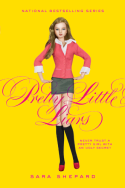
Pretty Little Liars by Sara Shepard

July 1, 2011 by Michelle Smith

From the front flap:
Gossip thrives amid the Mercedes-Benzes, mega mansions, and perfectly manicured hedges in the exclusive town of Rosewood, Pennsylvania. Behind their big Gucci sunglasses, beneath their perfectly pressed Polos, everyone has something to hide, especially high school juniors Spencer, Aria, Emily, and Hanna. Spencer covets her sister’s gorgeous new boyfriend. Aria is having an affair with her English teacher. Emily is infatuated with the new girl at school. And Hanna is using some ugly tricks to stay beautiful. Deeper and darker still is a horrible secret the girls have shared since sixth grade—a secret they thought was safe forever.

Review:
Confession: I have become addicted to the ABC Family adaptation of Pretty Little Liars. Now that it has started its second season, I figured it was safe to read the first book in the series. As it turns out, said book only covers the first few episodes of the show, so I needn’t have delayed.

The series was originally developed by Alloy Entertainment—who is behind most of the YA novel series that have recently become TV shows—to be a kind of teen version of Desperate Housewives. (I’d say that description is pretty apt, except that I think Pretty Little Liars is the better show, largely because when your protagonists do really stupid things it’s more forgivable when they’re sixteen than when they’re thirty-something.) Even though Sara Shepard receives sole authorship credits, interviews suggest that it’s really a team effort.

The first novel sets up the series and the secrets that each of its four protagonists carries. Back in sixth and seventh grade, Aria, Hanna, Spencer, and Emily clustered around their dazzling queen bee, Alison, who alternately beguiled and belittled them (and many others). She goaded them into a dangerous act of vandalism that left a fellow student blinded—an incident henceforth referred to as “the Jenna thing”—and then disappeared the summer before eighth grade. Aria’s family moved to Iceland shortly thereafter and the remaining girls—grieving but a little relieved to be free of Alison’s influence—drifted apart.

Now, three years later, Aria is back and so, possibly, is Alison, since each of the four girls begins receiving mysterious messages (text, e-mail, and handwritten) from someone calling themselves only “A.” A seems to know everyone’s secrets, and there are many. Bohemian Aria is having a secret fling with her English teacher, and also knows that her dad was cheating on her mom three years ago; obedient Emily is secretly attracted to girls; overachieving Spencer is not-so-secretly attracted to her sister’s boyfriend; and Hanna—impatient, impulsive, newly popular Hanna—secretly feels desperately unloved, and has a couple scrapes with the law while trying to conquer her bulimia. Chapters alternate between the characters, and it’s only at the end, when they discover that they’ve all been A’s victims, that they seem poised to renew their friendship.

It’s hard for me to say how I would feel about the novel had I not seen the show. There are differences, of course—a different timeline of events, characters who do not resemble the actresses ultimately chosen to portray them, some siblings for Emily, more bad behavior than ABC Family evidently was comfortable with—but nothing major plot-wise. I think the TV series is more effective at humanizing the characters—especially Hanna, who unexpectedly became my favorite—and making them likeable, but reading the book helped me understand the characters better, especially Aria and Emily.

So, why should you check out Pretty Little Liars, in either of its forms? For the cracktastic soapy goodness with protagonists whom you can still like even if they do ridiculous things like steal their boyfriend’s car because he won’t put out and crash it into a tree. Sure, I’m a little embarrassed to be reading/watching it at my advanced age, but it entertains me, and sometimes that’s enough.

Filed Under: Books, Suspense, YA Tagged With: Sara Shepard

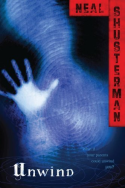
Unwind by Neal Shusterman

June 23, 2011 by Michelle Smith

From the front flap:
In a society where unwanted teens are salvaged for their body parts, three runaways fight the system that would “unwind” them.

Connor’s parents want to be rid of him because he’s a troublemaker. Risa has no parents and is being unwound to cut orphanage costs. Lev’s unwinding has been planned since his birth, as pat of his family’s strict religion. Brought together by chance, and kept together by desperation, these three unlikely companions make a harrowing cross-country journey, knowing their lives hang in the balance. If they can survive until their eighteenth birthday, they can’t be harmed—but when every piece of them, from their hands to their hearts, [is] wanted by a world gone mad, eighteen seems far, far away.

Review:
At some time in America’s future, the second civil war is fought over the issue of abortion. In the end, a compromise is reached. Known as the “bill of life,” the law says that life cannot be touched between birth and age thirteen, but between thirteen and eighteen parents can choose to retroactively abort a child in a process known as “unwinding,” by which the child does not technically die but is instead used for organ donation. Unwinding has now become a common and accepted practice in society.

This is a lot to swallow. One wonders why on earth anyone would agree to such a compromise, and I admit I struggled with the concept. After a while, though, one just accepts it and moves on, enjoying the story Shusterman lays out.

Unwind features three kids who are due to undergo the unwinding process. Connor Lassiter has trouble thinking through his actions and controlling his temper, causing his fed-up parents to decide to have him unwound. Risa Ward is a ward of the state. She’s been living in a state home, working hard to distinguish herself as a pianist, but she’s just not flawless enough to be worth saving, and is scheduled to be sent off to “harvest camp” in order to keep orphanage costs low. Lev Calder is a “tithe,” who was brought up by his parents and church to believe that his eventual unwinding is somehow a holy thing. Circumstances bring the three together, tear them apart, and bring them together again, with no one remaining unchanged.

While the plot of Unwind is certainly fast-paced and frequently surprising, the best thing about it is the way in which the characters are developed. At first, Connor’s lack of foresight and impulse control is maddening. He runs away to avoid being sent to harvest camp, but leaves his cell phone on, making him easy to track. He reacts to a baby left on a doorstep without thinking, saddling him and his companions with an infant they don’t have the resources to care for. In short, he’s more like a typical teen than a typical hero. Very gradually, and with the help from the more logical Risa, Connor evolves. He learns to keep his cool and discovers a talent for fixing things, be they mechanical or societal in nature. He becomes a leader, a genuine hero, and his progress is entirely believable.

Lev also changes a great deal. The youngest of the three, he’s only thirteen, and has spent his whole life being indoctrinated in certain beliefs. When Connor impulsively saves him from his “glorious fate,” Lev is not grateful at all, and turns Connor and Risa in at the first available opportunity. When he realizes that not even his pastor believes that what his family is doing is right, Lev’s world is thrown into turmoil. Separated now from Connor and Risa, he travels on his own, quickly becoming street-wise and meeting up with CyFi, a smart but troubled teen who once received a partial brain transplant from an unwind and is now contending with strange impulses from that other kid. Thrust into the harsh world with no preparation, Lev hardens quickly and learns to think for himself. Through learning of sin and evil, he becomes a much better person than he ever was before.

Risa doesn’t change as dramatically as the others, since she was always level-headed and cognizant of her possible fate. With her, the fact that she’s begun to allow herself to finally hope is what’s significant. I’m fond of her characterization in general, though, especially that she’s capable, competent, and so frequently the voice of reason. Her ability to keep a cool head during medical emergencies is also welcome.

Ultimately, while I could not completely suspend my disbelief in order to buy into the premise of this dystopic future world, I still liked Unwind a great deal. Even though Shusterman makes some Important Points, his approach is still balanced, as he questions whether it’s fair to bring unwanted children into the world in the first place even while his characters struggle so very hard for the right to live. Lastly, I must commend him for a positively chilling depiction of the unwinding process. That will seriously stick with me for a long time.

In conclusion, Unwind is good. Go read it. And Shusterman, get cracking on that sequel (Unwholly, TBA).

Filed Under: Books, Sci-Fi, YA Tagged With: Neal Shusterman

Rocket Girls by Housuke Nojiri

June 13, 2011 by Michelle Smith

From the back cover:
Yukari Morita is a high school girl on a quest to find her missing father. While searching for him in the Solomon Islands, she receives the offer of a lifetime—she’ll get the help she needs to find her father, and all she need do in return is become the world’s youngest, lightest astronaut. Yukari and her half-sister Matsuri, also petite, are the perfect crew for the Solomon Space Association’s launches, or will be once they complete their rigorous and sometimes dangerous training.

Review:
I was really looking forward to reading Rocket Girls. I’ve long been intrigued by VIZ Media’s venture into Japanese sci-fi, Haikasoru, but this is the first title in the lineup that I’ve read (unless you count Brave Story, which I read before it was grandfathered into the imprint). Alas, I ended up disappointed.

The basic plot is that Yukari Morita, a high school student weighing 37 kg. (81 lbs.) has traveled to the Solomon Islands during summer vacation to search for her deadbeat father. She ends up meeting scientists from the Solomon Space Association just when they’ve determined that they need a really light person to pilot their rocket, and when the director promises to help her find her father, she agrees. Later, her similarly petite half-sister Matsuri joins up to serve as backup. The SSA folks have a lot of trouble getting a rocket into orbit, but eventually succeed (sort of) and Yukari becomes a national hero.

I guess I was hoping for the novel equivalent of Twin Spica or something, but Rocket Girls doesn’t even come close to achieving the passion and poignancy on display in that series. In fact, it almost totally lacks any depth whatsoever. The book is about 80% dialogue, with very little insight into Yukari’s thoughts, let alone anyone else’s. As a result, many of the characters’ reactions and decisions are inexplicable. Here are some examples:

  • The director of the space program, Isao Nasuda, calls up Yukari’s mother to obtain her permission for Yukari to become an astronaut. Without asking any questions at all, her mother agrees. I could accept a similarly carefree mom in a manga comedy, but it’s harder to swallow in a sci-fi novel.
  • Very quickly, Yukari finds her father, who had no idea she even existed (having disappeared during his honeymoon). His reaction? “How about that?” What, that’s it?!
  • Yukari decides she doesn’t fancy dying in an unsafe spacecraft, but her father won’t come back to Japan with her if she outright quits, so she decides to gain weight so that Matsuri will have to take her place. And then, suddenly, she’s done with that idea. I think this is because one of the scientists guys waxed poetic about his spacefaring dreams, but I’m not sure.
  • Yukari then decides to become hyper-vigilant about the safety of the craft and goes on a hunger strike protesting some new fuel mixture. And then later, when she’s strapped in and ready to take off, the team finds a problem. Her response? “If we let every little thing scare us, we’ll never launch.” Uh, then what was that whole protest about? She even had a sign.

At first, I was bothered that none of the adults seemed to have any empathy for Yukari. They treated her as a tool and spoke dispassionately of bringing her to her breaking point so they could test the jungle-survival capabilities of the new skintight spacesuit they’d designed for her. But then I realized that I had lost all empathy for Yukari, too! Probably I was supposed to care when she nearly died during the flight, but I did not. I just wanted the book to end. After a kind of cool but very brief visit to Mir, I got my wish.

Is one slightly nifty bit near the end enough to recommend the book? I think not. There is also a sequel, but I’ve no intention of reading it.

Filed Under: Books, Sci-Fi Tagged With: Housuke Nojiri, VIZ

The Science of Doctor Who by Paul Parsons

June 4, 2011 by Michelle Smith

From the front flap:
Almost fifty years after the Doctor first crossed the small screen, he remains a science fiction touchstone. His exploits are thrilling, his world is mind-boggling, and that time travel machine—known as the Tardis—is almost certainly an old-fashioned blue police box, once commonly found in London.

Paul Parsons’s plain-English account of the real science behind the fantastic universe portrayed in the television series answers such burning questions as whether a sonic screwdriver is any use for putting up a shelf, how Cybermen make little Cybermen, where the toilets are in the Tardis, and much more.

(Note: This is the 2010 revision of a book originally published in 2006.)

Review:
I am not a science person. In my years of schooling, I never once came up with a non-lame idea for a science project and was positively abysmal at experiments. I did pretty well on tests and homework, but if someone’s test tube was going to spontaneously erupt in a geyser of brown froth (true story!), it would be mine.

Suffice it to say, then, that while I enjoy science fiction entertainment, it’s not because of the science. Still, The Science of Doctor Who promises “a plain-English account of the real science behind the fantastic universe portrayed in the television series,” so I reckoned on being able to follow it. Alas, Paul Parsons’s definition of plain English is a bit different than mine.

I was okay with the majority of the material. Chapter topics include the Doctor’s recurring foes, regeneration, gadgets, weapons, space stations, force fields, parallel universes, and more. In general, Parsons would start by mentioning something that happened in a particular Doctor Who serial and then interview renowned scientists as to whether this is actually possible. Most of the time the answer is “no” or “only with extreme amounts of energy/effort,” but there are a few things that are not so far off. The chapters on alien worlds (Lots of planets really do have a north!) and mirror planets were particular favorites of mine.

Stupidly, however, I hadn’t counted on there being so much physics! I frequently found my eyes glazing over during these sections, which were unfortunately clustered near the beginning (making it hard to get started) and end (causing a strong urge to set the book down with only forty pages to go) of the book.

Take, for example, this quote from page 35:

M-theory’s main thrust is to generalize the one-dimensional objects of string theory into p-dimensional objects known, amusingly enough, as p-branes (where setting p = 0 gives a particle, p = 1 gives a string, p = 2 a “membrane,” and so on).

My brain’s response: asdlkjasldkfzzt!

Seriously, is that plain English? I note that Parsons did not bother to define “p-dimensional,” though that probably wouldn’t have been much help to me anyway.

In the end, I did learn some interesting things. In the chapter on Cybermen, for example, I learned that a cybernetic brain implant currently exists that can block the signals that cause Parkinson’s disease. That’s pretty awesome! I also now know that Sontarans reproduce by cloning and it takes only ten minutes for their offspring to reach adulthood. That’s less awesome.

I’m glad I didn’t give up on reading The Science of Doctor Who but now I think I’ll give my brain a rest by actually watching some.

Additional reviews of The Science of Doctor Who can be found at Triple Take.

Filed Under: Books, Nonfiction, Science, Television, Triple Take Tagged With: Doctor Who, Paul Parsons

A Spy in the House by Y. S. Lee

June 4, 2011 by Michelle Smith

From the back cover:
Mary Quinn leads a remarkable life. At twelve, an orphan and convicted thief, she was miraculously rescued from the gallows. Now, at seventeen, she has a new and astonishing chance to work undercover for the Agency.

It is May 1858, and a foul-smelling heat wave paralyzed London. Mary enters a rich merchant’s household to solve the mystery of his lost cargo ships. But as she soon learns, the house is full of deceptions, and people are not what they seem—including Mary herself.

Review:
As a convicted thief, twelve-year-old Mary Lang is about to be executed when she is saved by the ladies of Miss Scrimshaw’s Academy for Girls. There, she receives an education and by the age of seventeen is teaching other students the skills they will need to be independent. Trouble is, she’s not satisfied and the few other career options open to her gender don’t interest her much, either. When she mentions this to the two women running the school, they suggest another alternative: the Agency.

The Agency is a covert organization of female spies, operating under the assumption that because women are presumed to be flighty and empty-headed, their agents will be able to retrieve information more easily than a man might, particularly in situations of domestic servitude. Mary quickly agrees, despite the threat of danger, and soon finds herself serving as paid companion to spoiled Miss Angelica Thorold, whose merchant father is suspected of dealing in stolen Hindu goods.

Mary (now using the surname Quinn) isn’t the lead on the investigation and isn’t supposed to actually do much of anything, but she gets antsy, and in the process of snooping meets James Easton. James’s older brother desperately wants to marry Angelica, but James has heard rumors about her father’s business practices, and so is doing some sleuthing of his own to determine whether a family connection would be unwise. He and Mary form a partnership and spend most of the book poking about in warehouses and rest homes for aging Asian sailors and following people on foot or in carriages while maintaining a flirty sort of bickering banter.

Author Y. S. Lee tries to make the mystery interesting, giving us a bit of intrigue between Angelica and her father’s secretary as a distraction, but ultimately it feels very insubstantial to me. Nothing much comes as a surprise and two story elements that could’ve been highlights—Mary’s month-long intensive training and Scotland Yard’s raid on the Thorold house—occur off camera! Too, Mary is harboring a secret about her parentage which is thoroughly obvious: she’s part Asian. Only towards the end did Lee actually make clear that Mary is keeping this a secret from others because of the foreigner bias of the time, and I must wonder whether the intended young adult audience was reading this going, “What’s the big deal?”

Not that it isn’t nifty to have a part-Asian heroine, of course. Mary is competent and level-headed, though I admit I did get irritated by how often she is favorably compared to “ordinary women,” who would scream or faint in situations in which Mary is able to keep her head. When a mystery stars a male sleuth, do we need to hear over and over how much smarter he is than the ordinary fellow? I don’t think so. On the flip side, the overall theme of the book seems to be “don’t understimate women,” and Mary finds time to inspire a scullery maid to seek out Miss Scrimshaw’s and to convince Angelica to pursue a musical career.

In the end, A Spy in the House is a decent read. It’s not perfect, but I still plan to read the second book in the series in the near future.

Additional reviews of A Spy in the House can be found at Triple Take.

Filed Under: Books, Historical Fiction, Mystery, Triple Take, YA Tagged With: Y. S. Lee

In the Presence of the Enemy by Elizabeth George

May 27, 2011 by Michelle Smith

Book description:
When a young girl disappears from the streets of London without a trace, her mother, a well-respected MP, is convinced she knows the identity of the kidnapper—the child’s father. But Detective Inspector Thomas Lynley and Sergeant Barbara Havers soon learn that nothing in this investigation is what it appears to be, and that in betrayal and deception, lies death.

Review:
Eleven years ago, at a Tory conference, a young political hopeful named Eve Bowen enjoyed a week-long fling with Dennis Luxford, a tabloid journalist with Labour Party views. There was no love between them, and when Eve found out she was pregnant, she informed Luxford that she didn’t want him to have anything to do with the child. Luxford respected her wishes, but when he receives an anonymous letter instructing him to acknowledge his firstborn on the front page of his newspaper or she’ll be killed, his first instinct is to comply.

Eve, now a Member of Parliament and an Undersecretary of the Home Office, won’t have it, however. Her suspicion of Luxford—he’s the only other person who knows the truth about the child’s parentage, after all—and obstinate refusal to even consider that he might be innocent blind her to the real peril her daughter, Charlotte, is in, and the delay ultimately costs Charlotte her life. Inspector Lynley and Sergeant Havers are called in to investigate, and then Luxford’s son, Leo, is taken.

It’s an intricate plot, with many enjoyable twists and turns, memorable characters, and a satisfying conclusion. Among the cast are two particularly infuriating women, though, whom I wanted to take a moment to describe. The first, Eve Bowen, views all events through the veil of what they might mean to her political career. She’s convinced that Luxford is out to ruin her, experiences essentially no grief when Charlotte dies, and is just thoroughly unpleasant throughout. The other, Corrine Payne, is the mother of the local constable with whom Havers works in Wiltshire. She’s convinced that Havers and her son are having an affair, and refuses to listen to any of Barbara’s denials. Plus, she’s manipulative in a feeble, whiny sort of way. I think what gets under my skin the most about both of them is the way they absolutely refuse to listen to reason. Irksome qualities aside, they’re both well-written characters, so this does not actually constitute a complaint of any kind.

Moving on to everything I liked! Because Eve refuses to go to the police, Luxford hires Simon St. James to do some investigating on his behalf, so a substantial portion of the beginning of the novel is Simon, Helen, and Deborah looking for clues. When Lynley finds out they were involved and could have gone to the police and possibly prevented Charlotte’s death, he is livid. And then Helen tells him off for being self-righteous. Everyone’s so likeable and flawed simultaneously; it’s great.

Also great is that Havers gets a chance to shine. Although Charlotte was kidnapped in London, her body is found in a canal in Wiltshire, so while Lynley—assisted by the increasingly charismatic DC Nkata—heads up the London end, Havers is given charge of the Wiltshire investigation, and performs admirably. George does employ the tried-and-true “female detective finds herself alone in the murderer’s clutches” plot development near the end, but Havers proves far from helpless, as does Leo Luxford.

The depiction of the Luxford family is also one of my favorite things about the book. Here’s a man, the editor of a sleazy tabloid newspaper, whom one would expect to care less about the life of a daughter he never met than her actual mother, but that turns out not to be the case at all. He also faces some unpleasant truths about his motives for attempting to toughen up his son, and realizes near the end of the book the tyrannical figure he’s become in that regard. The final scene concerns this family and it seriously made me cry.

I think this may actually be my favorite Lynley mystery yet!

Filed Under: Books Tagged With: Elizabeth George

Take My Word for It by John Marsden

May 14, 2011 by Michelle Smith

From the back cover:
Lisa Morris could be the girl next door. She could be your cousin. She could be sitting behind you in class.

She could be you.

But Lisa, cool and beautiful Lisa, remote and private Lisa, has more going on in her life than anyone imagines.

Only her journal knows the truth about her life. Only her journal—and you.

Review:
This short little book functions as both companion piece and epilogue to Marsden’s So Much to Tell You, a (slightly better) book written as the journal of Marina, a silent, traumatized girl attending an Australian boarding school called Warrington. Take My Word for It presents the journal of Marina’s classmate, Lisa, who appears tough and cool in the eyes of others but has her own share of problems.

While I did enjoy reading Take My Word for It, I suspect it was never published in the US (I imported my copy from Australia) because it just doesn’t stand on its own very well. Lisa is a realistic character, and I have some sympathy for her struggle to accept the fact that her parents have divorced (which she believes is her fault) and that, as time goes on, the family is proceeding separately down paths that take them further and further away from the childhood home for which Lisa pines.

But the most interesting parts of this novel for me were the times we got insight into the other novel. Why, for example, did Lisa break down and cry at one point, sending Marina into a tizzy of worry and indecision? What does Marina actually look like? And, best, what happens after Marina finally speaks to her father? I guess I had expected the stories to end at the same point, but upon reflection, why would they conveniently do that? So, Marina comes back to school after seeing her dad over a break, and very gradually begins to talk to her dormmates. It’s nice, though I could’ve done without the dangled thread that Marina might leave Warrington, which Marsden never follows up on.

Like Marsden’s other protagonists, Lisa has a secret that she obliquely references while writing. In Marina’s case, we knew something had happened to her, but not what. Specifics were doled out sparingly and it was at least moderately suspenseful. In Lisa’s case, her secret is pretty obvious early on, so further attempts at cryptic hinting are just kind of annoying. On the plus side, she uses loads of interesting Australian slang, so I’ve learned several cool new words, like “dob” and “bludge.”

I sincerely doubt there’s any such thing as a lousy book by John Marsden, but this one, alas, is not my favorite.

Filed Under: Books Tagged With: John Marsden

Alanna: The First Adventure by Tamora Pierce

April 29, 2011 by Michelle Smith

From the back cover:
“From now on I’m Alan of Trebond, the younger twin. I’ll be a knight.”

And so young Alanna of Trebond begins the journey to knighthood. Though a girl, Alanna has always craved the adventure and daring allowed only for boys; her twin brother, Thom, yearns to learn the art of magic. So one day they decide to switch places: disguised as a girl, Thom heads for the convent to learn magic; Alanna, pretending to be a boy, is on her way to the castle of King Roald to begin her training as a page.

But the road to knighthood is not an easy one. As Alanna masters the skills necessary for battle, she must also learn to control her heart and to discern her enemies from her allies.

Filled with swords and sorcery, adventure and intrigue, good and evil, Alanna’s first adventure begins—one that will lead to the fulfillment of her dreams and the magical destiny that will make her a legend in her land.

Review:
For a period of several years, I was an administrator on an online roleplaying game based on a popular series of children’s fantasy books starring a protagonist with a peculiarly shaped scar. New players to this game would frequently submit applications for characters that read very similar to this:

“Ten-year-old Alanna has red hair, purple eyes, and a twin brother. She is very smart, determined, and brave. Plus, she has a great magical gift, so great that she will one day be able to succeed in curing a deadly sickness where all other healers have failed. She also excels at becoming the best at unarmed combat and swordsmanship (albeit with quite a lot of practice), distrusting bad guys instantly, and conveniently finding ancient, powerful swords with sparkly crystals on them.”

Okay, perhaps that’s a bit better than your average newbie attempt, but there are still some striking similarities. This resulted in me snickering out loud the first time Alanna’s looks—for, yes, that paragraph is describing the protagonist of this book—were mentioned, and in rolling my eyes every time her awesomeness was further established. The action in the book covers several years, and Alanna’s plan is to divulge her secret on her eighteenth birthday, after she is made a knight. It’s certainly welcome to see a female proving herself in that environment so adeptly. I don’t mean to suggest that awesome women cannot exist, but after a while I started asking myself, “What next?”

Perhaps such a heroine appeals more to young adults, the intended audience for this book. There are some good messages here about applying oneself when the things you want to do prove challenging and not letting anyone’s idea of your limitations get in your way. It’s just that everything kind of happens too easily. Even though we know Alanna is spending hours and hours practicing, her evolution from fumbling beginner to “a matchless swordsman” doesn’t seem to take very long. The climactic battle at the end against an immortal race of evil beings living in “the black city” also seems too simple.

In the end, I liked Alanna: The First Adventure enough to continue with the rest of the quartet. It appears to be the first book Pierce published, so it’s no wonder it doesn’t match up to my favorites amongst her works.

Filed Under: Books Tagged With: Tamora Pierce

So Much to Tell You by John Marsden

April 5, 2011 by Michelle Smith

From the back cover:
Fourteen-year-old Marina didn’t know why she was sent away to school. Actually, that wasn’t completely true. She knew it had something to do with the progress she hadn’t made in the hospital. After all, she still didn’t talk. And Marina knew her mother didn’t want her at home.

Then Marina started writing in a journal for English class. Bit by bit the trauma of her silence began to unfold as a shocking nightmare that continued to haunt her. But Marina refused to talk about it or to feel anything. Still, before she realized it, Marina began to feel a little—to reach out to some of the girls at school, to her favorite teacher, to her family—if only she could find the words…

Review:
I have been in a serious John Marsden mood lately, and this is the first of several of his books that will be coming down the pipeline in the near future. This was his first novel, published in 1987, and it’s set in Australia.

It’s February 6, the start of a new term, and an unnamed fourteen-year-old girl has just been assigned journal-writing as homework by the English teacher at Warrington, the boarding school she’s been sent to to learn to talk again. She promises herself that she won’t write in it, but almost immediately begins saying more than she intended to.

As the girl describes life at school and chronicles her observations of her fellow boarders, we begin to pick up hints about what has happened to her. Her face is terribly scarred, for one thing, and she’s spent time in the psych ward of a hospital without much improvement. As she gradually learns to trust her classmates and makes tentative efforts at communication, the truth of what happened to her becomes more clear.

What I really like about So Much to Tell You is that it isn’t a suspense novel. One’s not (or at least I wasn’t) on the edge of one’s seat, frothing to know exactly what happened to the girl (whom we learn at the very end of the novel is called Marina). Instead, what we’re really witnessing is her beginning to heal. Scarred mentally and physically by the family she happened to be born into, with a workaholic father who snapped when his materialistic wife tried to take everything he’d worked so hard for, she begins to realize that most people are fundamentally good, and are more acquainted with feelings of loneliness and ostracism than she expected.

Gradually, Marina finds herself wanting to reach out to her classmates, toward whom she feels no bitterness. Indeed, she is able to praise them quite freely. This, in turn, helps her to reach out to her father, who more than anyone could understand what she’s been going through. Although we aren’t privy to her full recovery, the novel concludes at a point where Marina is clearly going to be okay. Still, I was sorry it was over. Happily, my copy of the companion novel—the journal of one of Marina’s classmates—arrived yesterday, so I will be devouring that promptly.

Lastly, a word of praise for narrator Kate Hosking. I listened to an unabridged recording, and Hosking’s narration really elevated the book for me. She brings Marina to life—and has a cool Australian accent to boot!—and sells Marsden’s prose, which is occasionally a bit too on-the-nose, beautifully. I would happily listen to her read anything.

Filed Under: Books Tagged With: John Marsden

The Eyre Affair by Jasper Fforde

April 1, 2011 by Michelle Smith

From the back cover:
Welcome to a surreal version of Great Britain, circa 1985, where time travel is routine, cloning is a reality (dodos are the resurrected pet of choice), and literature is taken very, very seriously. England is a virtual police state where an aunt can get lost (literally) in a Wordsworth poem, militant Baconians heckle performances of Hamlet, and forging Byronic verse is a punishable offense. All this is business as usual for Thursday Next, renowned Special Operative in literary detection, until someone begins kidnapping characters from works of literature. When Jane Eyre is plucked from the pages of Brontë’s novel, Thursday must track down the villain and enter the novel herself to avert a heinous act of literary homicide.

Review:
The Eyre Affair takes place in an alternate version of 1980s England wherein Winston Churchill died as a teen, Wales is a socialist republic, and technology allows for time travel but not recording security-camera footage on anything more advanced than a videotape. (Fforde can dream big but not dream medium, it seems.) Literature is a very big deal in this universe: original manuscripts are kept under armed guard, kids trade Henry Fielding cards, ardent fans of John Milton abound, and literary crime (frauds, forgeries, etc.) is rampant. To combat this last, the Literary Detectives division of the Special Operations Network was formed.

Thursday Next has worked in the London office for eight years, handling mostly routine cases. When the original manuscript of Dickens’ Martin Chuzzlewit is stolen and master criminal Acheron Hades suspected, Thursday is called in because she was once a student of Hades and can identify him. Through a long and winding road that involves a transfer to Swindon, a bizarre detour into vampire-fighting, and attendance at an audience-participation rendition of Richard III, Thursday pursues Acheron, eventually into the pages of Jane Eyre, where their confrontation changes the outcome of the novel (into the version we know).

My list of complaints is longer than my list of compliments. I didn’t like the alternate universe very much, nor the ubiquity of cloned dodos, nor the silly names for some characters, nor the plot about the corrupt weapons dealer attempting to extend the Crimean War (already in its 131st year). The main problem, though, was Thursday herself, who is irritatingly perfect. She’s practically revered by the general public and every man wants her. Her former beau is willing to ditch his new fiancée if Thursday will just give the word. Her new partner is instantly smitten. Acheron Hades is impressed with her and declares her his greatest adversary. Hell, even Edward freakin’ Rochester from Jane Eyre has taken a shine to her!

On the brighter side, parts of the story that seem random do come together in a reasonably clever way (even the supernatural excursion into Slayerdom was eventually relevant) and I found Acheron quite amusing. He’s gleefully, hammily evil, so his appearances are quite fun, though I wonder how Thursday was privy to what was said in meetings at which she was not present (this being a first-person narrative and all). One baffling point is that, once he makes it into Jane Eyre, Acheron sort of sits around docilely for quite some time. It’s puzzling, but by that point in the novel I was just shaking my head and saying “whatever” whenever such things occurred.

Ultimately, I am torn. You’d think that with my general meh feeling about the world and decidedly less positive view of its protagonist, I would be firmly opposed to continuing the series, but that is not, in fact, the case. I’m willing to give it one more shot, at least. Maybe it will grow on me.

Additional reviews of The Eyre Affair can be found at Triple Take.

Filed Under: Alternate History, Books, Sci-Fi, Triple Take Tagged With: Jasper Fforde

Five Children and It by E. Nesbit: B+

March 17, 2011 by Michelle Smith

From the back cover:
‘It’ is a Psammead, an ancient, ugly and irritable sand fairy the children find one day in a gravel pit. It grants them a wish a day, lasting until sunset. But they soon learn it is very hard to think of really sensible wishes, and each one gets them into unexpected difficulties. Magic, the children find, can be as awkward as it is enticing.

Review:
After reading and really enjoying The Railway Children, I decided that I definitely needed to read more by E. Nesbit. Five Children and It was my first pick, because I’ve been curious about the book for ages. Expect to see more Nebsit after this one!

Five Children and It (1902) actually has some things in common with The Railway Children (1906). It’s obvious from the titles that both feature kids, but more specifically these kids are siblings from the city who are moving into a new house in the country. Both stories are told by a companionable and amusing narrator. In the case of the latter book, the kids meet and help a lot of new people, and a warm, feel-good tone is the result. There is, alas, less of that feeling in Five Children and It, though it’s still an imaginative and entertaining tale.

Cyril, Anthea, Robert, Jane, and “the Lamb” (the nickname for the youngest, a two-year-old boy whose given name is Hilary) have just moved into their new house, and are keen to explore. One day, when their mother has gone off to tend to her ailing mother, their wanderings take them to a nearby gravel pit, where they dig and find a strange creature called a psammead, or sand-fairy. The psammead agrees to grant the children one wish per day, the results of which will disappear at sunset, and the majority of the book is made up of their wishes and the usually unpleasant repercussions thereof.

Nothing ever seems to turn out like they hope. When they wish for money, it comes in a form unrecognizable and unaccepted by local merchants. When they wish for wings, they fail to account for how hungry the exertion of flying will make them, and end up stranded on a rooftop after stealing someone else’s dinner. When they wish they lived in a castle, it’s ill-defended and in the midst of a siege. Each time, they attempt to learn from what went wrong and get the best from their next wish, but by the time their mother returns home they’re quite ready to quit with the wishing altogether. If I had to pick a theme for the book, I’d say it’s “be content with your lot.”

What’s really nice about the story is that the kids aren’t idealized at all. In fact, Nesbit says up front that they can be tiresome, and they’re shown being disagreeable often enough. They’re also, however, shown being clever and level-headed, particularly Anthea, the oldest girl. It takes a while for them to emerge as individual characters, though, and I’m still not really sure how to describe Jane, the youngest girl. This is another aspect in which The Railway Children is the superior book, since each of those characters is memorable and distinct. I do think, though, that Anthea and Railway‘s Roberta would like each other very much. In fact, now I kind of want to read fanfic in which they hang out and are sensible together.

In the end, I definitely enjoyed Five Children and It and look forward to reading its two sequels, but it doesn’t supplant The Railway Children as my favorite Nesbit so far.

Filed Under: Books Tagged With: E. Nesbit

Playing for the Ashes by Elizabeth George: A-

March 10, 2011 by Michelle Smith

Book description:
When country milkman Martin Snell makes his usual delivery to fifteenth-century Celandine Cottage one fine spring morning in Kent, he expects to be greeted by the cottage’s seductive tenant, Gabriella Patten, not the ugly remains of a fire pointing to murder.

As all of England, as well as the magnetic world of national cricket, discovers itself reeling from the shock of this particular crime, Lynley and Havers find themselves working on the most frustrating case of their careers: the perfect crime. When in an act of desperation Lynley breaks department rules to flush out the killer, he risks being pulled from the case and jeopardizes his career with New Scotland Yard.

In Playing for the Ashes, a deft study of human nature and a crime with too much evidence result in a powerful work of fiction that pulls the reader into a fully created world to explore the dark side of passion and self-delusion.

Review:
I would normally never dream of naming the culprit in a review of a mystery novel. But your average mystery novel usually doesn’t have themes, which this one does, and exploring those requires me to divulge some essential details. Major spoilers ahead.

When Kenneth Fleming, a renowned batsman for England’s cricket team, is found dead in his lover’s rented cottage in Kent, a media frenzy ensues. Scotland Yard is called in to assist in the investigation, and Inspector Lynley and Sergeant Havers must get the truth out of various recalcitrant witnesses before their lack of results sees them ousted from the case. The principal cast includes Jean Cooper, Fleming’s soon-to-be ex-wife; Jimmy Cooper, his grungy and rebellious teenage son; Miriam Whitelaw, Fleming’s former teacher and current roommate and patron; Olivia Whitelaw, Miriam’s estranged daughter and frequent narrator; and Chris Farraday, animal activist and Olivia’s bargemate.

I mentioned above that this work has themes, and the central one seems to be: choices. Everyone in the story is either faced with a choice or dealing with the repercussions of a choice they made in the past. While teenagers, Fleming and Jean chose to have unprotected sex, then chose to marry and keep the baby, putting an end to his scholastic ambitions, much to Miriam Whitelaw’s dismay. Olivia Whitelaw chose to break free of her privileged life and pursue a path of debauchery and drugs.

In the present, Lynley has still not received a response to his marriage proposal to Lady Helen, and he finally insists that she decide one way or the other. Fleming chooses not to reveal that he has decided to cancel a fishing trip with his son to go to Kent and end his relationship with a promiscuous girlfriend, an omission which leads to his death, as Miriam chooses that moment to get rid of the problem girlfriend on his behalf. Jimmy chooses to follow his dad and to later confess to the crime, believing that the person he saw at the cottage that night was his mother.

Despite the objections of his superiors, Lynley chooses to bring media scrutiny down upon Jimmy to exert pressure on Olivia, who must choose whether to reveal admissions of guilt made by her mother, just when the two had achieved some measure of reconciliation brought on by Olivia’s request for help in dealing with her illness, ALS. This choice affects Farraday’s life, as well, since Olivia being in her mother’s care will allow him to spend more time with the woman he loves. Heck, even Havers faces a choice regarding whether to befriend an eight-year-old neighbor!

Another prominent theme is the comparison of platonic love and physical love. Both Olivia and her mother are living with men they love who, though they care for the Whitelaw women, don’t return their feelings in the same degree. Actually loving a man is painful for Olivia, for whom sex has always been a casual thing, since the one person she really wants to be with in that respect sees her only as a friend. Physical relationships are portrayed as fleeting and lust-driven, and George goes a bit overboard in depicting some of these, especially an awful scene occurring between a hostile young Olivia and her father. In fact, much of Olivia’s early narration is frustrating, because she is so insolent as to be borderline intolerable, but by the end of the novel she does become a sympathetic character.

On the whole, despite some unpleasant and unnecessary bits, I liked Playing for the Ashes a lot. I thought it was cleverly constructed and well written, and was impressed that it managed to convey just how much the victim would be missed by those he left behind, something many mysteries fail to do. It made me care about the characters more than the solution, and I actually got sniffly when Lady Helen (who has the best line of the novel in “I’m very nearly frivolity personified”) finally made her decision. Happily, I still have ten more books in this series to go!

Filed Under: Books Tagged With: Elizabeth George

Better Than Life by Grant Naylor: C

February 23, 2011 by Michelle Smith

From the back cover:
Life just couldn’t have been better—or maybe it couldn’t have gotten worse. Aboard the massive starship Red Dwarf, life was barely happening at all. Holly, the ship’s computer, had gone from super genius to so dumb that even a talking Toaster could hold its own with him. And the only surviving human aboard, David Lister—along with the holographic Arnold Rimmer; Cat, the best-groomed entity in the universe; and the cleaning robot Kryten—was trapped in a game called “Better Than Life.”

At one time Holly could have easily saved them. But right now Holly couldn’t even keep Red Dwarf from colliding with a runaway planet. It looked like Lister might be stuck in the game until he died—or until Red Dwarf was destroyed. Unless, of course, the cheap little Toaster and the cleaning robot could find the way back to reality without killing everyone in the process…

Review:
Every now and then it’s tempting to post a review that consists merely of the word “meh.” This is one of those times.

Better Than Life picks up where the first Red Dwarf book, Infinity Welcomes Careful Drivers, leaves off: all four members of the crew are stuck inside the addictive virtual reality game, Better Than Life, leaving Holly (the computer) alone with only a talking toaster for company.

They do eventually make it out, only to discover that Holly, having followed the toaster’s advice, has increased his IQ to over 12,000 but has decreased his remaining runtime to about two minutes. Oh, and there’s an ice planet headed straight for the stalled ship.

From here on out, the book is basically a sequence of dire perils over which four rather moronic characters must somehow triumph. Lister performs a feat of planetary billiards to knock the incoming planet away, but then ends up stranded on it. As it thaws due to the proximity to its new sun, it’s revealed to be Earth, relegated to garbage planet status by the rest of our solar system literally eons ago. There are flying cockroaches. There is a black hole. There’s a fair amount of scientific explanation for things.

And that’s where the book falters. See, as a show, Red Dwarf is a sci-fi comedy. The science takes such a back seat it’s four cars back. Better Than Life, on the other hand, attempts to be comedic sci-fi, but it doesn’t even manage that, because hardly any of it is actually amusing. Even Chris Barrie’s narration—again, excellent with the voices but a bit dodgy with pronunciation—can’t resuscitate what is essentially an exceedingly dull story. There are a few good moments of characterization, however. I especially enjoyed anything that proved that Rimmer really does care about Lister.

We end on another cliffhanger, with Lister transported to a planet on another universe on which time runs backwards. I can only assume that this is what the later book in the series, Backwards, is about. The only thing is… that one’s not available on unabridged audio and though I did procure myself a used copy, I’m not inclined just yet to expend the effort and time that reading a paper book demands. Maybe someday.

Filed Under: Books Tagged With: Red Dwarf

Human Nature by Paul Cornell: B-

February 13, 2011 by Michelle Smith

From the back cover:
“Who’s going to save us this time?”

April, 1914. The inhabitants of the little Norfolk town of Farringham are enjoying an early summer, unaware that war is on the way. Amongst them is Dr. John Smith, a short, middle-aged history teacher from Aberdeen. He’s having a hard time with his new post as house master at Hulton Academy for Boys, a school dedicated to producing military officers.

Bernice Summerfield is enjoying her holiday in the town, getting over the terrible events that befell her in France. But then she meets a future Doctor, and things start to get dangerous very quickly. With the Doctor she knows gone, and only a suffragette and an elderly rake for company, can Benny fight off a vicious alien attack? And will Dr. Smith be able to save the day?

Review:
Despite the fact that I own about ten of The New Adventures novels starring the Seventh Doctor, I’d never read any of them. It took a .pdf of Human Nature hosted on the BBC website (sadly no longer available) to compel me to finally check one out.

Why Human Nature? Because this novel is the basis for a rather emotional two-parter in the third season of the new incarnation of Doctor Who. I was curious to see how the original novel differs from the televised version (for those fortunate enough to snag a copy of the .pdf before its disappearance, author Paul Cornell does devote part of his endnotes to a discussion of the process of adapting the story for the screen) and also eager to read about Bernice (“Benny”) Summerfield, a companion of the Seventh Doctor whom I have previously encountered only in audio dramas.

The basic gist of the plot is the same in both versions. The Doctor has hidden away his Time Lord essence and is living as a human named John Smith, an unconventional teacher at an all-boys’ school in England on the eve of the first World War. As Smith, the Doctor writes fanciful stories and falls in love with fellow teacher, Joan Redfern. Bliss does not ensue, however, due to a family of aliens that has followed The Doctor and ends up attacking the school. It’s up to The Doctor’s companion to remind Smith of his true identity, and up to Smith to decide whether to remain human and pursue a chance at happiness with Joan or don the mantle of the Time Lord once more and save the day.

The differences are in the details. Why The Doctor chooses to live as a human, for instance. The identity of his companion and her relationship to Smith. The reasons the aliens have for pursuing him. These things don’t matter all that much, but in nearly every instance I prefer the televised version. It’s a much more emotional story—largely because it’s more easy to believe David Tennant’s Tenth Doctor as a romantic lead than Sylvester McCoy’s Seventh—and I sympathized with Smith’s dilemma more when I could physically see the agony the decision was causing him.

Too, boiling the story down to its most essential bits results in a tighter, more coherent tale. The book’s well-intentioned but random attempt at a gay romance is excised, for example, as is Benny’s brief and ill-fated friendship with a suffragette. (If you thought I’d pass up this opportunity to make a “Benny and the ‘gettes” joke, you are much mistaken.) Some of the dialogue in the book doesn’t sound natural, either, like this line from Joan when she’s meeting The Doctor for the first time:

‘Oh…’ Joan closed her eyes for a long, hard, instant. Then she opened them. ‘I’m very pleased to meet you, Doctor. Is there nothing about you that’s like the man to whom I’ve become engaged?’

I mean, I love me some grammar about twelve times as much as the next gal, but I’m pretty sure I would dispense with it in a moment like that! I do like the detail about her eyes, though.

Complaints aside, there is one thing that the book has that the televised version lacks, and it’s for this one thing alone that the book is worth reading: Benny. I positively adore Benny. She’s brilliant, competent, funny, bawdy, and a bit of a lush. Part of why I love her might be because Cornell based her on Harriet Vane, the awesomely independent and intelligent writer of detective fiction from Dorothy L. Sayers’ Lord Peter Wimsey mysteries. Whenever I snickered whilst reading this book, it was all due to Benny, like this description of a table of women at a beverage tent on some planet’s marketplace:

They looked like they all came from different places, and had clustered together out of the familiar realisation that internal gonads are best, actually.

Her presence gave me something new to look forward to in a story with which I was familiar, and I liked her so much that I am going to try to find time to read Love and War, another New Adventures effort from Cornell that introduces the character. Any other recommendations?

Filed Under: Books Tagged With: Doctor Who

Red Dwarf: Infinity Welcomes Careful Drivers by Grant Naylor: B

January 19, 2011 by Michelle Smith

Book description:
The first lesson Lister learned about space travel was you should never try it. But Lister didn’t have a choice. All he remembered was going on a birthday celebration pub crawl through London. When he came to his senses again, he was living in a locker on one of Saturn’s moons, with nothing in his pockets but a passport in the name of Emily Berkenstein.

So he did the only thing he could. Amazed to discover they would actually hire him, he joined the Space Corps—and found himself aboard Red Dwarf, a spaceship as big as a small city that, six or seven years from now, would get him back to Earth. What Lister couldn’t foresee was that he’d inadvertently signed up for a one-way jaunt three million years into the future—a future which would see him the last living member of the human race, with only a hologram crewmate and a highly evolved Cat for company. Of course, that was before the ship broke the light barrier and things began to get really weird…

Review:
Red Dwarf: Infinity Welcomes Careful Drivers retells a handful of episodes from the first two seasons of the BBC sci-fi comedy, Red Dwarf, and provides additional background information on its two main characters, priggish Arnold J. Rimmer and slovenly Dave Lister.

For those unfamiliar with the show, it takes place aboard the mining ship Red Dwarf. Rimmer is a lowly technician—just about the lowest rank on the ship, tasked with things like unclogging chicken soup nozzles on vending machines—and his only underling is Lister. While Lister is in stasis as punishment for smuggling a (pregnant) cat on board, Rimmer causes an accident that floods the ship with radiation, killing the entire crew.

It takes three million years for the radiation to reach levels safe enough for the computer to let Lister out, which triggers an iconic scene wherein Lister wanders around while the computer, Holly, repeats, “Everybody’s dead, Dave,” with varying inflections until the Liverpudlian finally gets it. Holly brings Rimmer back as a hologram, judging him to be the companion best suited to keep Lister sane, and they soon discover that the cat’s descendants have evolved into a highly fashion-conscious civilization, of which only one member now remains. Episodic silliness ensues.

The book follows this basic outline, too, but adds some scenes to flesh out the characters. For example, rather than meeting Rimmer and Lister aboard the ship, we first encounter them on Mimas, one of Saturn’s moons, in a scene in which Lister has stolen the equivalent of a taxi and picks Rimmer up as a fare. We learn that Lister joined the Space Corps solely as a means of getting back to Earth—and purposefully got caught with the cat so that he’d be put in stasis and the journey home would feel shorter—and receive additional insight on Rimmer’s desperation to become an officer. Both benefit from this treatment and emerge as more sympathetic characters.

Not every episode from the first two seasons is represented—Lister isn’t shown taking the chef’s exam in order to outrank Rimmer, for example—but some, like “Future Echoes,” are included almost verbatim. Because of this structure, there’s not so much a cohesive plot as a string of linear events, culminating in the crew believing that they’ve managed to return to Earth. The material, both old and new, provides quite a few giggles, but can also be extremely unfunny, like when Rimmer and his holographic double squabble interminably.

In addition, a few changes have been made that outright contradict the show. The captain, once male, is now female. Although Lister never was able to tell his long-time crush, Kristine Kochanski, about his feelings on the show, in the book they enjoy a month-long fling. There’s no obvious reason for these alterations, but it’s better to think Grant Naylor—the pseudonym adopted by the show’s creators, Rob Grant and Doug Naylor—made them for some purpose rather than merely by accident.

What this all boils down to is that the content of this book is decently entertaining, though not excellent, and probably deserves somewhere in the vicinity of a B-, which is the grade it likely would have received had I read the print edition. But I didn’t. Instead, Hubby and I listened to the unabridged audiobook read by Chris Barrie (the actor who portrayed Rimmer) and holy freakin’ crap! He was amazing!

Okay, true, Barrie mispronounces the occasional word—“irrevocably” being the most egregious—but his skill in impersonating his castmates is truly incredible. So good, in fact, that I found myself thinking, “I can’t wait until they discover Cat so I can hear Chris Barrie do his voice!” Every single one is great, and though Kryten is perhaps the most eerily accurate, I found myself most transported by Barrie’s take on Lister. Many, many times I forgot that I was not actually listening to Craig Charles in the part.

Barrie’s performance bumps the grade up a notch, and I’d go so far as to say that one should eschew the print edition entirely. He really does bring that much to one’s enjoyment of the book.

Filed Under: Books Tagged With: Red Dwarf

  • « Go to Previous Page
  • Page 1
  • Interim pages omitted …
  • Page 3
  • Page 4
  • Page 5
  • Page 6
  • Page 7
  • Interim pages omitted …
  • Page 20
  • Go to Next Page »
 | Log in
Copyright © 2010 Manga Bookshelf | Powered by WordPress & the Genesis Framework